The most successful edition of Barcelona Wine Week (BWW) to date —measured by attendance, exhibitor numbers (1,350) and a 25% increase in international buyers— highlighted the determination of Spanish producers to showcase their wines to the world at a time of uncertainty and widespread decline in consumption.
"Spain has an urgent need to internationalise and to sell abroad. Very few wineries are absent from the fair; they have realised that they need to be part of this collective Spanish wine platform in order to export,” said Javier Pagès, president of BWW, during a press breakfast.
According to ICEX (the Spanish Institute of Foreign Trade), Spain has almost 4,000 exporting wineries, 70% of which operate regularly in international markets. It is also worth remembering that almost 70% of all wine produced in Spain is sold abroad.
BWW is a central pillar of ICEX’s national strategy. For María Naranjo, its director for the agri-food industry, it is essential that small wineries can access international buyers in an environment in which they feel at ease. “There is no better place to sell Spanish wine. At Wine Paris, we are not playing at home. France is the third-largest buyer of Spanish wine, but its focus is on bulk,” she said, referring to the French fair —heir to Vinexpo— which opens on 9 February and is comepting with Germany’s Prowein, scheduled for March, to establish itself as Europe’s leading international wine trade show.
Within an increasingly congested calendar that also includes Vinitaly in April, BWW’s greatest strength remains its commitment to showcasing the diversity of Spanish wine. This is achieved through an inclusive format that accommodates both large groups and wineries exhibiting under their own brands, alongside the majority of exhibitors (73% in this edition) presenting their wines under their respective appellations of origin. A dedicated area within the largest hall is reserved for smaller producers, and, with its natural wine showroom atmosphere, remains one of the fair's most vibrant sections.
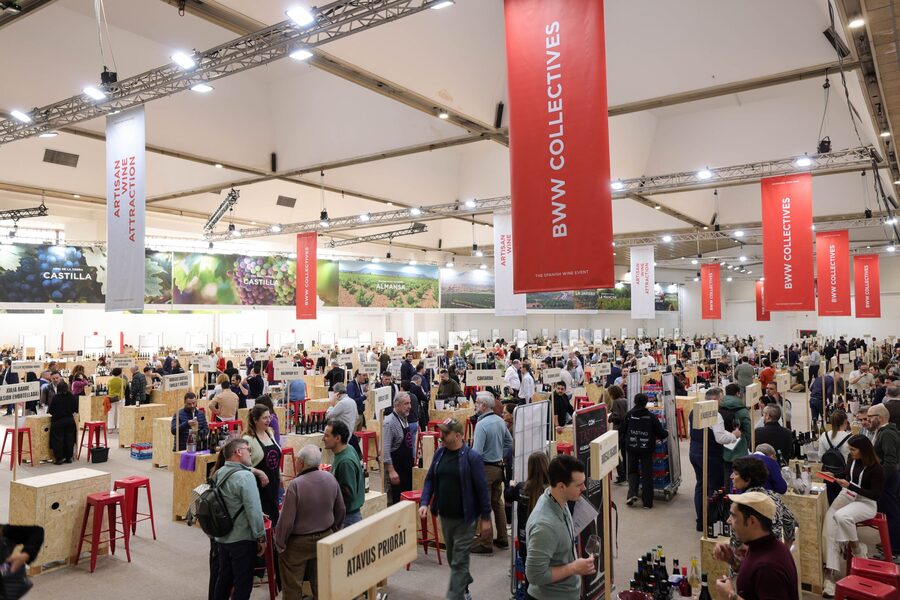
At this stage, and despite some notable absences, growth is not the fair’s primary objective. Its director, Céline Pérez Nuzzo, is instead focused on quality and representation: “What matters to us is maintaining the balance between buyers and exhibitors.” This year, the number of international buyers reached 962, with the United States the most strongly represented country, followed by Canada, Germany, the Netherlands, and China. Particular efforts were also made to attract buyers from Mercosur, particularly Brazil, and from markets where trade agreements are currently being finalised, such as India, China and Australia. “The key to success, now and in the future, is business, which is why selecting the right buyers is so important,” explained Pagès.
Monday proved to be the busiest day, with 11,000 visitors. Temporary access restrictions were imposed to avoid exceeding capacity, a minor inconvenience that also occurred on Tuesday and at the 2025 edition. The final tally for the three-day fair stood at 25,953 visitors, 20% of them international, closely aligned with the organisers’ target of 26,000.
Doing business in uncertain times
Speaking at the pre-fair press conference a few weeks earlier, Pérez Nuzzo framed the 2026 edition as one of adaption. "BWW 2026 is defined by strategic adjustment to the new political and global landscape, as well as to emerging consumption trends," she said. In her view, the main challenges are tariffs, climate change, stagnating or declining consumption, and the impact of generational change on drinking habits. "The new normal is that there are problems," she added.
The experience of the fair varied widely depending on factors like winery size, target markets and segments and wine styles. Many of the producers we spoke to reported a high number of contacts and meetings, although it remains unclear how many of these will translate into actual sales or collaborations.
As the public face of Grupo Muriel, an export-driven group with roots in Rioja, Javier Murúa described a market that is both saturated and contradictory. While he acknowledges the need to continue selling oak-aged Ribera del Duero and Rioja crianzas —categories that drive volume— his group is also working to segment its porfolio and broaden its offer to suit different consumption occasions. One example is the new single-varietal Viña Eguía wines from Rioja, priced in supermarkets a €5–7. The aim is not to raise prices, but to add value through quality. "Diversity generates interest outside Spain. With the Viña Muriel brand, by contrast, we seek to generate interest based on origin. Here, we find that some export markets do not recognise a higher status without the Reserva designation. This forces us to stay alert to assess all trends in order to adapt," he explained.

Murúa also called for a deeper structural debate within the sector. “Can all Rioja categories really be produced with yields of 6,500 kg/ha?” he asked. Why not allow vineyards to self-classify according to Reserva and Gran Reserva yields? With young wines, it is impossible to compete at these levels.” He even suggested reopening the discussion around the introdution of a Vino de la Tierra indication within DOCa Rioja.
At the premium end of the market, Valentí Llagostera of Mas Doix (Priorat) highlighted the increased presence of high-calibre international buyers, particularly from Asia and the United States. Many of them subsequently travel on to Wine Paris and leave Barcelona impressed by the range of the offer. “You can see scale, depth and critical mass. I wish we’d had a fair like this years ago,” he remarked. Llagostera believes the time has come to abandon negative narratives and focus on practical solutions. He also pointed to the strong presence of the domestic restaurant trade. “Face-to-face contact is essential; we’ve had many visitors who wanted to put a face to a name.” Having attended every edition of BWW, he cited crowd control delays and transport disruptions, caused by problems on Catalonia’s commuter and high-speed rail networks, as the main drawbacks.
The outlook from smaller producers was more cautious. Roberto Oliván of Rioja-based Tentenublo confirmed that attractively priced wines are currenly selling well, while high-end wines —limited-production, single-vineyard bottlings in his case— are a tougher sell. He has noticed this particularly in Michelin-starred restaurants and in export markets such as Canada. "In a context of global uncertainty, many importers are not adding new producers to their portfolios," he said.
The most pessimistic assesment came from Toni Aguado of German distributor Pinard de Picard, who believes Spain’s country brand remains weak. “Consumers looking for premium winescontinue to choose safe bets such as Burgundy, Barolo or Champagne. Even Rioja can be difficult to sell. Tondonia holds its ground thanks to the hype surrounding its white wine, but other wines with the class and quality of, say, Recaredo are not valued in the same way." Despite this, he regards BWW as the benchmark wine fair for Spain, with a contemporary vision, and praised the efficiency of the Hosted Buyers programme.
The inevitable question: the United States
One of the sector’s most pressing concerns is the adverse situation in the US, Spain’s third-largest market by value, driven by rising tariffs and a weakening dollar. At a round table dedicated to exploring alternatives, Elena Cifuentes, director of the international department at the Spanish Wine Federation (FEV), explained that maintaining market position now requires a major effort from both wineries and importers. According to Cifuentes, demand is shifting towards more affordable products, while US wines are being promoted more aggressively and importers are narrowing their portfolios due to slower stock rotation.
The discussion made it clear that no combination of alternative markets can compensate for the importance of the United States for Spanish wine. Speakers agreed that Brazil —the Mercosur country with the greatest purchasing power— and India represent long-term development opportunities, unlike mature, highly price-sensitive markets such as the UK and Germany. Cifuentes highlighted the positive prospects in Mexico, Ireland, and the Netherlands, and recommended short-term strategies in smaller markets.

Even so, the conversation repeatedly returned to the US. Jorge Rivero, commercial director of Grupo Marqués del Atrio, acknowledged that Spain is still “in its infancy” there, stressing the importance of adding value and building brands. His group is also expanding its presence in Canada, Central America and the Caribbean. In the current climate of uncertainty, the strategy of the Rías Baixas cooperative Paco & Lola is to “think global and act local”, according to its president, Carlos Carrión. This involves exploring the specific characteristics of each of the 50 US states and tailoring initiatives accordingly.
"The relationship between consumers and wine is changing in the United States," said Lucas Payà, a sommelier and consultant based there. "With baby boomers in decline, millennials and Gen Z are looking for flexibility and emotional connection, and they get their information through social media." He also noted that wine competes with craft beer, no- and low-alcohol drinks, and RTDs (ready-to-drink beverages), while the growing use of drugs such as Ozempic is reducing the desire to drink alcohol.
The good news, he added, is that recent government guidelines are less restrictive than those introduced during the Biden era. "Now, a glass of wine is no longer seen as so bad." As for Spanish wines, Payà added that the average American consumer is familiar with Rioja and that Albariño's success in the US has been driven by a clear focus on the grape variety.
María Naranjo from ICEX stressed the importance of not abandoning the US market, recommending segmentation, niche targeting and close cooperation with importers —an approach that, in her view, requires regulatory councils and producers to be present on the ground. The message, said Naranjo, should not be “good, pretty and cheap”, but rather that Spain exceeds expectations: “Spain overdelivers”.
And the domestic market?
BWW also hosted the presentation of Observatorio del vino en España: hábitos de consumo, percepción, tendencias y futuro del sector, a study about consumption habits and trends conducted by IO Investigación for Alimarket. It was based on interviews with 1,598 respondents, including a significant number of young consumers (304 aged 18–29).
The findings show that everyday wine is mainly purchased in supermarkets, while specialist retailers are favoured for special occasions. Three out of four respondents consider Spanish wine to be of good or very good quality, creating a strong emotional connection with the product. At the point of purchase, clarity of labelling and breath of choice matter more than promotions. Quality is highly valued, yet knowledge of grape varieties and winemaking processes remains limited. Reassuringly, even when consumers ackowledge this lack of expertise, they do not seek alternatives.

In the hospitality sector, fair pricing ranks among the most important factor, followed by a strong by-the-glass offer and a clear, varied wine list. Interestingly, only one in four consumers believes that wine prices in restaurants are appropriate, despite the fact that costs in most of our European neighbours are higher. Beyond price, other factors expected to influence wine consumption and purchasing decisions in 2026 include changes in social habits and the emergence of new drinking occasions. Therefore, the study recommends lowering barriers to entry by offering more reasonable prices, adapting formats and clearer communication. “The way to boost wine consumption is to make it more accessible, not reinvent it,” the report concludes.
Almost 30% of respondents said that they would significantly increase their wine consumption if no- or low-alcohol wines (NoLo) were available in restaurants. However, the strongest motivating factor (43.7%) is flavour comparable to that of traditional wines.
Among younger consumers, preferences lean towards lighter wines and more casual drinking occasions. Whites, with or without an appellation, wine-based drinks, young reds, and lightly sparkling or pét-nat styles outperform aged Denominación de Origen (DO) wines, as well as NoLo wines and cava or Champagne. However, interest in NoLo wines and wine served with ice is higher than in other age groups. The environmental impact of packaging also weighs more heavily with younger drinkers, who are more receptive to promotions and online information.
The study’s four main recommendations are: to use wine tourism as a gateway to the world of wine; to improve consumer education with a more engaging approach; to stimulate wine consumption in hospitality by offering more by-the-glass options and smaller formats; and to use NoLo wines to introduce new communication codes already familiar from other beverages, such as beer.
BWW's commitment to non-alcohol wines was clearly reflected in its events programme, which included a dedicated half-day workshop as well as tastings and panel discussions.
BWW and its parallel events: our itinerary
Beyong gauging the mood of the sector and assessing the atmosphere of the fair, much of our time was spent attending tastings and talks, and seeking out new projects —both across BWW’s two halls at the Montjuïc venue, and at the parallel 'off' events, which were more evenly distributed this year. On Sunday, we attended the Corpinnat base wine tasting; on Monday, Off the Record and Futuro Viñador; and on Tuesday, Liquid and Mujeres del Vino. Our itinerary represents just one of many possible routes through such a dense concentration of producers. We will shortly publish a selection of wines, another one of producers and a piece about the new Corpinnat additions over the past 12 months. In the In Brief section of the website, readers can find further coverage of the tastings we attended, one of them moderated by Yolanda Ortiz de Arri, plus notes on particularly interesting wines from older vintages or not currently on the market.

Author
Amaya Cervera
A wine journalist with almost 30 years' experience, she is the founder of the award-winning Spanish Wine Lover website. In 2023, she won the National Gastronomy Award for Gastronomic Communication