At this year's BWW, two main ideas ran through the programme: the human factor and legacy. Much of the spotlight fell on wine-producing families with more than a century behind them, and on the challenges of generational succession.
Evolution or revolution? That was the question put to Martina Prieto Pariente (José Pariente, Rueda) and A Vilerma (Ribeiro), Leo and Roc Gramona (Gramona, Penedès) and Carlos López de Lacalle (Artadi, Álava).
There was broad consensus that their parents’ generation was shaped by the momentum of technological progress, whereas their own is more focused on the vineyards, the soils, and the territory. Martina Prieto praised her mother, Mariví Pariente, whose work was instrumental in bringing out Verdejo’s quality potential in Rueda. Now, she and her brother are focusing on soil mapping. "The real revolution is to pause, observe what is happening, and move forward with a critical eye. Our contribution is to define identity and demonstrate Verdejo's ageing potential", she said.
López de Lacalle framed the debate in broader terms. "We are the second generation of those who opened Spain up to the world in the 1980s and championed different wine regions; now we must start talking about the villages; otherwise, we will have failed to make our mark, because the language of wine today is global."
The sixth generation at Gramona is investing in soil research and vineyard management as tools to respond to climate change. In parallel, they are also refining their approach to sparkling wines in great detail. "Still wines needed a revolution," said Roc Gramona. “Penedès has tended to look to Bordeaux, but I think our affinities lie more with the Rhône or Burgundy.” His cousin Leo struck a note of self-belief: “We must present our bottles to the world with confidence.”
From Vineyard to Bottle
Generational renewal also set the tone for a tasting organised by EDA Drinks & Wine Campus. Under the heading From Growers to Winemakers: A New Generation Takes the Leap, four young vignerons gathered to discuss how they are transforming family-grown grapes into wines with a voice of their own.
Martí Torrallardona of La Fita Vins Personals in Penedès captured the shift succinctly. For years, his family farmed grapes that were sold on to other cellars, only to buy back base wine for sparkling production. “My grandparents sold their grapes cheaply and bought wine badly,” he said candidly. “I realised we had to give value to those family vineyards and make wines with meaning and identity.”
In Méntrida, David Villamiel of A Pie de Tierra runs a small venture with sommelier Aitor Paul in a village where, as he pointed out, barely three wineries remain. Even so, his path was clear from an early age. “I skipped school to help with the harvest,” he recalled. “I knew the family vineyard would end with my father, so I decided to take it on —with fear, but also with hope.” He remembers a time when vineyard ownership conferred status. “In my grandfather’s day, having vines made you the envy of the village. We’re trying to restore some of that prestige to the role of the grower.”
Sara Valencia of Casa Genara, whom we also saw in a panel discussion about San Martín de Unx in Navarra, spoke about returning to her home village to look after the family plots. The young grower balances vineyard life with her role at Vivid, a rural innovation lab focused on wine, viticulture and depopulation. “I’m passionate about encouraging young talent to move back to the countryside and fulfil their potential there,” she said, describing viticulture not simply as a profession but as a life project.
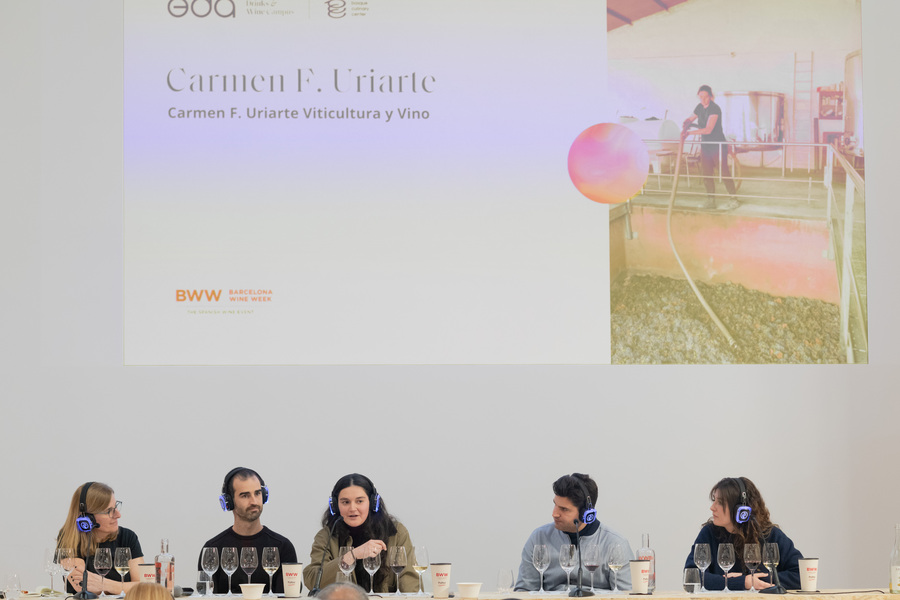
Carmen F. Uriarte’s story is not strictly one of succession, yet she is determined to secure the future of a small Rioja Alavesa cellar that might otherwise have disappeared. A Madrid-trained agronomist and WSET Diploma candidate, she spent her childhood tinkering in a relative’s winery in Fuenmayor. In 2023 she took over the cellar of Txutxi Muro in Lapuebla —a highly respected cosechero with no successor in the family.
Just a year later she released three wines from her inaugural vintage, all made by carbonic maceration, preserving Txutxi’s house style. During the tasting she spoke movingly of receiving her official grower’s registration just before travelling to Barcelona for her first BWW, and of her determination to safeguard the legacy entrusted to her. “The transfer of knowledge has been fundamental to my development; Txutxi Muro’s support has been decisive.” She is keen to uphold tradition, but not without imprinting her own style: earlier picking, she explained, in pursuit of lighter, more fluid wines with genuine drinkability.

Author
Amaya Cervera
A wine journalist with almost 30 years' experience, she is the founder of the award-winning Spanish Wine Lover website. In 2023, she won the National Gastronomy Award for Gastronomic Communication

Author
Yolanda Ortiz de Arri
A journalist with over 25 years' experience in national and international media. WSET3, wine educator and translator

Previous Post