


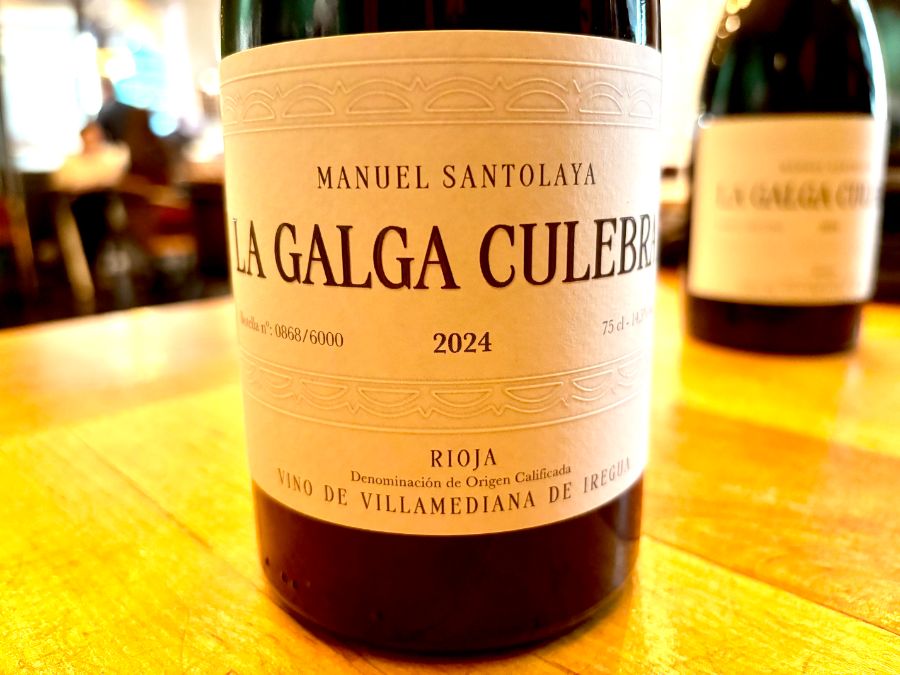
Village wines continue to gain ground in Rioja, with Villamediana de Iregua among the latest to join their ranks. La Galga Culebra is the first wine from this town, located 7 km south of Logroño, to be labelled as 'vino de pueblo'. It is made from grapes grown by the Santolaya family, a respected name in the DOCa, thanks in no small part to the prominence and pioneering spirit of Agustín Santolaya, managing director of Roda. However, it is his son Manuel, an agricultural engineer and oenologist specialising in wine consultancy, who has taken on the challenge of putting Villamediana on the Rioja map.
The family’s winemaking tradition began with Agustín, Manuel’s great-grandfather, who made carbonic maceration wines in open concrete vats and sold them in 16-litre demijohns. His grandfather, meanwhile, was more interested in farming, although Agustín Sr. soon became a staunch advocate of old vines. He stopped using herbicides and embraced more sustainable viticultural practices, albeit "without being radical", according to Manuel.
The family owns 20 hectares of vineyards and leases a further seven, selling grapes to producers such as Barón de Ley and Roda. While Villamediana has abundant irrigated farmland —it is situated between the rivers Iregua and Leza, with the former flowing close by—, the Zorraquín area is home to dry-farmed vineyards. The family's plots are scattered across the southern slope of La Rad, an ancient terrace of the River Ebro which marks the boundary between the villages of Villamediana, Murillo and Agoncillo. It poor, deep soils are unsuitable for cereal cultivation.
This is the most traditional aspect of a village which has undergone considerable industrialisation and growth as a result of its proximity to Logroño. Its population has risen from 2,500 inhabitants in 2001 to approximately 10,000 today. According to figures from the Regulatory Board, the current area under vine is just under 340 hectares.
Although Villamediana is part of Rioja Oriental, Manuel describes the area as a transition zone between Tempranillo and Garnacha country. His aim is therefore to capture the character of both the site and its grapes, vinifying individual plots and varieties separately. Alongside Tempranillo and Garnacha, he also works with Mazuelo and Graciano.
Manuel produces his wine in the cellar beneath his father’s house. His father Agustín first tried to establish a family winery there in the early 1990s, but had to abandon the project because of his growing commitments at Roda. In 2013, he made a second attempt with his daughter, María, also an oenologist and agricultural engineer who works at Roda. It was not until 2021 that Manuel decided to take the plunge, renovating the cellar with the knowledge that its capacity is limited to 8,000 bottles.
The 2024 vintage is the first he has felt confident enough to release commercially. The wine combines 40-year-old Tempranillo vines and century-old Garnacha, which accounts for 25% of the blend and is carefully selected according to its ripeness. The wine is fermented in oak vats and aged in large, seasoned oak casks to minimise the influence of wood.
An expressive red, it offers fully ripe fruit and spicy notes. It is flavourful and juicy, with well-integrated oak and a pleasing chalky finish. Garnacha lends the wine character, imparting freshness and a rounded quality to the palate.
The name pays tribute to one of Manuel’s great-grandfather’s greyhounds, who lived in the 1970s, and to the stories about her that have been passed down through the family. La Galga Culebra's is a rather sad tale: she was grazed in the eye by a sickle and subsequently contracted tetanus. A white wine, La Galga Pólvora, will be released in 2028.
14.5% abv.
€28
6,000 bottles
Score: 93

Author
Amaya Cervera
A wine journalist with almost 30 years' experience, she is the founder of the award-winning Spanish Wine Lover website. In 2023, she won the National Gastronomy Award for Gastronomic Communication
Previous Post

