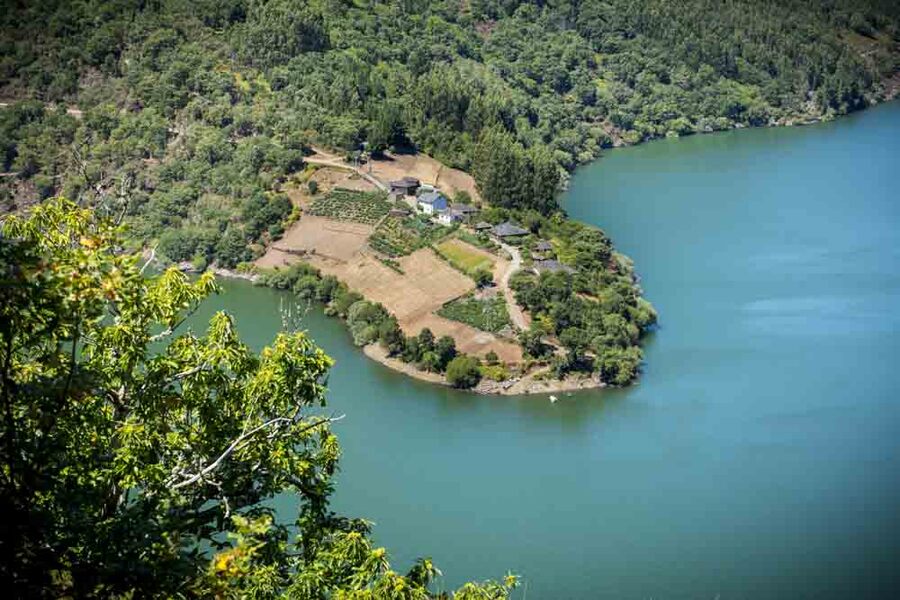
Galicia é o que vemos, wrote the poet Manuel María. “Galicia is what we see.”
It’s plain to see that Spain’s northwestern corner has become well-known to the savvy wine drinker over the past few decades. Widely touted as the home of some of the country’s most compelling white wines, it’s also increasingly common to see Galician reds pop up on top wine lists in Spain and beyond. For many, Galicia’s five Denominaciones de Origen represent the face of the region.
But as María’s poem goes on to say, hai outra Galicia: there’s another Galicia, one less immediately visible. Thankfully, when it comes to Galician wine, that relative obscurity doesn’t mean less interesting. Across the region, producers outside the established DOs are betting on minority grape varieties and artisanal methods to start a rural revolution —often in the shadow of their better-known neighbours.
Orphaned vineyards
Such is the case of growers who work in the Barbanza and Morrazo peninsulas, located geographically within the lower rías but absent from DO Rías Baixas. Stretching into the Atlantic like gnarled fingers on either side of the Salnés Valley, both have missed out on the neighboring wine region’s fame despite sharing centuries-old viticultural traditions.
“Geographically, historically, and in terms of wine tradition, Morrazo clearly belongs to Rías Baixas,” says winemaker Antonio Portela, pictured below. “Saying otherwise is almost ridiculous.” Vineyards have been planted in the peninsula since medieval times, with most of them located close to sea level as in much of Rías Baixas. There’s also plenty of Albariño. Yet when DO Rías Baixas was formally established in the 1980s, Morrazo was left out due to bureaucratic reasons. Afterwards, Portela says, winegrowing there was basically “orphaned.”

For Enrique Fernández-Peran, however, the historical slight might have been a blessing in disguise. His family owns Reboraina, a winery in the Indicación Xeográfica Protexida (IXP, known as Indicación Geográfica Protegida, or IGP, in the rest of Spain) Ribeiras do Morrazo, which covers the Morrazo peninsula and the surrounding area. “We’re not as large or powerful, but we’ve kept our character,” he says. As more and more Galician wineries are acquired by outside investors from regions such as Ribera del Duero or Rioja, some in Rías Baixas have worried about the loss of local identity. But in smaller regions, says Fernández-Peran, ownership is still 100% Galician.
Reboraina is one of six wineries in IXP Ribeiras do Morrazo, created in 2017 “out of necessity,” as Fernández-Peran puts it. Their wines are made primarily from Albariño, but since the variety is registered by Rías Baixas at the European level, they couldn’t put it on their labels. Establishing an IXP gave them that right. Now, producers in Morrazo can capitalize on the variety’s global fame while setting their Albariño apart from its neighbors. “There are differences between our Albariño and Rías Baixas Albariño, just like there are differences between Val do Salnés and O Rosal,” Fernández-Peran says. But distinguishing their wines from Rías Baixas can be an educational hurdle. “Everyone knows what a DO is, but a lot of people don’t know what an IXP is. I constantly have to explain that it’s essentially similar in quality controls, but the regulatory body is state-run, not private like in a DO. It can also be a step towards becoming a DO,” he says.

No less glamorous
North of the Ría de Arousa, IXP Barbanza e Iria also lies in the long shadow of DO Rías Baixas. While the constant comparisons might create an inferiority complex in some regions, the producers here reject that idea. “I don’t see what we do in Barbanza as less glamorous,” says David Rial, who makes wine in both Barbanza e Iria and the O Rosal subzone of DO Rías Baixas. “If anything, I see the opposite,” he adds. “Curiosity drives people who really like wine to discover lesser-known regions.” Rial, who is from the Barbanza region, began working with O Rosal native Juan Chamorro after the two met during a viticulture and winemaking course. They began in Rías Baixas in 2014, making wine from vines owned by a third partner, Manuel Calzado, and in 2017 they set their sights on two of Barbanza’s traditional white grapes, Ratiño and Raposo.

Although Ratiño has recently been autorised in Rías Baixas, only two other producers in Galicia currently work with it. Chamorro attributes its scarcity to its difficult nature. “Everything I’m about to tell you is negative,” he warns. “Not even the birds eat Ratiño.” A small, thick-skinned variety, Ratiño has low yields in the winery and an incredibly short harvest window. “With Albariño, from 11% to 15% potential alcohol you might get different types of wine, but it's fine,” says Chamorro. “Ratiño goes from very green to very ripe, so you only have a few days to select it.”
Despite its difficulties, the variety was once a prized commodity in Barbanza. Rial’s wife’s grandfather told the duo that in his time they called Ratiño the Civil Guard’s grape. “Since it has good alcohol and acidity, it keeps well over time,” says Chamorro. “Back then, when the Civil Guard would come to your house, you had to offer them the best wine so they'd leave happy and not bother you, and they gave them wine made from Ratiño.”

The other local variety is Branco Lexítimo, known in Barbanza as Raposo. Chamorro and Rial named their winery in homage to this local nickname: “raposo” means “fox” in the Galician language, so their project is called Cazapitas, or “Hen Hunter.” They like Raposo for its high acidity and ability to appeal to a wide range of tastes. “There’s more acidity analytically than on the palate,” says Chamorro. “Sometimes we're talking about wines with 8.5 grams of total acidity, which you’d think you’d really notice, but you don’t. That's its charm.” The high acidity also gives wines incredible ageing potential. “You'd have to drink a Raposo that was 40 years old to see what it can do. We'll have to make it now ourselves and get together for 2060,” he says with a laugh.
Experimentation without limits
Elsewhere in IXP Barbanza e Iria, José Crusat (in the photo below) has also been investing in Raposo. He and his father, Francisco, operate Adega Entre Os Ríos, a winery that began as a hobby for the elder Crusat in the 1980s and eventually grew into a full-fledged winery and a founding member of the IXP in 2000. Thirteen years later, Crusat made his first wine from Raposo, called Vulpes Vulpes. He began with 200 bottles and now makes 2,300, a number he plans to double. Since that first wine, Crusat has charted his own path at the winery with a series of wines called Komokabras. The name pokes fun at his father’s “madness” in buying the property —estar como una cabra is a Spanish expression that means to be crazy or act in an eccentric way— but Crusat says it also means not just staying in one profile: the Komokabras wines incorporate everything from barrels to clay amphorae to skin contact. Working outside a DO helps give him the freedom to experiment, he says. “I think in some ways the DOs are outdated. They’re a homogenising force,” he observes. “An IXP is a bit looser in regulations, which allows more freedom in production.”
The long road to recognition
For others, that freedom comes at the cost of recognition. “People know Galicia and Rías Baixas and the other DOs, but not the IXPs,” says José Luis Bouzón Beade, whose family winery, Ribeiras de Armea, makes wine in IXP Betanzos, about 25km from A Coruña, in northern Galicia.
Although Betanzos was home to over 1,000 hectares of vines in the 18th century, today it’s better known for originating a style of runny tortilla than for its wine. But for being one of Spain’s northernmost viticultural regions, Betanzos has surprisingly good conditions for grape growing. The Atlantic moderates temperatures, and the area gets about 1,100mm of rainfall per year compared to Rías Baixas’ 1,600mm. “You get that acidity, you achieve ripening and you don't need much else,” says Bouzón, pictured below. Ribeiras de Armea is one of a handful of producers who have recovered forgotten varieties along the slopes of the Mandeo and Mendo rivers like Agudelo (Chenin Blanc), Brancellao, Merenzao, and Betanzos’ star grape, Branco Lexítimo. Since taking over in 2014, Bouzón has led Ribeiras de Armea to become a local reference point. The next step will be spreading their message. “Betanzos is starting to be recognised, but it's still a very small area that has been stagnant for a long time,” he says.

Despite the historic importance of viticulture, most vineyards around Betanzos have been abandoned, and it’s often difficult to acquire land. “We had seven hectares divided into 27 plots. I’m not kidding,” assures Guillaume Barrier. The Bordelais winemaker followed his Ferrol-born wife back to Galicia and has spent the last six years managing viticulture and winemaking for Pagos de Brigante, a project founded by Luis Sande in 2020. After retiring from a career in civil service at the European Union, Sande began to pursue his dream of recovering historic vineyards around Betanzos. He passed away in 2025 after a battle with lung cancer, and now the winery is in the process of being sold. In regions like Betanzos, continuity is never guaranteed. But Sande’s legacy extends beyond Pagos de Brigante, says Barrier: “I think he put Betanzos on the map. I would say that what he did was more of a public service than a business,” he reflects.
Barrier (in the photo below) is now planning another project on Galicia’s northern coast, an area that, like Betanzos, he believes will only improve with climate change. “It's not crazy to say that half of Spain is going to be very difficult to cultivate in the future, so vineyards will have to move north,” he says. As recognition slowly arrives, Bouzón believes what Betanzos really needs is investment: “We need a project that has the means to cover viticulture and marketing expenses and the sensitivity to not just make commercial wines. You have to invest to stop the abandonment,” he says.

Against abandonment
One hundred kilometres to the southeast, Manuel Cancio is also worried about abandonment. He has good reason to be. Surrounded by the Ancares mountains on the banks of the Navia River, he lives and works in Negueira de Muñiz, the least populous municipality in Galicia. One of three producers in Galicia’s newest IXP, Terras do Navia, Cancio hopes wine could kick-start a rural revolution that brings people back to an area where, he says, “depopulation has been brutal.” Winemaking in Negueira dates back to at least the 17th century, but the 20th-century wave of emigration that affected much of rural Galicia almost completely wiped it out. “Emigration in the 1960s and 1970s was the second phylloxera,” says Cancio.
Though his family had always made wine for self-consumption, Cancio never considered doing anything on the professional level. But in 1995, encouraged by José Mourinho Cuba, an early promoter of DO Ribeira Sacra, he took the first steps towards what would eventually become Bodega Panchín. In 2001, he bottled his first vintage. A decade later, he met José Manuel Rodríguez, then president of DO Ribeira Sacra, who floated the possibility of the area around Negueira becoming a subzone. Cancio and other growers commissioned a report on the area’s viticultural potential and presented their application to Ribeira Sacra’s Regulatory Council. When they didn't get a reply, Cancio says, the group used the report to request an IXP. They submitted the official request in 2016, and IXP Terras do Navia was finally created in 2023.

Today, Terras do Navia’s three producers make wine from Branco Lexítimo, Merenzao (known locally as Verdejo Tinto), and Albarín Tinto. In Cancio’s opinion, the best wines come from Branco Lexítimo, which benefits from the drier, more Mediterranean influences in the area. Most vineyards are located between 200 and 500 meters above sea level, surrounded by the Ancares mountains which block the winds that blow from the ocean. “Last year my Branco Lexítimo reached 15% alcohol, all while keeping an acidity of 6 g/l,” he says. “If you manage the vineyard well, the variety has huge potential.”
Cancio notes that Terras do Navia is the IXP that has grown the most in the shortest time after getting official status: two more producers applied to register with the IXP in 2025. He hopes that success will convince more people to move to the area. “Each one of us has their personal challenge, but at a collective level our goal is for people to see that wine can be something that can bring people back to the countryside,” he says.
“Terroir isn’t just soil, it’s everything”
Commercial reality remains the principal obstacle. “A lot of people prune the vines, harvest the grapes, make the wine, and then go sell it at fairs themselves,” says Fernández-Peran. “You can’t be everywhere,” says Crusat. “You can’t deliver your wine to a bar, send invoices, chase payments…” Then there’s the price of the wines themselves. “All the vineyard work is much more expensive, so everything goes up,” says Barrier. “I’ve had clients ask ‘How much is your Albariño?’ ‘Five euros.’ And they say ‘No, in Rías Baixas I can get it for two euros.’ So, you need to lean into what makes your wine different,” Crusat explains. “We have grapes they don’t, like Raposo. We have a similar climate and soils, but we have different exposures. We need to champion that differentiation. Terroir isn’t just soil, it’s everything. Human decisions, the people behind the wine —those things are important.”
For Bouzón, the human part of terroir is what matters most. “I think the IXPs have to communicate that we’re small producers working in areas where it’s very costly to make wine,” he says. “When you’re small, you have to work harder,” admits Crusat. “But we're getting there—there's a certain level of recognition.”

Together, these IXPs embody the spirit of the other Galicia that Manuel María wrote about: not the image that has been transmitted by its DOs, but one that vai no sentimento, or “lives in feeling.” Outside the shelter of a DO, growers have fewer guarantees of commercial success, but they also have room to recover heritage varieties, revive traditions and places, and to live out their commitment to the land in a more radical way.
The best part about drinking wines from this “other Galicia” is learning that the region’s viticultural landscapes don’t just endure in a vacuum, but that there are people who choose year after year to make them possible. “I always say, look, in this bottle there’s not just wine,” says Cancio. “Living where we live and doing what we do has its merit, and that’s reflected in the bottle. Now we have to distinguish ourselves somehow. Maybe you say it won't happen, but I'm optimistic, eh?”
Six wines from Galicia’s unsung regions
Antonio Portela, Praia de Areabrava 2023
Cazapitas, O Peruco 2022
Reboraina, Albariño 2024
Adega Entre Os Ríos, Vulpes Vulpes 2023
Ribeiras de Armea, Blanco 2023
Adega Panchín, Panchín Branco 2025

Author
Noah Chichester
Wine writer and educator, he is the founder of winesofgalicia.com, the only English-language website dedicated to Galician wine. A contributor to Decanter, JancisRobinson.com, The World of Fine Wine, and others, he shares Galician wine with an international audience.
Next Post
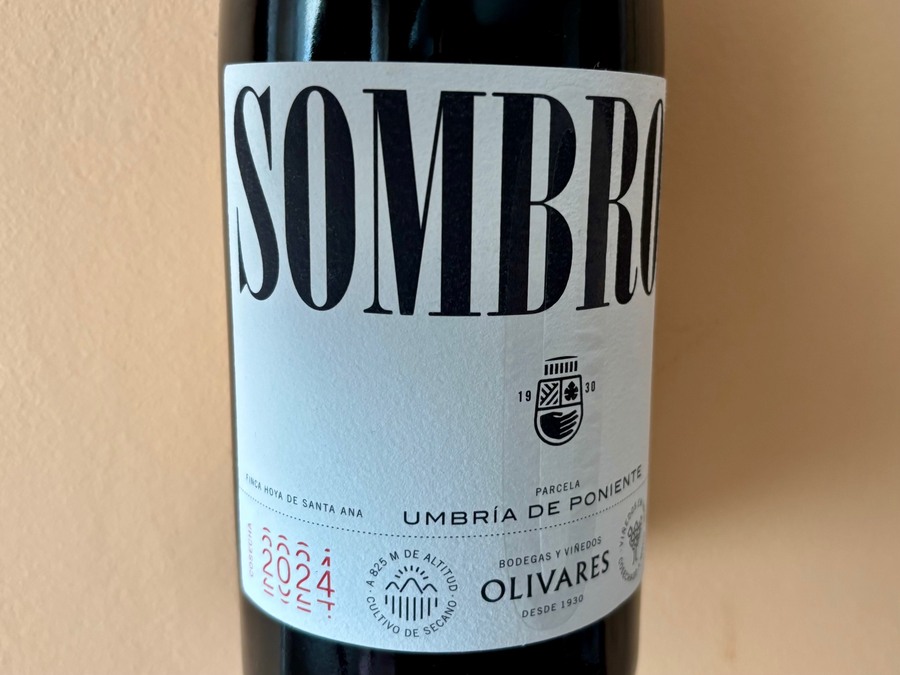
Sombroso Umbría de Poniente 2024 Red