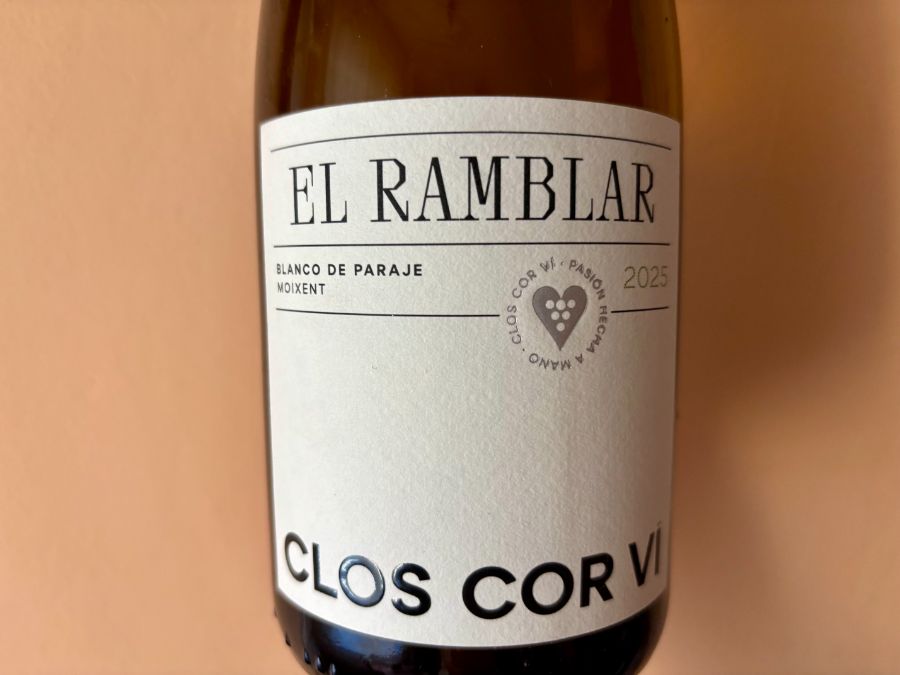
The new wave of Mediterranean wines also includes whites. This latest release from Valencia shows how international and local grape varieties can come together in a terroir-driven approach that puts the vineyard ahead of the varieties.
It was aged whites tasted in France —at a time when, in Spain, "whites had to be from the latest vintage"— that inspired pharmacist Luis Corbí Coloma to embark on a career in winemaking. In 2007, he purchased a six-hectare estate in Moixent, in the Alforins Valley, within the Clariano subregion in DO Valencia. There, he planted Riesling and Viognier in an attempt to recreate the French whites he had enjoyed so much. He also planted Verdil, a local white variety which is less common nowadays. "It was my tribute to the region. Working solely with international varieties would have been rather daring," he explains.
The range eventually grew to three single-varietal wines, one for each variety, as well as a Viognier-Riesling blend at the top end. However, in 2025, Corbí decided to overhaul the project completely. "The market is struggling. To sell at certain prices, you have to produce large volumes. It makes more sense to make higher-quality wines now that people are drinking less but better,” he says.
The aim was to craft more contemporary wines, so Corbí turned to Javi Revert, one of the producers who has best understood the new Mediterranean style, for help. Revert has an in-depth knowledge of the area, gained through his work as winemaker at Celler del Roure and his own project in the nearby village of La Font de la Figuera. This collaboration has proved successful for both the whites produced in Moixent and for Corbí’s second winery in Parque de las Hoces del Cabriel in Utiel-Requena, which focuses on reds made from Bobal.
The project has shifted away from single-varietal wines towards site-specific and single-vineyard bottlings. As part of this new approach, the winery has stopped buying grapes and is now focusing entirely on its own vineyards. Production across the two wineries has consequently fallen to around 30,000 bottles.
El Ramblar’s greatest strength lies in its Mediterranean character. Its identity clearly takes precedence over the individual grape varieties in the blend. Alongside floral and earthy notes, the wine's appeal lies in its rich, velvety texture, neatly offset by a bitter, lingering finish. It is a balanced, approachable wine that is very pleasant to drink.
Viognier and Riesling account for 80% of the blend, with Verdil making up the remainder. According to Corbí, Viognier complements Riesling particularly well, while Verdil — a variety with small, thin-skinned berries — adds Mediterranean notes and a long finish.
The three varieties are fermented and aged separately. The international grapes are aged in 500-litre seasoned French oak barrels to avoid imparting oak flavours, whereas Verdil is aged in clay amphorae, which may explain the wine’s earthy undertone that adds a measure of character. The current top-of-the-range wine, which we hope to taste soon, is a single-vineyard Verdil called La Loma de las Carrascas. Corbí intends to plant more of this variety in the future.
13.5% abv.
€20
10,500 bottles
Score: 91

Author
Amaya Cervera
A wine journalist with almost 30 years' experience, she is the founder of the award-winning Spanish Wine Lover website. In 2023, she won the National Gastronomy Award for Gastronomic Communication
Previous Post