Travelling to another country for your morning coffee is not a common experience in most of the world. For Abraham Quintas, it’s like taking a walk around the block. He owns the wine shop Templum Sensibus in the Galician town of Salvaterra de Miño, but drinks his coffee across the Miño River in Monção, Portugal.
Quintas is a raiano, an inhabitant of the borderland between Spain and Portugal, known locally as the Raia, or “the line”. Here, European freedom of movement means that crossing the border to shop, socialize, or do business is as common as heading to the next town over. But long before the Schengen Agreement, 700 years of coexistence far from the national centers of power has meant the raianos have evolved an identity that’s neither fully Spanish nor fully Portuguese. A sense of independence —and interdependence— permeates their approach to life.
For wine, historically confined by political and appellation borders, this identity hasn’t always mattered. But as rural life becomes more and more difficult to sustain on the Galician side of the border, embracing a raiano identity offers borderland winemakers a way to distinguish themselves in a sea of unique terroir stories. And at a time when the wine world is increasingly interested in the physical expressions of a place and less on the constraints of appellations, the Raia offers a fascinating story of how terroir doesn’t always stop where a map says it should.
The other Rías Baixas
With the Miño marking its southern border, the Condado do Tea spreads out eastward from the town of Tui across a series of undulating vine-covered hills and sloping river valleys. Despite Albariño’s dominance, the traditional local blend of Treixadura, Albariño, and Loureiro —the same mixture that still shapes the wines of Vinho Verde across the border— continues to thrive in Rías Baixas’ most inland subzone. That’s not to say the two sides of the Raia are one and the same: although they share climate, grape varieties, and soils, winemaking methods and harvest timing make it easy to distinguish a Condado wine from a wine from Monção-Melgaço. Where Portuguese winemakers tend to harvest earlier and make lighter wines with some effervescence or a few grams of residual sugar, the Galicians tend to like drier, more structured wines, Quintas explains.
Still, when all is said and done, “as far as vineyard practices, planting methods, and grape varieties go, Condado’s wines have far more in common with the other side of the river than the Salnés Valley,” he says.
When it comes to Rías Baixas though, the discussion always comes back to the latter. Although Condado do Tea existed as a viticultural region before DO Rías Baixas was created, “outsiders only hear ‘Salnés, Salnés, Salnés,’” says Óscar Cidanes. A former winner of Best Galician Sommelier, he owns the Vigo wine bar Detapaencepa and, with his partner Marcial Dorado, makes wine at their Condado do Tea winery, Destinos Cruzados. “People said [the Salnés Valley] was better than Condado, and we’ve never attracted as much attention,” he says.
Quintas believes Rías Baixas is a great marketing success story, but says that in order to build a strong global brand, some sacrifices were made. “The individual subzones lost some of their own visibility,” he says. “Now, it's just: Albariño–Rías Baixas.”
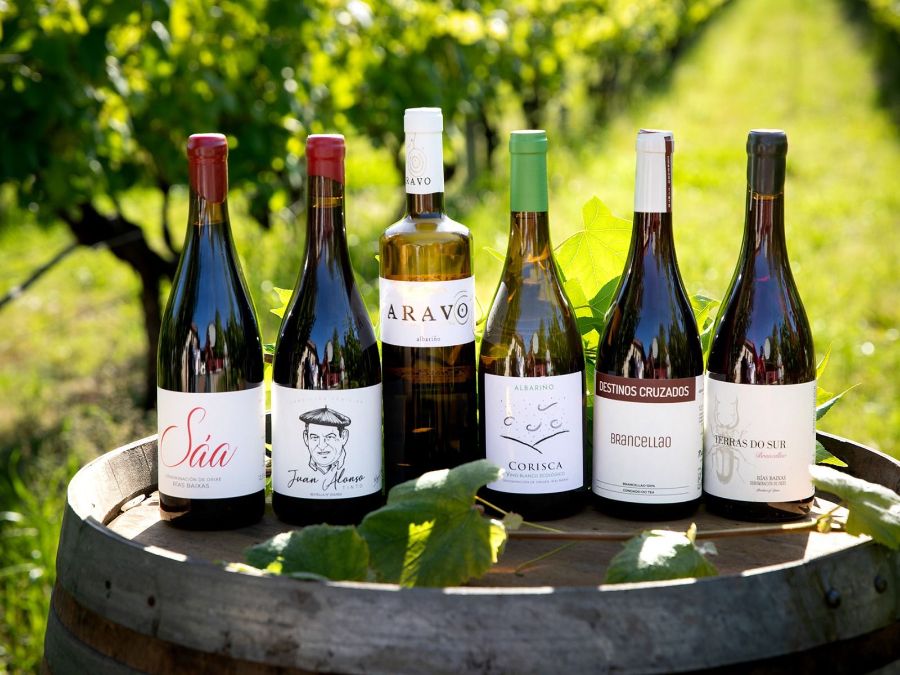
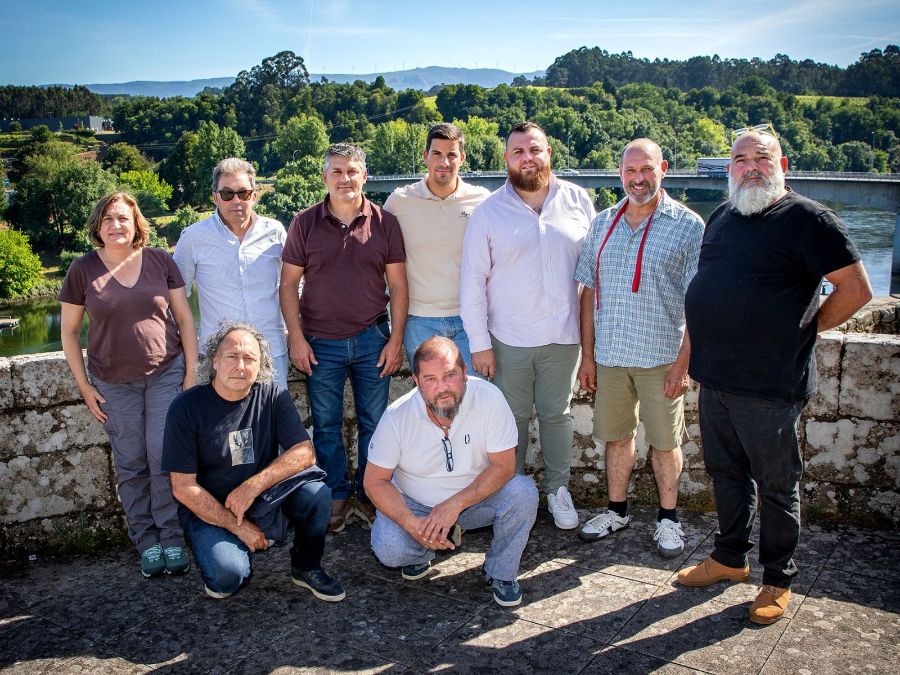
The need to stand out in an appellation whose marketing strategy leaves little room for internal diversity drove Quintas, Cidanes, and a handful of other local growers to organize. This year, they formed Viticultores Independentes do Condado, or VICO, a group of eight wineries* (see picture below) whose goal is to establish Condado do Tea as a benchmark wine-growing region, championing small-scale projects with names and stories behind them. Each producer has a distinct philosophy and personality, but they’re united by a mission to keep rural life viable along the Raia.
Even as the arrival of winery groups from outside Galicia brings money and attention to the Condado, more and more of the region’s longtime growers are struggling to make ends meet or abandoning their vineyards. Cidanes argues that VICO’s generation represents the best wines that have ever been made here. But none of their work means anything if they’re eclipsed by one-size-fits-all marketing or larger groups jockeying for a place in the region.
Labeling themselves as ‘independent’ isn’t a declaration of secession, but rather a way to assert their own identity within the DO. “We’re not only ‘independent’—we’re invisible, inquisitive, impatient, inspired… We have many ‘I’ words,” Cidanes says. Likewise, embracing their identity as raianos elevates a unique heritage that makes their wines worth discovering. Just as there are similarities and differences between both sides of the Raia, they argue, the same should be celebrated within Rías Baixas.
“I would never renounce being part of Rías Baixas,” says Quintas, “but I can't understand how you can go onto the DO’s website or Instagram and you don't see any independent growers featured, or any of the Condado's traditional multi-varietal wines. If I owned a car dealership, I'd advertise SUVs, sports cars, sedans —the whole range. That's where the richness lies.”
River wines
Although Galicia’s coast has become infamous for one type of trafficking, the Raia has also seen its fair share of cross-border contraband. When it comes to wine, the Guardia Civil occasionally catches smugglers ferrying Portuguese grapes into Rías Baixas, and often-murmured conspiracy theories allege that thousands of kilos of grapes find their way across the border each year. But if the soils and the grapes are the same on either side of the Miño, is there really such a difference between what each appellation claims to protect?
Gutier Seijo says no. His project, Mixtura Independent Wines, follows the Raia Húmeda, the name for the border along the Miño River, farming vineyards in the Ribeiro, Condado do Tea, and Melgaço regions before blending the fruit into what he calls “river wines.”
The concept of Mixtura took shape during Seijo’s time as winemaker at Dominio do Bibei, when he noticed that the borders of Galicia’s DOs could feel arbitrary.
“You can be in Ribeira Sacra and see vineyards just across the Bibei River,” he says, “but they’re in another DO” He applies the same logic to the Miño: both Melgaço-Monção and Condado do Tea would be part of the same DO if they were in the same country. “It wouldn’t make sense otherwise to separate those two parts of the valley,” he says.
After leaving Dominio do Bibei, Seijo began renting and buying plots on both sides of the Miño, and launched the first vintage of Mixtura Independent Wines in 2018. Mixtura Blanco, the flagship wine, is a blend of Treixadura from Ribeiro and Albariño from Melgaço. Mixtura Gold is a 50/50 blend of the best plots of the two varieties on either side of the border, and Mixtura Green comes from a single parcel of Albariño in Melgaço.
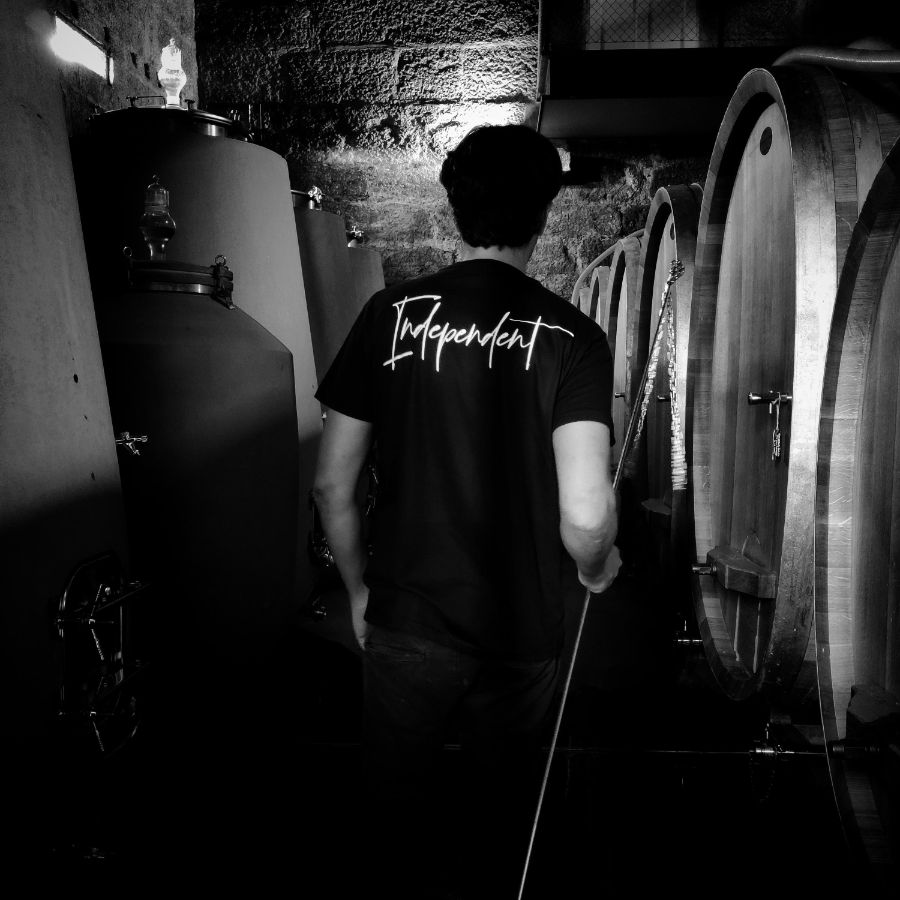
The project is ‘independent’ in the fullest sense, he says, because it doesn’t have the obligations imposed by an appellation or a country’s borders. Seijo officially classifies his wines as Wine from the European Union, in a nod to the cross-border origin of his grapes, but notes that since his cellar is in Spain he could just as easily label them as ‘Vino de España’.
As a raiano, he has no problem dealing with the bureaucracy of bringing grapes across the border. “Culturally it’s very, very similar on both sides of the valley,” he explains. “You obviously have to do the paperwork, go to the notary, and all that in another country, but we understand each other —there’s no problem at all,” he says. “Galicians and Portuguese, they fish together in the river, border to border. They both work together. They drink the same wine.”
Seijo is content to be outside the confines of a DO, but he thinks that Mixtura might provide an example for future terroir-based wine legislation. “Someday there really will be a wine that could be an IGP Galicia or an IGP Río Miño,” he says. “Look at Côtes du Rhône. There are very different areas —Châteauneuf du Pape has nothing to do with Côte Rôtie— but you can put together a Côtes du Rhône using grapes from different villages along the river. An IGP for the Río Miño would be really interesting, and it could include the Portuguese side, which is also part of the river,” he says.
In the end, Seijo believes that the natural world provides a much stronger sense of identity than politics. “If someone told me that a boundary existed because of soils or different exposures, that would be fine. But here, the only reason is that someone says, ‘this is the border.’ For me, the only border is geology.”
The Raia Seca
In the extreme southeast of Galicia, no longer defined by the Miño, the border becomes known as the Raia Seca —the “Dry Line”. Without a river to define it, the dividing line between Portugal and Spain was historically much more difficult to establish. These days, the borders may be fixed, but the lines on the map don’t always correspond to reality. Along the Raia Seca, people still live in a sort of no-man’s land, carrying a Portuguese or Spanish ID card in their wallets, but with their feet planted firmly on both sides of the border when it comes to language, culture, and identity.
Francisco ‘Xico’ Pérez is one of them. He’s one of the few inhabitants left in the tiny village of Mandín, located in the south of the Monterrei wine region. His winery, Couto Mixto, pays tribute to a place where borders once ceased to exist. In the 12th century, amid medieval battles for power between the Kingdoms of Portugal and León, an independent microstate emerged from three villages along the Raia Seca. Known as the Couto Mixto, its people were neither Spanish nor Portuguese, exempt from taxes and military service, and self-governed via a democratically elected leader. After 700 years of independence, the region was annexed into Spain in the 19th century, but the united identity it created remains.
For Pérez, this borderland identity is inseparable from the local terroir. When he began making wine, he looked for grape varieties that had disappeared from the Spanish side of the border and eventually found them in Portugal. He brought cuttings back across and grafted them in his own vineyards. Today, he farms several distinct forms of Verdello, planted alongside Dona Branca, Bastardo, Tinta Amarela, Caíño Longo and Espadeiro. It’s the best approximation of the vineyards of his youth, where Galicians and Portuguese worked side by side. “We lived together,” Pérez recalls. “The vine grafters were Portuguese, the grape pickers were Portuguese, because the economy was better on this side. But that's like talking about prehistory.”
In the decades since, Portugal’s rural villages have mostly survived, but the Galician side of the Raia Seca has been emptied out by emigration. In Mandín, the knowledge attached to the old vineyards survives through just a handful of people who continue to work the land.
Now, Pérez hopes to pass on the old ways while encouraging others to take his place. Alongside his own project, he’s begun collaborating with his friend, Ribeiro winemaker Bernardo Estévez (both pictured below), on a shared wine project called Terra.
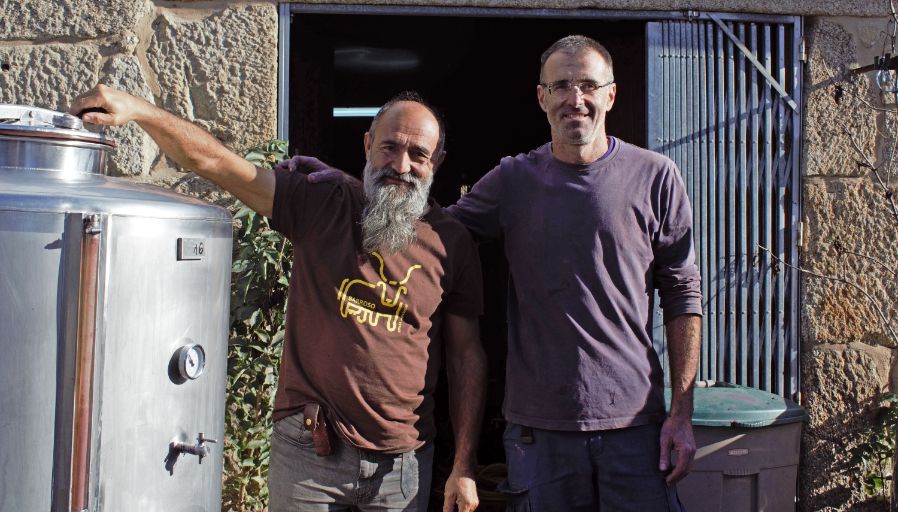
Estévez says that a changing climate and modern industrial viticulture runs the risk of making wines from the Raia Seca lose their balance: “I’ve tried wines that tend to be a little bit overripe,” he says. As he’s learned from Pérez, maintaining traditional coplantings and working the soil in a more sustainable way can reduce those problems. Estévez also sees the dry, warm Raia Seca as an opportunity to lean into the biodynamic winemaking that often costs him whole harvests in wetter, disease-prone Ribeiro. But at the end of the day, he says, everything is less a question of terroir than of intention. Under the right guidance, the methods of the past can be used to make fresh, mineral, and complex wines for the future.
Pérez hopes their project will make people see both the Raia’s viticultural potential and the value of the traditions he maintains. “The viticulture I knew as a child has become a world of labels and wineries,” he says. “Everyone is focused on Godello now; they only talk about white wine, about consumption, about so many other things. I feel lost.” He wants to keep working in the way he knows and to find others willing to do the same, lest the past be lost for good. “If our project is worthwhile, if someone else comes along who wants to make wines connected to the land, to the grape varieties, who works the soil with great respect…” He trails off, then laughs. “We’re the last of the Mohicans.”
Though the border has never been easier to cross, it’s never been more difficult to preserve its traditional ways of life. But if these raiano winemakers are able to persevere, they can teach the world a powerful lesson: a wine’s sense of place isn’t defined by political borders, appellation criteria, or lines on a map. Instead, it comes from the people who look after the vineyards, the traditions they preserve, the languages they speak, and the relationships that they maintain. Or as Quintas puts it: “it all comes down to culture, culture, and culture.”
*Pictured, the producers who form part of Vico: Adega do Ricón, Destinos Cruzados, Veigamoura, Miguel Alonso, Corisca, Terras do Sur, Chan de Vide, Pablo Saa y Abraham Quintas.

Author
Noah Chichester
Wine writer and educator, he is the founder of winesofgalicia.com, the only English-language website dedicated to Galician wine. A contributor to Decanter, JancisRobinson.com, The World of Fine Wine, and others, he shares Galician wine with an international audience.
Previous Post