Why do some grape varieties succeed in establishing a clear indentity in consumers' minds, while others never quite fulfil their potential? In León, Mencía from Bierzo has emerged as one of the great success stories of Spanish wine in this century. Yet in neighbouring DO León (formerly DO Tierra de León), Prieto Picudo has struggled to gain comparable traction —despite the involvement of leading Bierzo figures such as Raúl Pérez, who have advised and made wine in the area.
The area is historically associated with rosés made in underground cellars using a technique called madreo, which involves adding whole bunches during fermentation. This type of semi-carbonic maceration yielded juicy, lively wines. Although production today follows a more technical approach, rosés remain the backbone of the DO. Sales are still very local, focused mainly on León and Asturias.
According to Rafael Somonte, winemaker at Dominio de Tares in Bierzo, Prieto Picudo is also an incredible variety for red wines — one which, sadly, has not made a name for itself. “There has been a lack of long-term vision, both in terms of ageing and in producing wines that capture the essence of the region,” he notes.
Between 2004 and 2010, Dominio de Tares operated a second winery in DO Tierra de León region under the name Dominio Dostares. However, when it became apparent that the variety was failing to get momentum, production was transferred to Bierzo and the wines were subsequently released as VT Castilla y León.
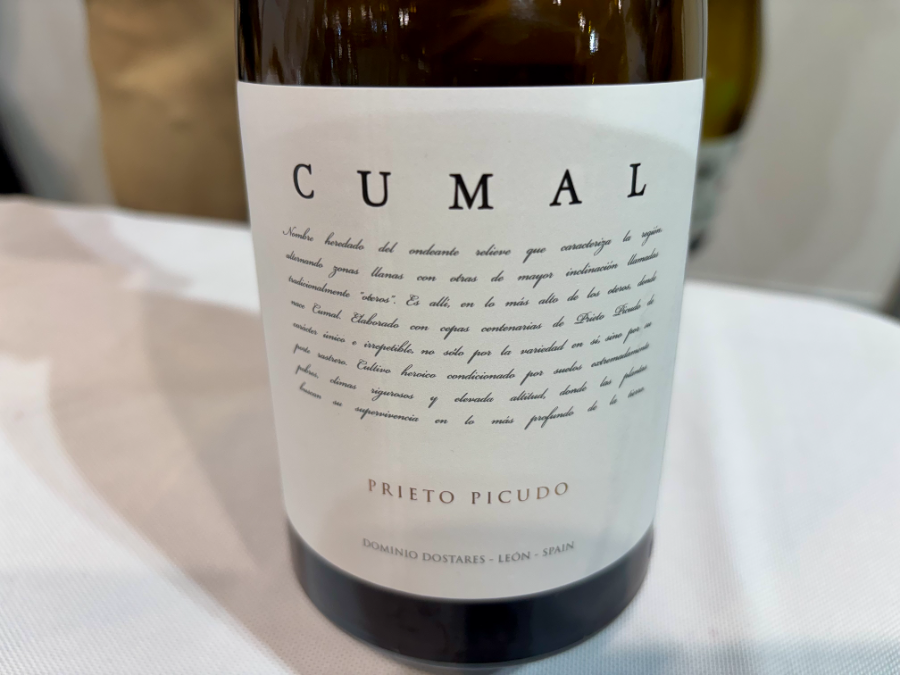
The estate still owns several vineyards in the area: 20 hectares of trellised vines, which are nearly 25 years old, currently leased to local winegrowers and expected to be incorporated into the project in the near future, as well as eight hectares of century-old creeping vines in Pajares de los Oteros, which supply the current range. They are located on a high plateau at over 800 metres elevation, punctuated by small, slightly higher rises known as cumales. The clay-rich soils made it easy to dig underground cellars, while the abundance of round stones help to drain water and radiate heat to the plants. For Somonte, the structure provided by these clay soils counterbalances the variety's signature acidity, helping to create rounded wines.
A major problem in the area is the increasing difficulty of finding people willing to work traditional vineyards. “Creeping vines are labour-intensive. They require very specific pruning and digging by hand, and no one is willing to bend down and harvest them anymore,” Somonte explains. Additionally, rain at harvest time increases the risk of rot, as the bunches hang very close to the ground.
How long will it be possible to produce Cumal from this century-old vineyards? Prieto Picudo itself is clearly in decline. The latest figures from the Ministry of Agriculture put the total vineyard area at just under 2,800 hectares, largely concentrated in this part of Castilla y León —a sharp fall from the more than 6,770 hectares reported in 1990 in the book Variedades de vid en España.
According to Somonte, the future will most likely be built around carefully tended trellises. In the meantime, this red wine is worth seeking out in the balanced 2021 vintage, which delivered fully ripe and healthy grapes. It was fermented with moderate extraction and spent nine months in oak, which is shorter than in previous vintages.
It is a complex, finely balanced red wine with perfectly ripe fruit and fresh herbal tones, despite the absence of stems in the fermentation. My favourite aspects are its depth and persistence. Considering the age of the vineyard, it offers excellent value for money and is a great way to braoden one’s vinous horizons and perhaps even discovering a new grape variety along the way.
13.5% abv.
€22
4,000 bottles
Score: 93

Author
Amaya Cervera
A wine journalist with almost 30 years' experience, she is the founder of the award-winning Spanish Wine Lover website. In 2023, she won the National Gastronomy Award for Gastronomic Communication