Christie’s in London sold a limited collection of historic wines sourced directly from the González Byass cellar. The bottles were the highlight of an online auction held between 5 and 19 June, which also featured fine wines, mainly from Bordeaux and Burgundy, as well as spirits.
The offering comprised nine lots, ranging from a selection of Finos Palmas and a vertical of Tío Pepe en Rama to a series of rare, exclusive bottles. Among the oldest were three Matusalems drawn from a solera established in the mid-19th century and bottled in 1908, 1909 and 1911, as well as the sweet wine Viña Amorosa 1911.
The sale also featured a number of vintage-dated wines from the winery’s contemporary era, reflecting the revival of añada sherries championed by Mauricio González-Gordon Díez, the father of González Byass's current president, after the category had largely fallen out of favour in the late 19th century. The auction's centrepiece, featured in six of the nine lots, was a 1997 Palo Cortado selected exclusively for Christie’s by Tim Triptree MW, the auction house’s international director of wines and spirits, together with Antonio Flores, the winery's technical director, at Bodega La Cuadrada. These are the only bottles of their kind available on the market.
Triptree has longstanding ties with the Jerez house since he was invited to selecting the 2023 release of Finos Palmas. González Byass wines have appeared at Christie's before, most notably in 1994 under the guidance of the late Michael Broadbent MW (1927–2020), one of the most influential authorities of historic wines.
“At Christie’s we are thrilled to see these exceptionally rare sherries direct from the cellars of González Byass perform so strongly,” Triptree noted. “These bottlings represent an important part of Sherry's history, and their performance highlights a growing recognition among collectors of the rarity, provenance and ageing potential of the category. Historic Sherry remains an exciting area of growth within the fine wine market, and we welcome further opportunities to bring similarly important wines to auction.”
The legacy of Jerez
In the weeks leading up to the auction, and during the Vinoble fair, Antonio Flores led a series of tastings in Madrid and Jerez de la Frontera. He describes the winery’s historic bottle collection as a “liquid archive”, complementing the historical records managed by the González Byass Foundation, which include correspondence, account books, and photographs dating back to 1837.
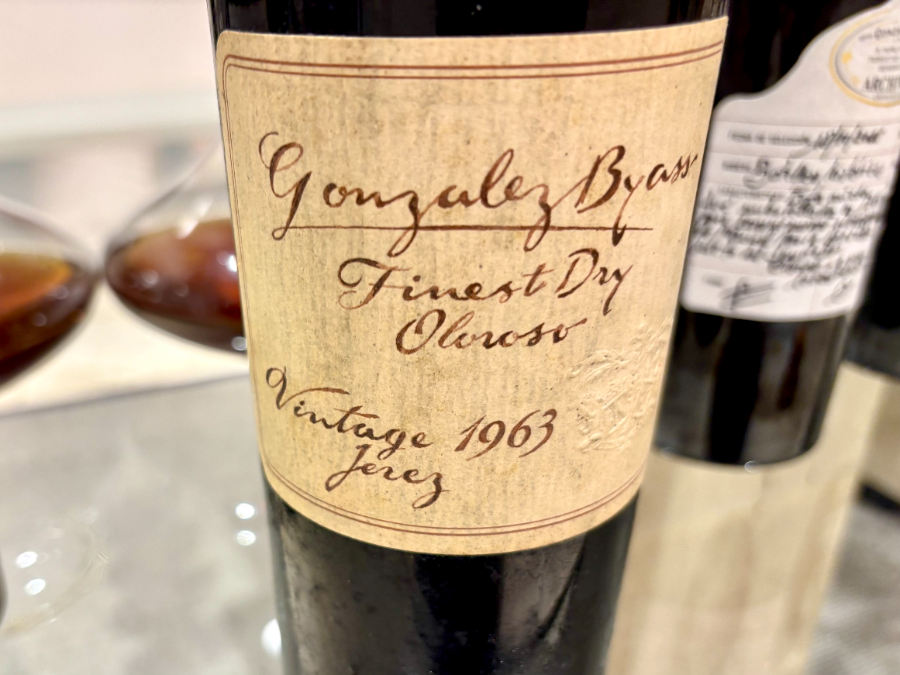
The idea of systematically cataloguing this material first emerged in the late 1980s. One of the most significant discoveries was a letter written in 1844 by Robert Blake Byass, the company’s London agent, who would later join the family business in 1855. Referring to the first shipment of Tío Pepe to England, he described a 'very, very pale' sherry. That document would later inspire a landmark release. In 1994, to mark the 150th anniversary of the event, Christie's auctioned an Oloroso de Añada 1963, the first vintage sherry of the modern era, following the efforts of González-Gordon Díez to revive the category. Thirty-two years later, the spotlight is on the 1997 Palo Cortado.
The liquid legacy in the hands of Antonio Flores comprises some 10,000 bottles, predominantly from the 20th-century, alongside a handful of examples from the 19th century. “This is the González Byass style book,” says Flores. The key to the cellar was handed down to him by his father upon retirement, and Flores hopes one day to pass it on to his daughter, Silvia, who now works with him as part of the winemaking team.
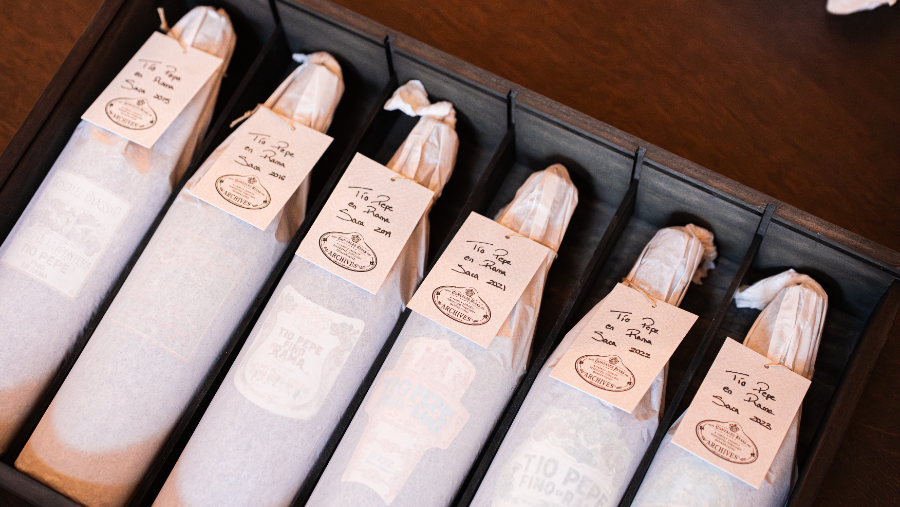
The collection offers compelling evidence of sherry’s ageing potential, much like any other fine wines worldwide. "There wasn't a tradition of cellaring sherry because it was thought that the wines stopped evolving once they were bottled,” explains Antonio Flores. He vividly recalls the concerns that surrounded the launch of Tío Pepe en Rama in 2010. The uncertainty was such that expiry dates were included on the earliest bottlings. Subsequently, they realised how well the wine could age. One of the most fascinating lots up for auction was therefore a vertical case of Tío Pepe en Rama, including the 2015, 2016, 2019, 2021, 2022 and 2023 releases.
A glimpse into ageing sherry
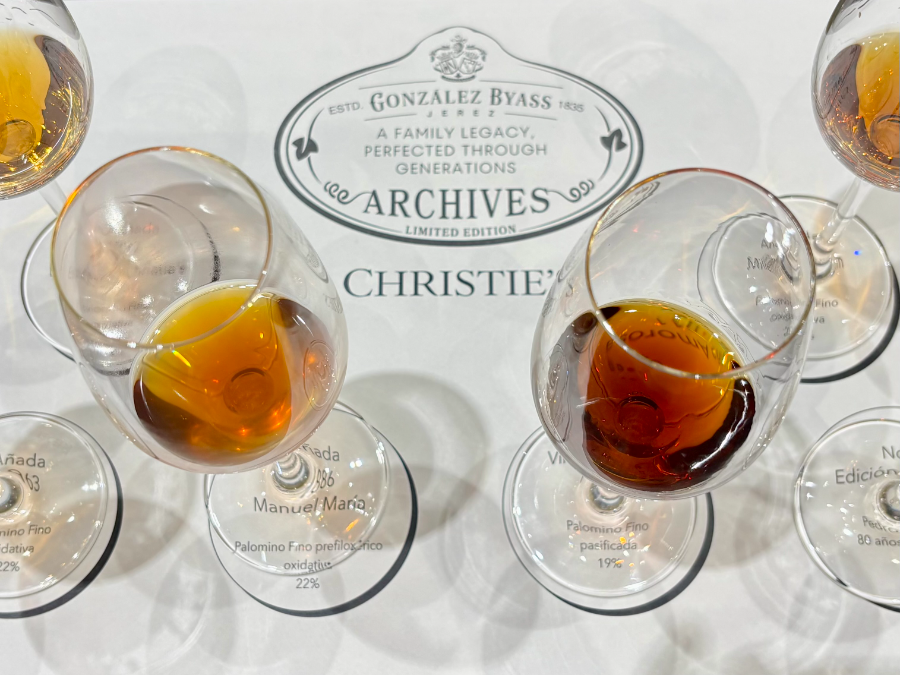
A preview tasting held at Christie’s Madrid offices offered the opportunity to sample several of the auction wines alongside bottles from the historic cellar which were not included in the sale. The tasting was hosted by Antonio Flores, Tim Triptree and Christie’s Spanish team.
Among the vintage sherries, the standout was the 1997 Palo Cortado from Bodega La Cuadrada, bottled exclusively for Christie’s. According to Flores, only around 1% of production is earmarked for static ageing in casks. Made from free-run must, the Palo Cortado contains between 8 and 9 g/l of glycerine due to the absence of flor during ageing. At 29 years old, it sits comfortably within the 25– to 35-year ageing window that Flores considers ideal for this category. It is a textbook Palo Cortado, offering hints of varnish and antique furniture, as well as a touch of aldehyde and distilled spirits layered with dark chocolate and nuts. Its full-bodied character is truly revealed on the palate: powerful but not aggresive, with a warming alcohol core (it reaches 22% abv) that lingers to an endless finish.
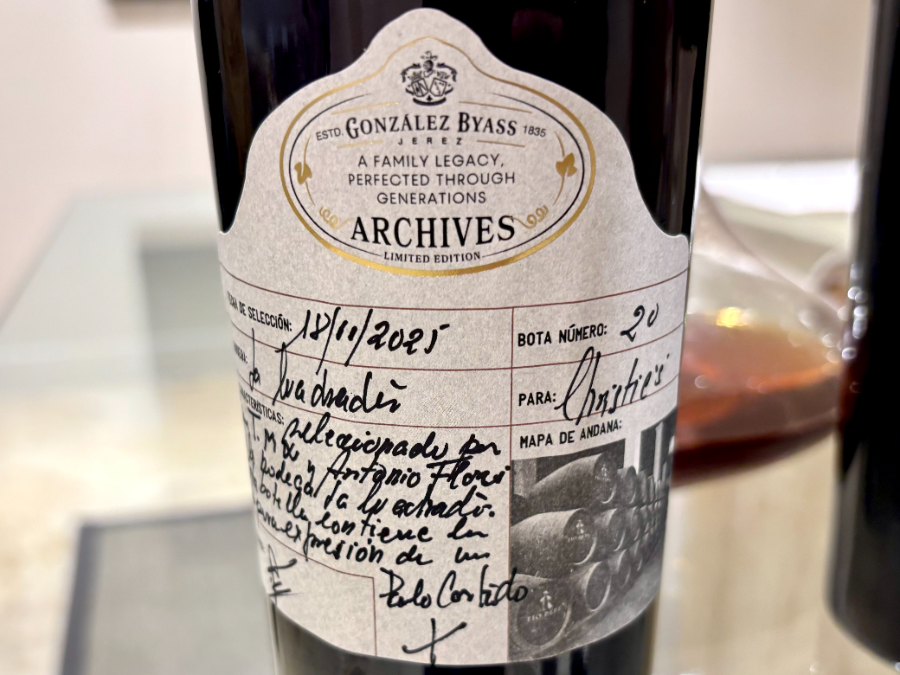
Also set to go under the hammer was the Viña Amorosa 1911, a sweet, unfortified Palomino Fino made from sun-dried, partially raisined grapes. Over time, the wine has naturally concentrated to reach 19% abv. Despite its age, it retained an exotic freshness on the nose, combining liqueur-like fruit with notes of burnt caramel, antique furniture and dark chocolate with orange zest. It felt well-balanced with fresh acidity and moderate sweetness compared to a PX, while maintaining good persistence. It stood out as one of the gems of the tasting. "It takes us back to a time when grapes were harvested not only by pagos but also by individual plots," noted Flores. Incidentally, Viña Amorosa comes from Pago Carrascal in Jerez de la Frontera.
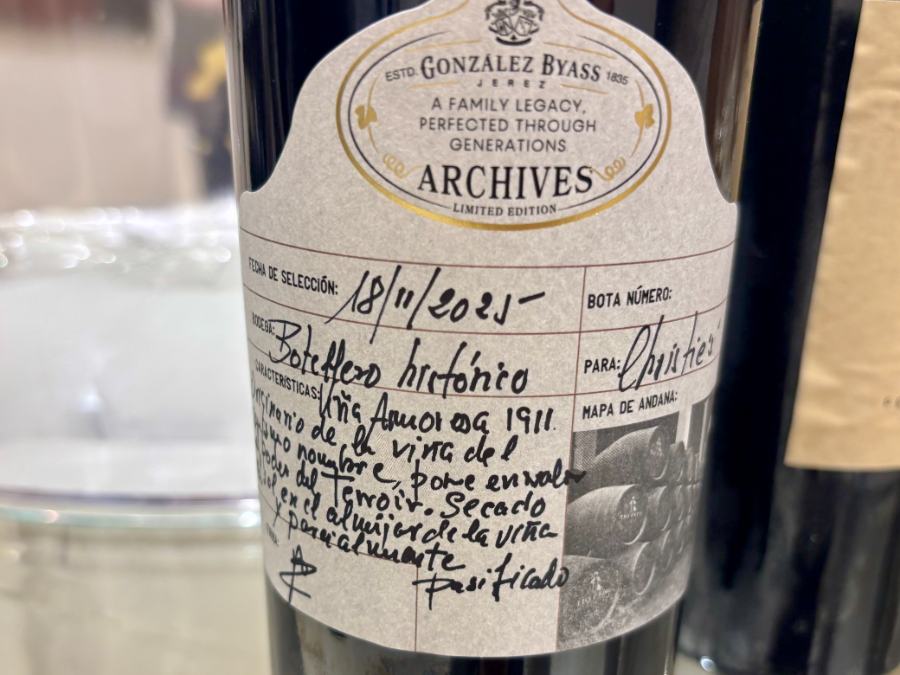
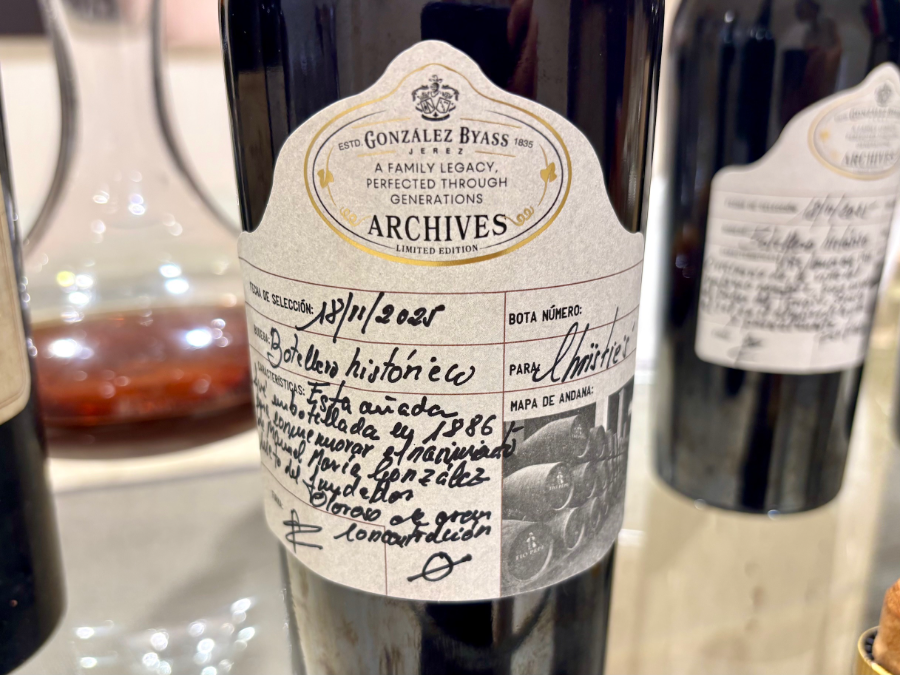
The oldest sherry for sale in the auction was Manuel María González Oloroso 1886, represented by a single bottle. The wine was made to celebrate the birth of Manuel María González, the grandson of the winery’s founder, and was bottled 30 years later. Here, the alcohol takes centre stage, giving the wine an almost spirit-like character. While not the most balanced or complex example in the line-up, its significance lies in being a pre-phylloxera wine.
The auction also included a bottle of Pío IX Moscatel 1846. This wine is part of a series produced between the late 19th and early 20th centuries in honour of various popes in the year of their appointment. A naturally sweet wine, it has just 9% abv. Another notable offering was a bottle of Palo Cortado 1978, of which only 778 bottles were made.
The fine wine market
Having González Byass take centre stage in an auction of this calibre is another step towards strengthening Spain’s position in the secondary market. “Spain is gaining momentum at auction”, says Charlie Foley, one of Christie’s best-known auctioneers. “The top fine wine producers such as Vega Sicilia, López de Heredia, Pingus, Álvaro Palacios, Murrieta, Artadi, La Rioja Alta, Torres Mas La Plana, Muga, CVNE, etc. have held their own at auctions for a long time. Christie’s, in particular, has a strong track record with Spanish wines”.
Out of the 494 lots on sale, the majority were fromBordeaux, Burgundy and the Rhône, as well as Port, German wines, and a small selection of spirits. Beyond González Byass, the Spanish representation included two lots of Vega Sicilia Único from the 1966 and 1972 vintages, as well as two lots from Rioja with bottles such as Viña Real Reserva Especial 1966 and Viña Pomal Cuvée Especial 1955.
Foley points out that recently established producers like Benjamín Romeo, Comando G, Terroir al Limit or Telmo Rodríguez are increasingly attracting buyers’ attention as interest grows in terroir-driven wines. Nevertheless, he believes merchants and specialist retailers remain crucial to establishing Spain’s reputation as a source of fine wines capable of ageing gracefully and appreciating in value.
“If we (at auction houses) don’t find these wines in people’s cellars, we cannot offer them at auction. That is why producer direct sales [such as of González Byass] are important, as they shine a light on Spanish wines as ageable and tradable, which helps buyers increase their interest in the country’s wines,” Foley concludes.
Other old wines beyond the auction
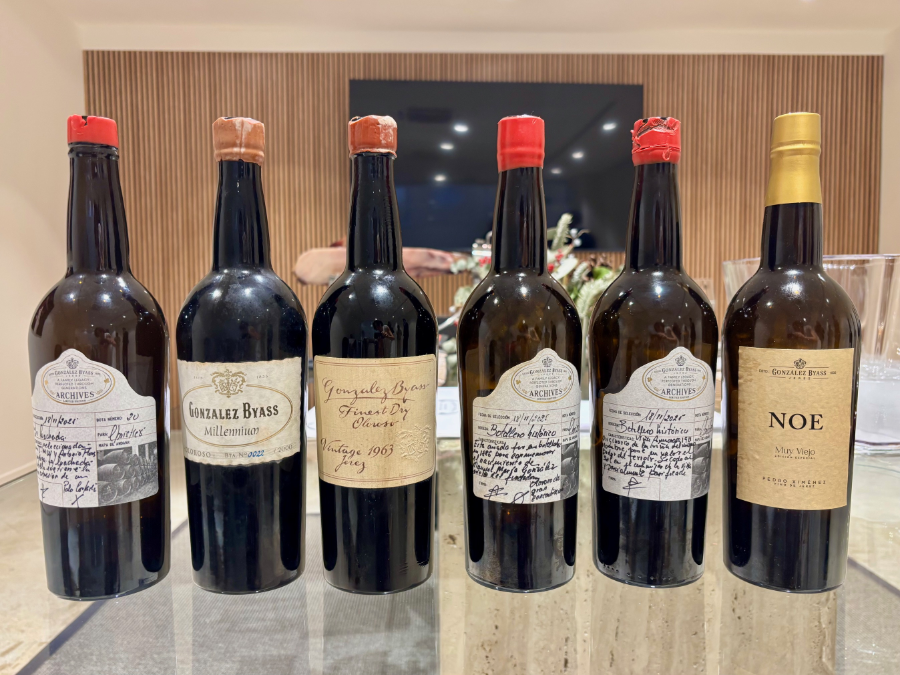
The sale also demonstrated the potential of historic wineryes to command attention in auctions. In fact, during the tastings organised around the event, González Byass presented a number of old wines that were not included in Christie's catalogue, among them two Oloroso sherries and the extremely old sweet Noé reviewed below.
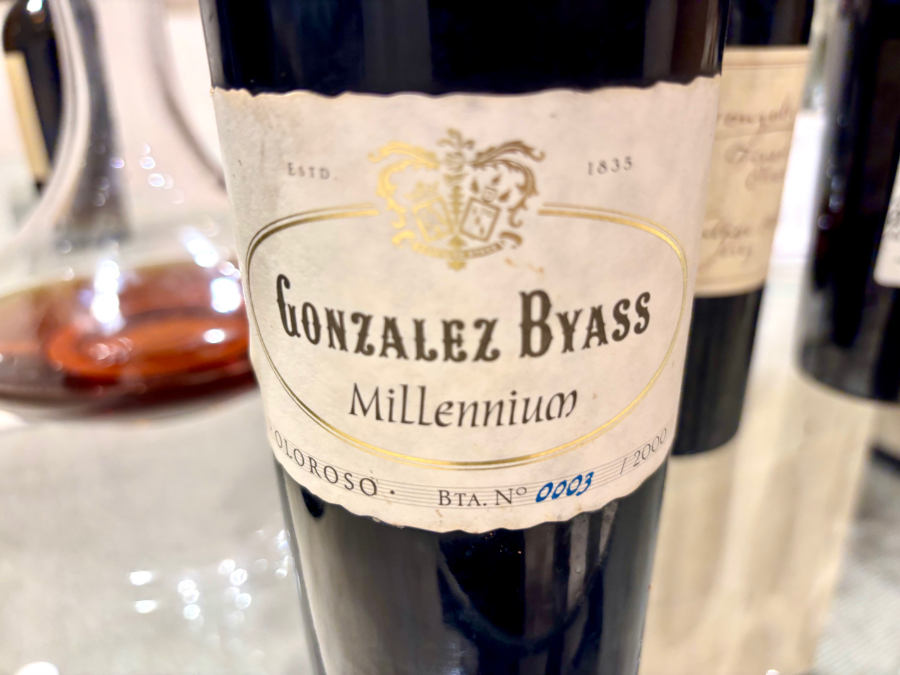
González Byass Millennium Oloroso. Designed as a liquid time capsule of the 20th century, this wine was the brainchild of Mauricio González-Gordon Díez. The blend was assembled from some of the finest vintages of the century and bottled in 2000. It contains remnants from 1902, 1917, 1923 (the year of his birth), 1935, 1946, 1957, 1962, 1977, 1983 and 1992. Both cask-aged and bottled wines contributed to the final blend. The wine displays aromas of antique furniture, sweet spices, liqueur fruit and hazelnut. It is incredibly concentrated on the palate, almost harsh and overwhelming, yet the warmth of the alcohol softens the finish.
González Byass Finest Dry Oloroso 1963. This was Gonzalez Byass’s first contemporary vintage sherry. Bottled in 1994, it was auctioned at Christie’s in London that same year under the direction of Michael Broadbent. Deeper in colour than Millennium Oloroso, it shows a golden-amber in colour and remarkable concentration. A very serious, concentrated wine, it displays old wooden furniture, toasted and nougat notes, with noticeable alcohol on the nose. The palate is powerful and extremely dry, finishing with notes of pistachio and caramel. It develops well in the glass. A total of 963 bottles were produced. Flores explained that, for vintage wines, a third of the cask's capacity is left empty to allow for oxidation. Once the wine is balanced with the wood, the cask is topped up almost to the brim to minimise evaporation and prevent excessive oak influence. Vintage wines were also used to refresh or top up certain soleras.
Noé Edición Especial Pedro Ximénez Sweet. “To make good wine, you have to use a lot of chalk and wear out your shoe soles,” says Antonio Flores. When he joined González Byass in 1980, he quickly developed a reputation as a relentless explorer of the winery’s cellars. This wine is the result of his talent for discovering hidden gems. It comes from a cask that was removed from its solera at Bodega de la Constancia. Flores estimates the wine to be around 80 years old.
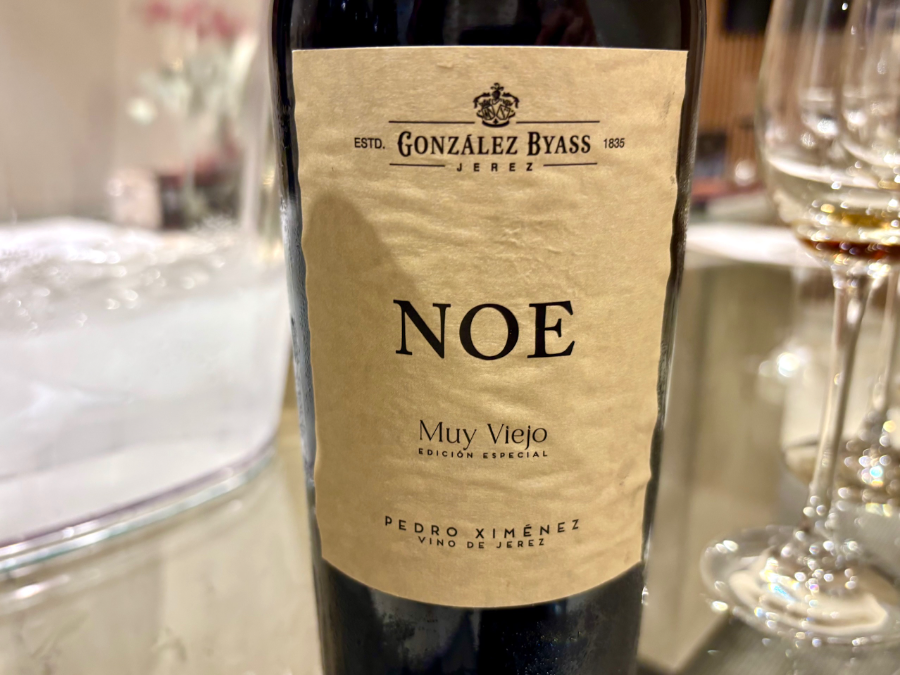
As expected from a PX of such age, the wine is virtually opaque, with a deep black colour and thick tears that move slowly down the glass. It has highly concentrated aromas of raisins, coffee, cream caramel and a hint of vanilla. Initially, it feels sticky, but the acidity and some fresh herbal notes soon come as a surprise. Bottle age has lightened and mellowed the wine’s structure, yet the finish still delivers intense notes of coffee, crème caramel and dark chocolate, lingering with great intensity.
González Byass at auction: All the lots in detail
Lot 1: two 75 cl. bottles
González Byass Olorosso 1886
González Byass La Cuadrada Palo Cortado Añada 1997
Estimate £: 1,200-1,800
Price realised £: 2,250
Lot 2: two 75 cl. bottles
González Byass Viña Amorosa 1911
González Byass La Cuadrada Palo Cortado Añada 1997
Estimate £: 1,500-2,000
Price realised £: 2,000
Lot 3: three 75 cl. bottles
González Byass Matusalem 1908
González Byass Matusalem 1909
González Byass Matusalem 1911
Estimate £: 3,000-5,000
Price realised £: 4,750
Lot 4: two 75 cl. bottles
González Byass Pío IX Moscatel 1846
González Byass La Cuadrada Palo Cortado Añada 1997
Estimate £: 2,000-3,000
Price realised £: 2,500
Lot 5: three 75 cl. bottles
González Byass La Cuadrada Palo Cortado Añada 1997
Estimate £: 900-1,400
Price realised £: 1,000
Lot 6: three 50 cl. bottles
Viña Dulce Nombre 1986
Estimate £: 240-350
Price realised £: 400
Lot 7: two 75 cl. bottles
González Byass La Cuadrada Palo Cortado Añada 1997
González Byass Palo Cortado Añada 1978
Estimate £: 600-1,000
Price realised £: 600
Lot 8: six 75 cl. bottles
Tío Pepe en Rama 2015.
Tío Pepe en Rama 2016
Tío Pepe en Rama 2019
Tío Pepe en Rama 2021
Tío Pepe en Rama 2022
Tío Pepe en Rama 2023
Estimate £: 200-300
Price realised £: 300
Lot 9: six 50 cl. bottles
Tío Pepe Fino 4 Palmas 2013
Tío Pepe Fino 3 Palmas 2014
Tío Pepe Fino 2 Palmas 2016
Tío Pepe Fino 1 Palma 2017
Tío Pepe Fino 4 Palmas 2019
Tío Pepe Fino 2 Palmas 2021
Estimate £: 600-1,000
Price realised £: 620

Author
Amaya Cervera
A wine journalist with almost 30 years' experience, she is the founder of the award-winning Spanish Wine Lover website. In 2023, she won the National Gastronomy Award for Gastronomic Communication
Previous Post
Next Post
Palo Blanco 2024 White