Very few people, even wine lovers, would instinctively associate Ibiza with wine. However, despite the pressure of tourism and real estate development, the island’s VT Ibiza designation covers 59 hectares of vineyards farmed by 34 growers. Of those, 25 hectares belong to Can Rich, a project established in the late 1990s that has gained renewed momentum under managing director Álvaro Pérez Navazo, who joined the estate two years ago.
After a long career at Abadía Retuerta, first as marketing director and later as head of the Terroir Academy, Pérez Navazo has found in this project —launched by his wife’s family—an opportunity to explore Mediterranean wines and delve deeper into the island’s varietal identity.
The winery produces 80,000 to 90,000 bottles per year, focusing mainly on whites and rosés. The main white varieties are Muscat à Petit Grains, Muscat of Alexandria and Malvasia. Monastrell is used to produce an interesting rosé, although DNA analysis has shown that the island’s plant material differs genetically from that found in mainland Spain. As a result, the possibility of renaming the variety Eivissenc (from Ibiza) is now being considered.
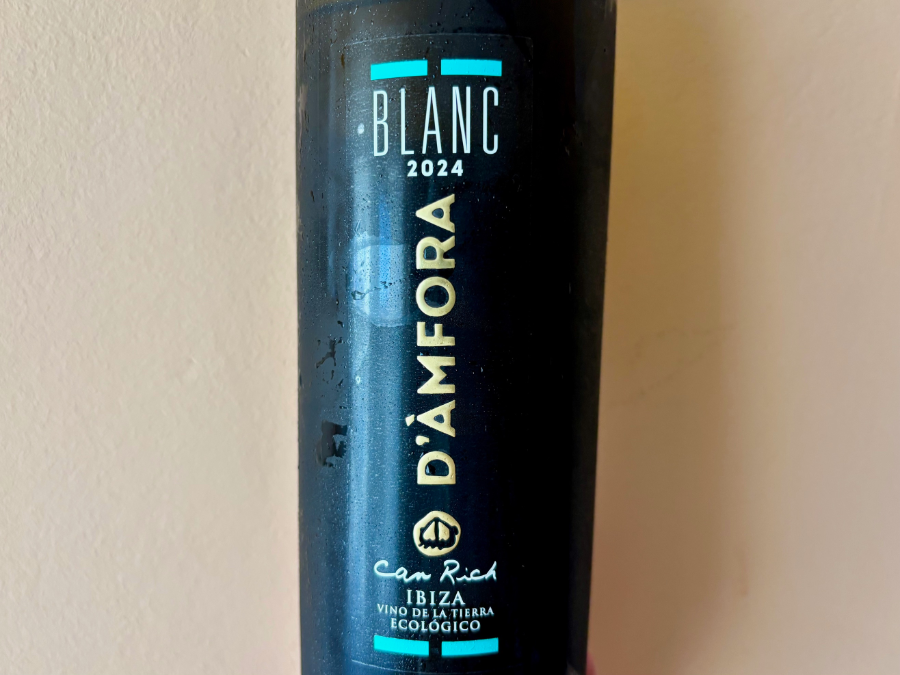
Another remarkable finding is that Ibiza’s ancient grape varieties appear to be unique to the island. They differ from those found in Mallorca, pointing to a high degree of insularity. Can Rich is actively contributing to their preservation through a grafting programme involving a selection of these recovered vines. While we await wines made from Grec, seemlingly akin to Malvasia, or from pink-skinned varieties with evocative names such as Lluquina and Vermellet, Can Rich’s white aged in amphorae offers a glimpse of the island’s character.
The wine is made from Muscat à Petit Grains, a variety with deep roots on the island that was formerly used to produce sweet wines from sun-dried bunches. The grapes are not sourced from the estate’s main vineyard in Sant Antoni de Portmany, but from Can Llaudis, a second site with 3,000 olive trees and five hectares of vines located to the south in Ses Salines Natural Park, close to the sea. The soils are loamy and sandy, and the grapes ripen much earlier here. In fact, the Muscat à Petit Grains was picked on 29 July.
The wine udergoes some skin maceration to build texture, but according to Pérez Navazo, it is the gentle oxygenationin amphorae that gives the wine more volume. Distinctly Muscat yet fresh and restrained, it displays herbal and floral notes (lavender) and hints of mandarin peel. This is a genuinely Mediterranean white: versatile beyond the aperitif and well suited to a wide range of light summer dishes. Its moderate alcohol content is much welcomed.
12.5% abv.
7,500 bottles
€18
Score: 91

Author
Amaya Cervera
A wine journalist with almost 30 years' experience, she is the founder of the award-winning Spanish Wine Lover website. In 2023, she won the National Gastronomy Award for Gastronomic Communication
Previous Post