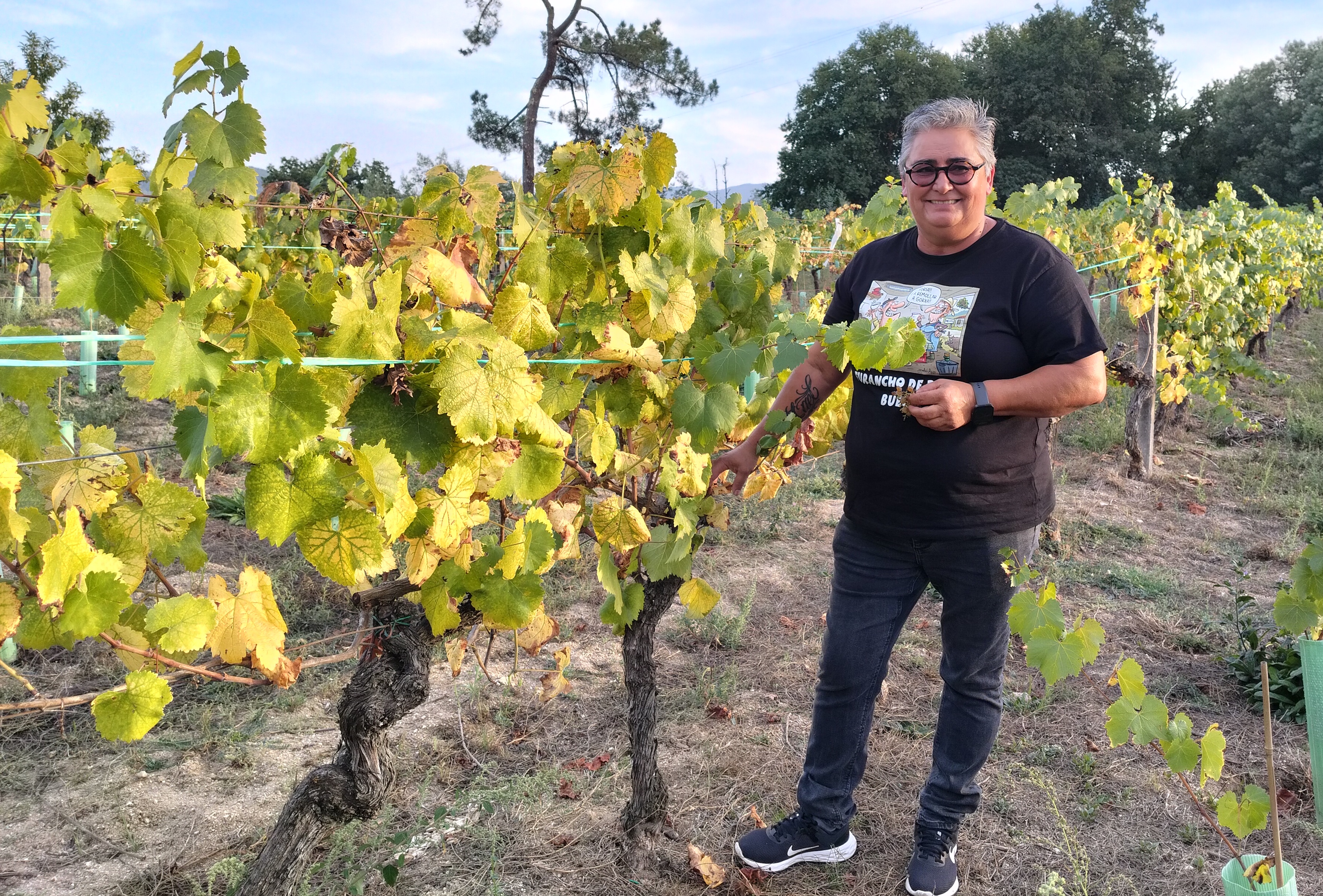
Xulia Bande’s life story is anything but conventional. Over the years she has been a bagpipe and saxophone teacher, a lorry driver, a viticultural consultant for nearly four decades, a winegrower since the age of 19 and, eventually, a winemaker by choice rather than design. Along the way, she has built —and rebuilt— a deeply personal project in Ribeiro, shaped as much by a lifetime spent working the vines as by a life marked by hardship and bold decisions.
Strong-willed, generous in spirit and resolutely independent, Xulia launched Son de Arrieiro with the 2014 vintage. It was not a calculated market move, but the natural outcome of a long professional journey. “I only started making wine once I knew exactly how I wanted to do it,” she says. And that how is inseparable from place, from decades of accumulated experience, and from her own way of understanding viticulture.
Vine growing was not initially a choice. Raised by her grandparents in the Arnoia valley, Xulia recalls a childhood spent in the fields when all she really wanted was to be playing in the village square. The turning point came when her grandfather fell ill and she began to help him in the vineyard. “Something just clicked,” she says. After his death, the vines were left untended for two years, but eventually she returned to them. “In the end, I went back —and that’s where it all began.”
For 38 years, she combined looking after the family vineyards with running a viticulture and oenology consultancy that advised other wineries. That period is essential to understanding Son de Arrieiro. “It was my real education. I saw how each variety behaved in every place, on every soil, in every valley.” She worked extensively in Ribeiro, but also in Rías Baixas and Portugal, particularly in the early years when opportunities at home were scarce.
Starting out at 19 and being a woman did not make things easier. “No one trusted me at all,” she recalls. For years, she had to send an older male worker to close contracts. “If I went myself, I didn’t get the job. That lasted until I was about 30.” The shift came when she began working with Altos de Torona in Tomiño, the largest vineyard estate in Galicia, with over 150 hectares. “From then on, it didn’t matter that I was young or a woman —although none of that would have happened to a young man. Still, something changed in people’s minds.”
The invisible house
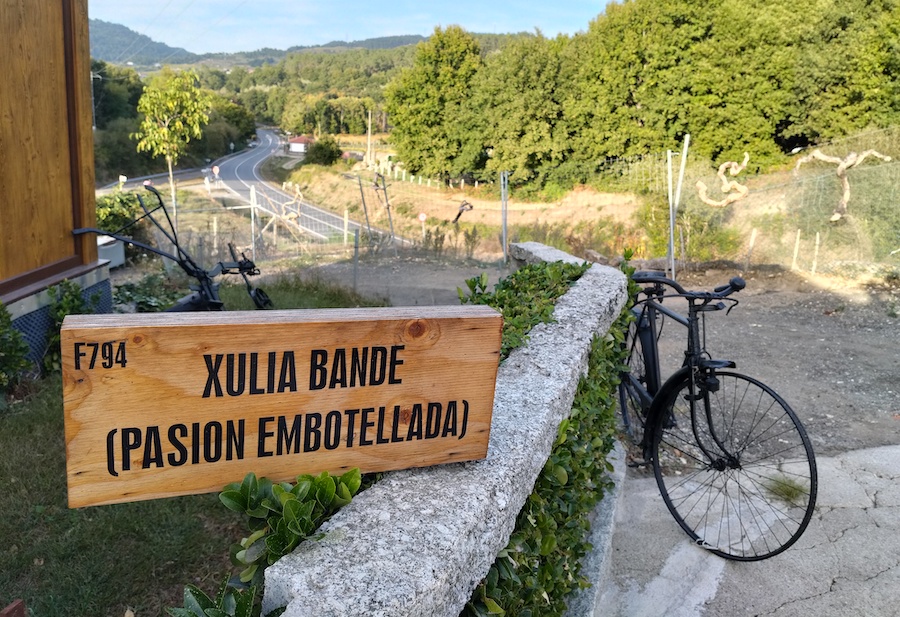
Like so many things in her life, the house where Xulia now lives and works, in the Avia valley near the monastery of San Clodio, was not part of a master plan. She found it almost by chance in 2000, shortly after freeing herself from an abusive marriage. She was looking for a fresh start and a place to store tools after taking over the business. “One stormy day a plank fell in front of my tractor. I stopped, thinking it was an animal, and saw a half-faded sign saying ‘house and land for sale’.”
There was no house in sight —just scrubland and forest. She rang a barely legible number for days until someone answered from Vigo. “They told me: the house is down there, you just can’t see it. Go in.” Most people would have turned back, but Xulia returned that same afternoon with a sickle and waterproofs. For days she found nothing, until one day, walking down a rocky path, she hit her head. “I looked up and thought: bloody hell, the house. There you were.”
The building was literally set into the rock. Beneath the house was a cavity that had once served as a cellar, with naturally stable temperatures and gravity-fed flow. “When I saw that, I thought: this is it.” She rebuilt the house using stone and wood, preserving old floors and thick walls. In 2012, just as the work was finished, an electrical fault caused a fire that destroyed everything. “Everything except what I was wearing,” she says. “The car and I were all that was left.”
It was a devastating blow, but also a turning point. With her energy, her ability to keep going and the support of her partner of 18 years, Benigno Freijedo —Beni— she rebuilt once again. Today the property combines home, winery, tasting room and a small organic garden with hers, trees and vegetables. “This house was meant for me,” she says. “My wine is called Son de Arrieiro in honour of my grandfather, who was an arrieiro, carrying wine to Pontevedra and bringing back octopus. And it turns out the old muleteers’ route passes right by the house —I lived here for 10 years without knowing it.”
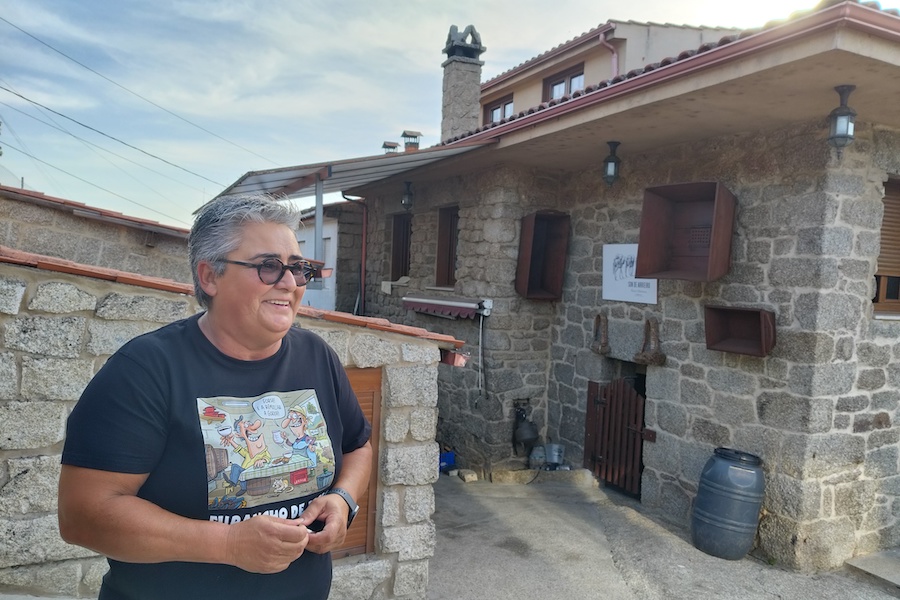
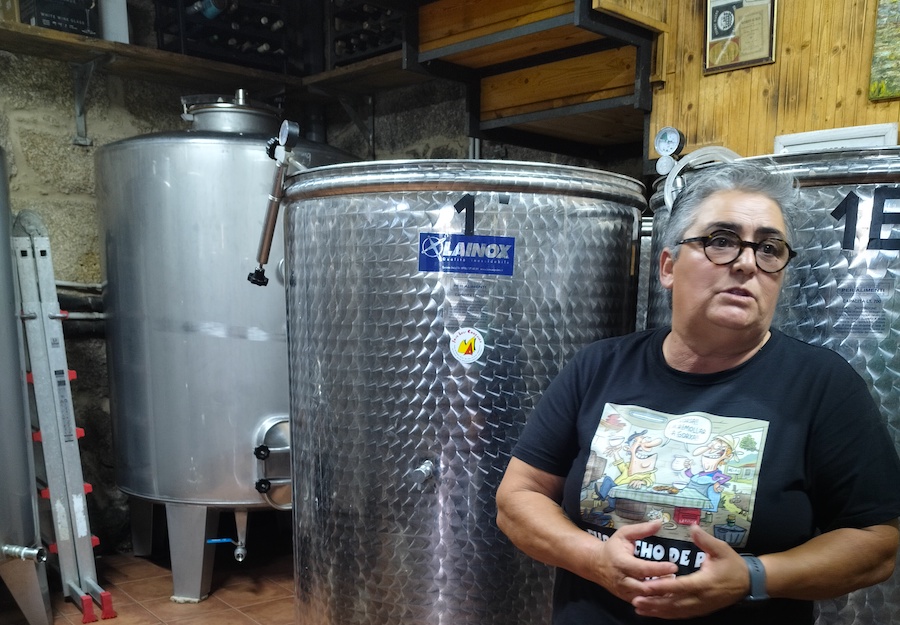
At Son de Arrieiro, there is no clear line between life and work. “This is my home, my winery and my office,” Xulia explains. She lives among the vines and welcomes visitors in the same space where her wines ferment and age. The winery, carved into the rock, maintains a steady winter temperature of around 14 ºC and allows the wines to be moved by gravity, without pumping.
Space is limited and dictates everything. There are many small tanks, countless micro-vinifications and a distinctly hands-on logistics. “Sometimes we play Tetris. We ask each other’s permission just to get in and out,” she jokes.
As visits increased, she made a practical decision: turning a swimming pool into a tasting room. “Nobody ever used it and I spent my Sundays cleaning it. Now it’s a tasting room and extra storage.” For Xulia, welcoming people is part of the project. “After years of me travelling everywhere, now people want to come here and see the vines, the sheep, the cellar. To see that what I say is actually true.”
Four hectares and three valleys
Son de Arrieiro’s vineyards cover around four hectares, split into numerous small plots across the three historic valleys of Ribeiro: Avia, Arnoia and, to a lesser extent, the Miño. “I’m looking for different soils, exposures and climates,” Xulia explains. “Not because they’re better, but because they’re different.”
The fragmentation is extreme. In Arnoia alone, one hectare is made up of 178 tiny plots gradually pieced together over time. “It’s madness, but that’s how things are here.” With one exception, all the vineyards are owned by Xulia and were bought from retiring growers. They are also deliberately isolated from neighbouring plots to avoid contamination from systemic treatments. “I haven’t worked this way for 10 years just to have a neighbour ruin it,” she says, standing in a vineyard surrounded by woodland. Apart from harvest time, all vineyard, winery and office work is handled by Xulia and Beni.
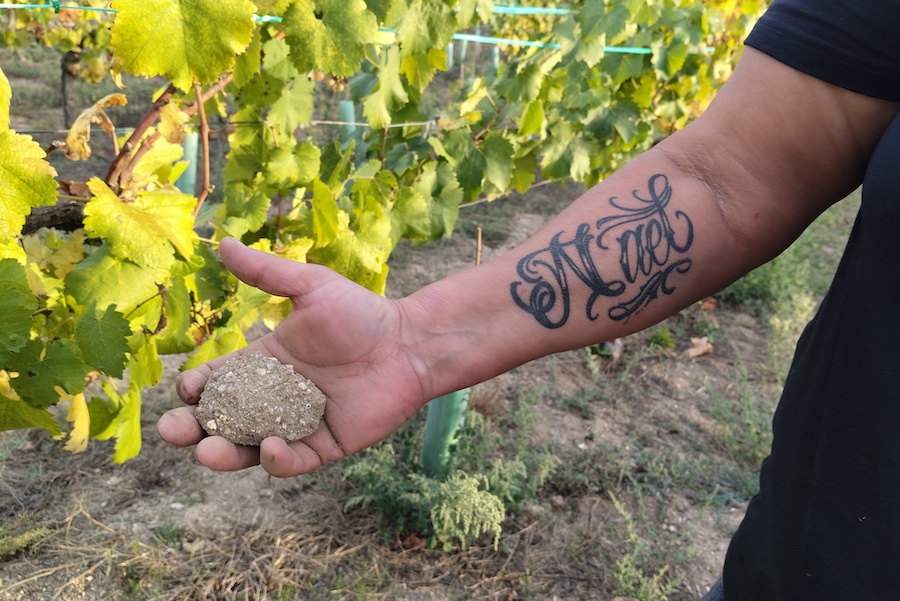
In a region rich in native varieties, each valley brings different nuances because soils, exposures, elevation and climate vary so widely. “They’re like natural amphitheatres, valleys surrounded by mountains. Not a single vineyard is the same.”
Avia is, for her, “the Treixadura valley par excellence”; in Arnoia, Lado and Loureira shine; while in the Miño, depending on soil type, Godello shows very different profiles, particularly on river pebbles. “A Godello on slate has nothing to do with one on pebbles. That’s where you really see the soil.”
Work in the vineyard follows an organic approach adapted to Galicia’s conditions. Xulia avoids systemic products and relies on canopy ventilation as her main defence. “Making organic wine in the cellar is fairly easy; doing it in Ribeiro’s vineyards is almost impossible. Either you compromise, or you lose the crop.”
She keeps permanent ground cover, uses only her own compost and avoids sowing artificial cover crops. “The plants already tell you what the soil needs. Fern means acidity; clover means potassium. Why plant something that lies to you?” Her 12 sheep play a key role too. “They’re my mowing squad,” she says, watching them strip vegetation up to vine-head height. They make pre-pruning easier, add organic matter and reduce mechanical work.
Recent climate conditions have added further pressure. The 2025 harvest was especially harsh, with white grape yields down by 51%. “It was a disastrous year —and the one before wasn’t great either.” Drought has even forced her to consider supplementary irrigation for new plantings. “I don’t want irrigation in my vineyards, but in the first year I won’t let them die.”
Varieties, micro-vinifications and time
Xulia carries out her own clonal selection from old vines and works with traditional Ribeiro varieties: Treixadura (“small berries, thick skins, little juice”), Lado, Loureira, Godello and Albilla do Avia for whites; Sousón, the various Caíños, Ferrón, Brancellao and Espadeiro for reds. She has always championed the region’s red wine potential. “Ribeiro was always a red wine region. People think it’s about whites, but it isn’t.” Of the authorised varieties, 17 are red, compared to 32 white. She also avoids grapes that never truly adapted to the area. “Ribeiro’s failure was planting varieties that didn’t ripen here. Then people complained the wines were acidic —but they were simply green.”
In the cellar, every plot and variety is vinified separately, with gentle extraction, no filtration and minimal sulphur. Oak —500-litre French barrels— is used sparingly and for short ageing. “I want it to show a little, but not take away the fruit.”
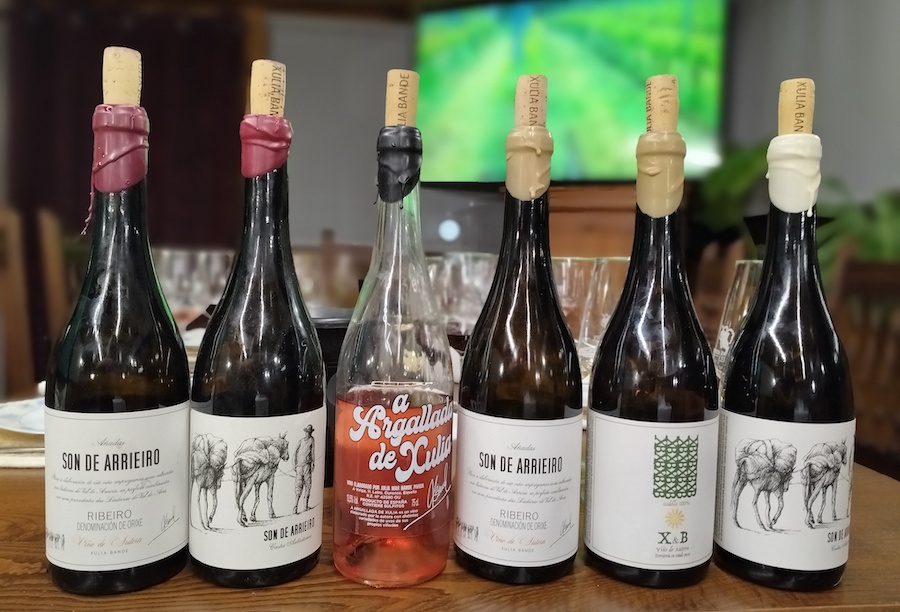
Production ranges between 15,000 and 18,000 bottles depending on the vintage, across half a dozen wines. All ferment with native yeasts and spend at least two years in the cellar before release. The first wines were Son de Arrieiro white and red (4,000 bottles each, €22), with labels showing her grandfather and his mules leaving Ribeiro. The white, a blend of Treixadura from Avia with Lado and Loureira from the higher slopes of Arnoia, is fermented in stainless steel and aged for a year without oak. Fresh, saline and energetic, it evolves well in both glass and bottle. The red blends Ferrón, Sousón, Brancellao and Caíño Longo from old Arnoia vines. After a short cold soak of four to five days, it ferments in steel, resulting in a juicy, expressive wine with vibrant red fruit and deeper dark-fruit notes.
Blending vintages
One of the project’s most distinctive features is its multi-vintage wines. “I wanted to see how wines evolved, so I started saving 100 or 200 litres from special years,” Xulia explains. When the number of tanks became unmanageable, she decided to blend complementary vintages. “A warm year gives fruit, a cool year gives acidity, and a third balances it all. That way I don’t need to correct anything.”
Although the idea initially met resistance —“it had never been done before”— the DO eventually approved the wines, since all vintages were certified, even if they cannot be listed on the label. Embracing the independent spirit, Xulia describes them as vinos de autora.
The production process for the Añadas wines is long. Xulia first selects around 1,000 litres in total of both the white and red Son de Arrieiro from each vintage —sometimes two, sometimes three, sometimes four different years. Each vintage is then kept separately for around 20 days in new 500-litre French oak barrels (in the case of the red, it spends a full month in the barrel previously used for the white). After this stage, each vintage is transferred individually to tank, where it remains for a further year before the final blend is assembled. The wine is then bottled and left to rest for yet another year, which means these wines do not reach the market until eight or nine years after the first vintage. “It’s a huge risk,” Xulia admits. “You have a lot of money tied up down there.” What started as a production of 1,500 bottles is now close to 3,000, sold at around €30 a bottle. “But if you don’t take risks, you don’t get those wines.”
Both the white and the red are expressive, highly personal wines with real textural presence. Any initial imprint of the oak quickly fades into the background, allowing the wines to open up in the glass, gaining depth and complexity as they breathe.
Alongside the Godello with lees X&B —a tribute to Beni, from a pebble-rich parcel by the Avia river— Xulia’s small argallada —a Galician word meaning a playful mischief— is A Argallada de Xulia (around 1,000 bottles, €25), a rosé made from all six traditional red varieties of Ribeiro. Sold outside the DO because rosé is not recognised, it is produced by direct pressing and results in a fine, fresh, savoury wine with red fruit and herbal notes. Demand is so strong that it often sells out before bottling
Restless and short on sleep, Xulia also makes herbal liqueurs from her garden, xuropía (“the poor man’s tostado, which is Treixadura must fortified with alcohol”), and is experimenting with an orange wine that may or may not see the light of day.
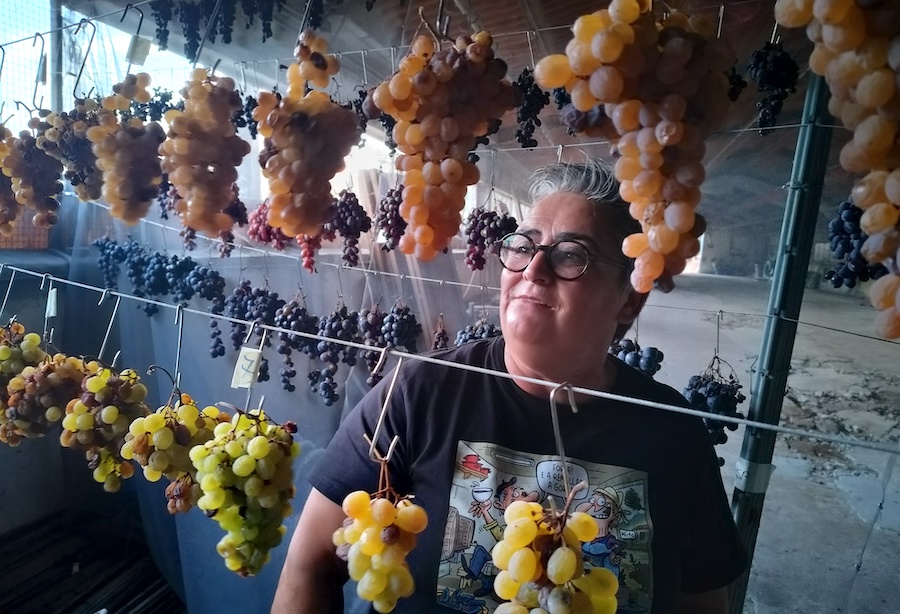
Her most recent project is a traditional tostado made against the grain, using mainly red grapes —including Garnacha Tintorera— with a touch of Palomino. In 2025, despite the small harvest, she set aside 1,500 kg of grapes and hung them to dry in a carefully adapted former chicken shed fitted with mosquito nets. Picked almost unripe in August, the grapes benefited from warm nights and low humidity. “Yields are tiny and it’s a huge amount of work —you have to come almost every day to remove damaged grapes—but I don’t mind,” she says with a smile, in that easy, down-to-earth way that comes so naturally to her. “I’m happy living with my madness.” If the result is good, she plans to build a sturdier drying cabin next year to keep out insects, including Asian hornets.
Asked about the future, Xulia is pragmatic. The next generation is interested in the vineyards, less so in the winery —at least for now. She has two grandchildren, aged six and two, and hopes that if they ever choose to return, they will find the land alive and well cared for. The wider picture, however, is worrying. More and more vineyards are being abandoned in Ribeiro, and those who remain are few. Well-funded groups from other regions have brought renewed activity, but not always to the historic vineyards, which are harder to work and impossible to mechanise. Meanwhile, many traditional plots —the true wealth of Ribeiro— are slowly being reclaimed by scrub.
In that context, Son de Arrieiro does not claim to be a model or a solution, but simply a possible continuity: a Ribeiro built on diversity and tradition. The rest will depend on time —and on whether someone emerges with the energy and work ethic embodied by Xulia Bande today, something about as rare as a DO-approved rosé in Ribeiro.

Author
Yolanda Ortiz de Arri
A journalist with over 25 years' experience in national and international media. WSET3, wine educator and translator
Previous Post