One of the less obvious but decisive influences on Domaine Dexaie’s rise as one of the most promising projects in Gredos is José Luis Mateo. When Emmanuel Campana, an Argentine winemaker raised in Chile, called him about working together in Monterrei, the response was hardly encouraging. “I can’t teach you anything —you won’t learn from me,” the Galician grower told him, not without reason given Campana’s track record across Chile, Argentina, Napa, the Rhône and Chianti. Nevertheless, Campana persisted. “I kept pushing until he finally said, ‘fine, come’.”
The 2019 harvest at Quinta de Muradella marked a turning point. “It gave me back my enthusiasm for wine. I’d become disillusioned with the industrial side, and José Luis showed me another way of understanding it —as a life project, something honest, something with real generosity.”
From that moment, Campana knew he wanted to build something of his own along those lines. His partner, the Cádiz-born winemaker Carmen de la Pascua, who had been working in Jerez with Willy Pérez, joined him without hesitation. The two had met several years earlier at Matetic in Chile, where organic and biodynamic farming were embedded in a broader, estate-wide vision.
Another Galician connection nudged them towards Gredos: their friend Roberto Núñez, formerly at Comando G in the area and now behind A Barouta in Ribeiro, encouraged them to visit. The rest came down to instinct and, crucially, an opportunity that arose in 2021 with Basque entrepreneur Luis Villar, who had quietly acquired several vineyards in the Alto Alberche. Villar, a man who avoids publicity and invested in the area for family reasons, offered them full control of the project, with complete freedom in both vineyard and cellar.
Carmen and Emmanuel did not hesitate. “In Chile we were working in a large valley with alpacas, sheep and so on —we were thinking in terms of a whole farm rather than just vineyards. Luis immediately understood what we were looking for and aligned with us: to start from the vines, but with the idea of building something broader: a place, a landscape,” they explain. “He lets us get on with it, and that’s essential. Today we already have four zones, all in Navarrevisca.”
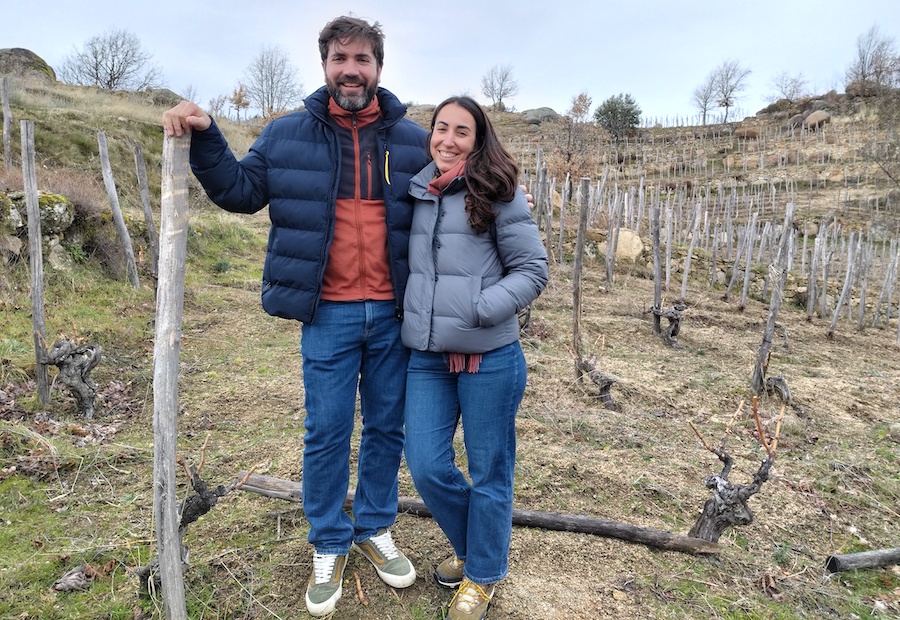
The name Dexaie, a Norman Latin prayer meaning “may God help us”, is both an appeal to nature and a statement of intent. “Nature is clearly in charge, along with the grapes, the climate and the soil, but people matter just as much,” they say. The team currently consists of four additional workers across vineyard and cellar.
Navarrevisca: the heart of the project
At around 1,100 metres elevation, Navarrevisca forms the core of Domaine Dexaie’s vineyards. In this village in southern Ávila, vines were once part of a subsistence economy, divided into small plots that families farmed for their own consumption. Over time, many were abandoned, leaving behind a fragmented landscape of old vines and overgrown paths.
“You meet an elderly man in the bar who tells you he used to harvest his mother’s vineyard —which no longer exists,” says Emmanuel. “There are vineyards everywhere, but they’re scattered and hidden.” Reassembling that mosaic is, in many ways, the starting point for the project.
Unlike areas such as Cebreros, further east, constant winds sweep through here via the Serranillos and Mijares passes, the two natural corridors that shape the landscape. “You need a lot of energy and enthusiasm to come here, otherwise you’ll turn back in your first year,” Emmanuel admits. Like others in the Alto Alberche, they contend with frost, hungry deer and wild boar, dry summers, recurring wildfires and erratic rainfall. Add to that the low yields of old vines —often impossible to mechanise— and the scarcity of infrastructure and labour. “There are many obstacles, but they also become strengths, and that’s the beauty of this place. Anyone who settles here to make wine has no choice but to care deeply for the project,” they explain. The couple live in Burgohondo with their daughter, born in the area.
A jewel called La Camilleja
The estate currently covers around 14 hectares, with plans to grow modestly to 16 or 18, always within Navarrevisca. It is a patchwork of small plots: some well preserved, others recovered from abandonment, others replanted. “Our youngest vineyard dates from 1960,” says Carmen. “Then there’s a huge gap —people left and nothing was replanted for decades.”
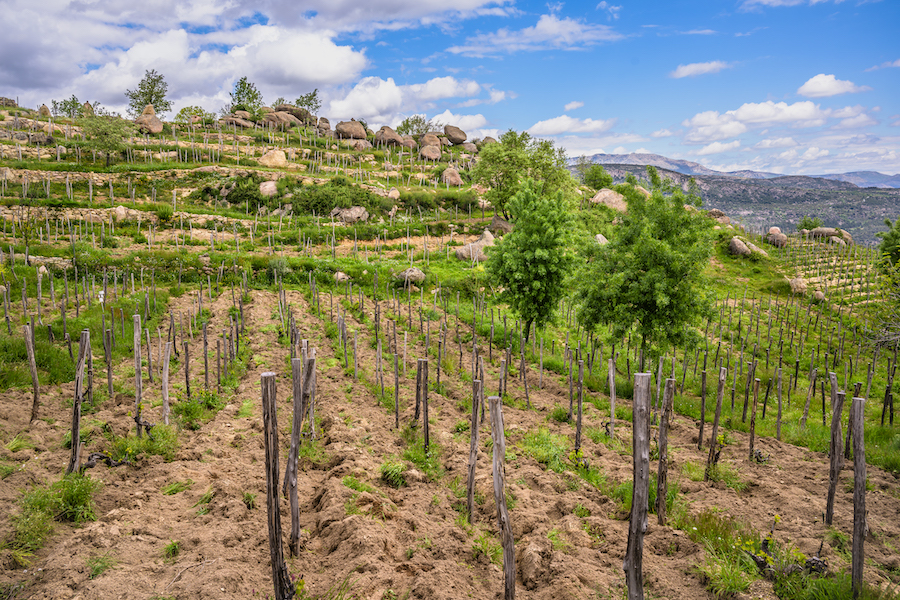
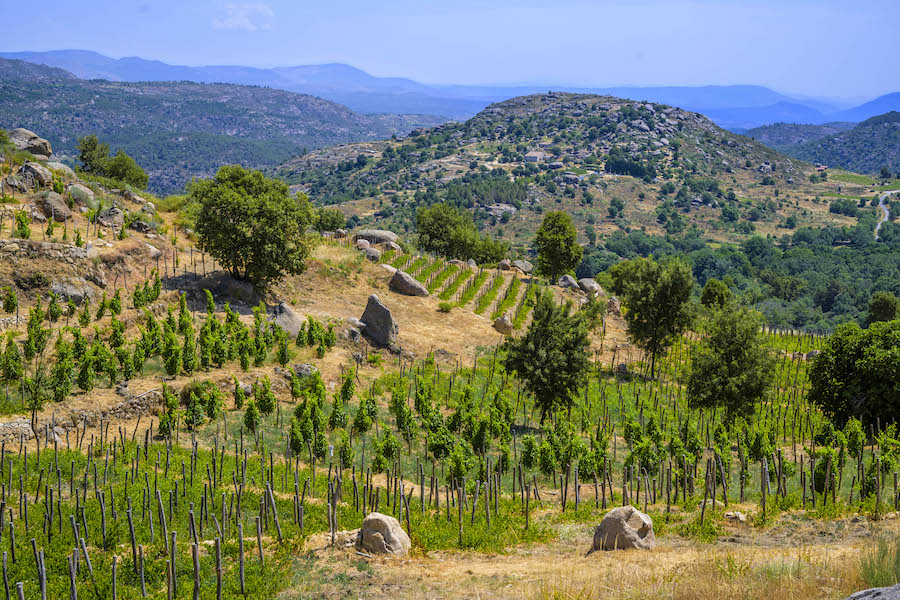
Domaine Dexaie is working to fill part of that gap. Its most emblematic site is La Camilleja, a striking hillside at over 1,000 metres elevation, with terraces reminiscent of the northern Rhône —a region that has strongly influenced them— yet defined by the enormous granite boulders that define the Gredos landscape.
When they arrived, many of the plots were overgrown, vines hidden and dry-stone walls badly deteriorated. “We wanted to plant from the outset, but realised we first had to rebuild,” they recall. “The first year was spent simply clearing, restoring walls and terraces, and preparing the ground.”
Since then, progress has been slow and deliberate. They have bought and consolidated parcels within the site —navigating the administrative complexity of managing around 300 deeds— recovered old Garnacha vines, replanted missing plants and developed their own massal selection from the best material. Some of this is grafted on the vineyard, while some is sent to the nursery. “That way we preserve the identity of what was already here. We want these vineyards to last 200 years, but that requires constant renewal; without young vines, there is no future.”
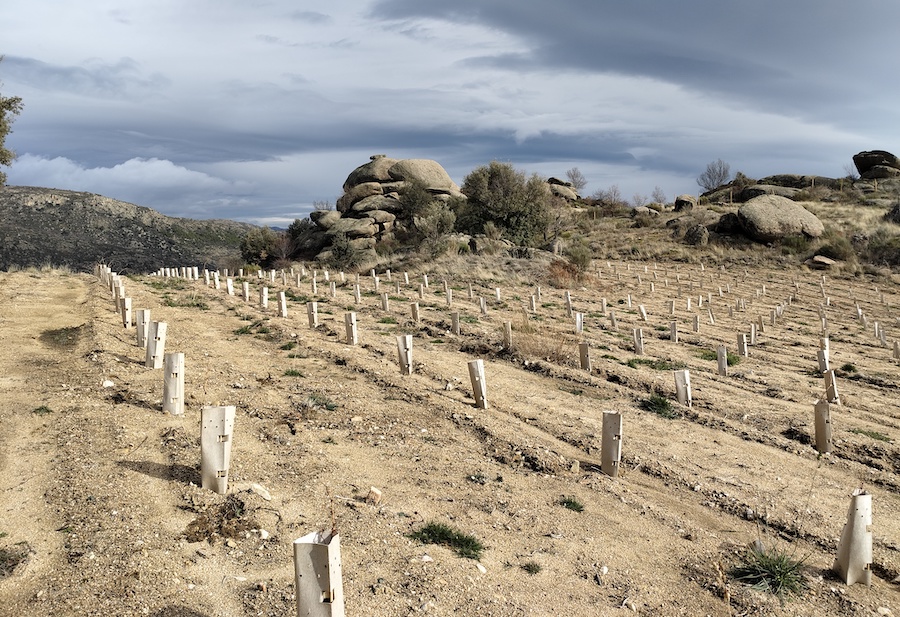
Around La Camilleja —primarily east-facing, but with plots at different elevations facing south and north— they have added new areas such as Las Colmenas (around 3.5 hectares recently planted) and small terraces in sites like Carrascalejo, barely 500 vines in a hard-to-access location where soil differences are already reflected in the wines. “Some areas are more clay-rich, others more sandy —and the wines show it,” says Emmanuel. “That’s what interests me. We don’t want to impose differences through viticulture; we want the place itself to express them.”
Viticulture in search of balance
Granite is the common thread, with sandy soils and small proportions of silt and clay that help retain water and nutrients —particularly important in hot, dry summers. Orientation, however, introduces crucial variation. “The north-facing slopes evolve very differently from the south-facing ones, and what grows there is different. One receives more rainfall; the other more heat. Over 300 million years, those differences have become very pronounced,” explains Emmanuel, drawing on his experience with granite soils in Chile.
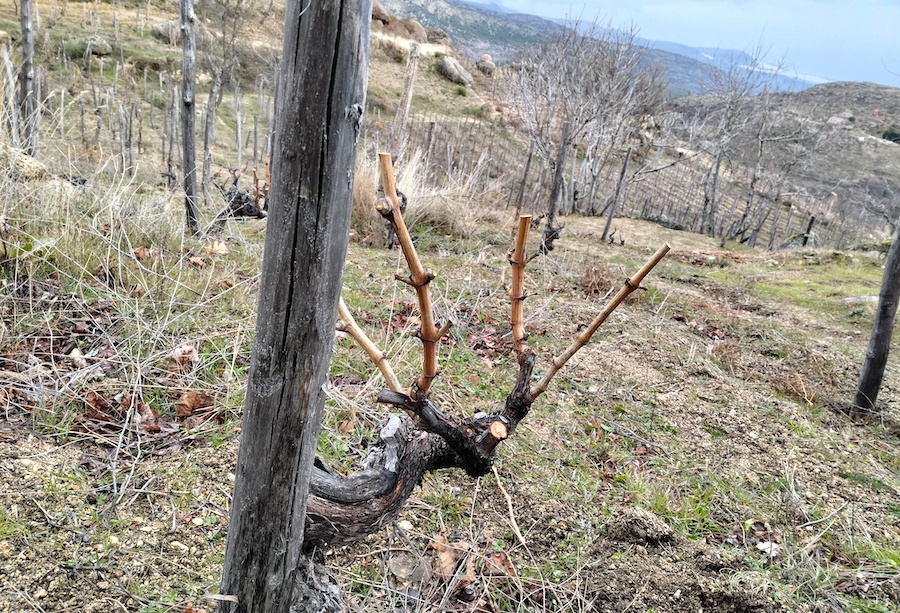
Garnacha dominates, with the occasional Tempranillo vines and minor varieties such as Malvar, which they largely leave for the birds. Harvest is carried out parcel by parcel, with differences of up to two weeks within the same site. Their approach to viticulture is focused on balance rather than concentration. “We’re not looking for high yields,” says Carmen. “We prefer less fruit, but more balanced, juicier bunches.” Part of that work involves protecting the grapes from direct sunlight. “Garnacha wants warmth, not direct sun. Our job is to create shade.”
They farm organically by conviction and are currently in the process of certification, though they acknowledge the advantage of working in a relatively isolated area—one of the reasons they invested in La Camilleja. They also adapt their practices to the climate, delaying tillage —done with a mule in parcels with a tighter planting layout— and pruning in order to postpone budbreak. They leave four shoots to ensure a crop in the event of early frost. The aim is to grow resilient plants that, together with the site and soils, give their wines a clear identity, while accepting that every year is different. “Here, you never quite know what will happen,” Emmanuel sums up. “And that, too, is part of the project.”
Domaine Dexaie’s winery is open-plan, functional and fully equipped. It occupies an industrial unit in Navaluenga, a 20-minute drive from the vineyards —a practical solution given the lack of suitable space in Navarrevisca. “We decided the energy had to go into the vineyard,” Emmanuel explains. “We considered building something from scratch, but it felt too ambitious at the start."
They work with a wide range of vessels —stainless steel tanks, concrete eggs, demijohns, vats and barrels— on a small scale consistent with the project. The approach is low-intervention but precise, with whole clusters used in much of the winemaking and grapes foot-trodden. “We like the texture it gives,” says Carmen, “and the way tannins can transmit the character of the soil.”
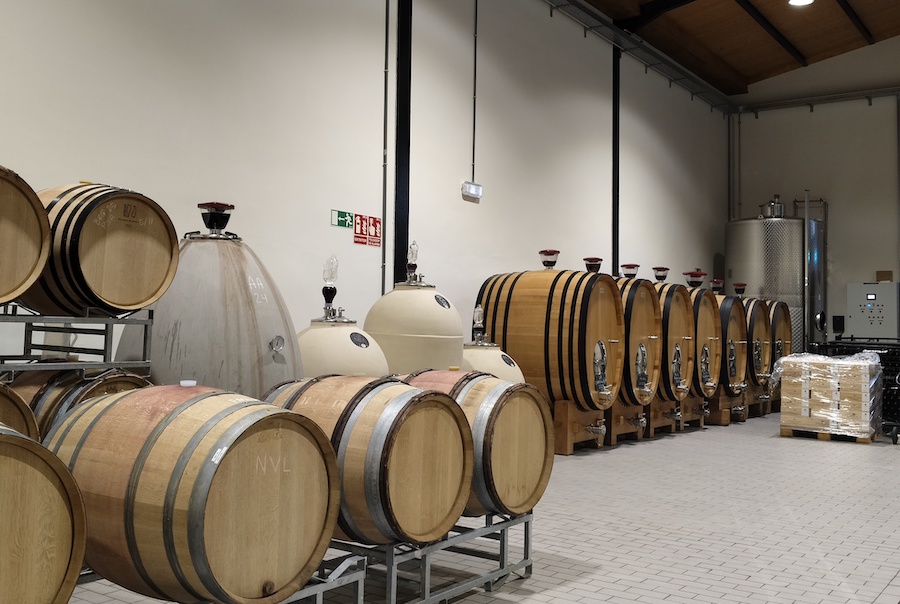
As with the harvest, fermentations are carried out separately by parcel, always by gravity, with long macerations —between one and two months— and gentle pump-overs. Ageing takes place in both concrete and oak, in different formats, for around 16 to 18 months. The wines are neither fined nor filtered, and sulphur is used judiciously to produce wines that, as they put it, “can age without losing their natural character.”
The wines
Their first harvest, in 2021, was made in near garage conditions and never released, but the wines —despite being experimental— show striking energy and quality. “That first year we brought in 800 kilos; now we’re close to 4,000,” says Emmanuel. “Gradually you start to see the work paying off.”
In 2022 —a dry, warm vintage in contrast to the previous year— they again made a small quantity of wine from their own vineyards, but as the winery was still under construction and lacked the necessary sanitary permits, the wines were not released. Production remains limited, but the project began to take shape in 2023 with two wines on the market.
Alto Alberche 2023 is their first commercial release (5,800 bottles, around €45), made from both estate fruit and grapes sourced from growers in Burgohondo and Navatalgordo. “It’s both a valley and a mountain wine,” Emmanuel explains. “It combines the fruit and freshness of the valley with the minerality and finesse of the mountains.” La Camilleja 2023 (2,300 bottles, €130) is the single-site wine, sourced exclusively from their mountain vineyards. It is deeper and more structured, with mineral and spicy notes, a more defined character and a broad palate with a long finish.
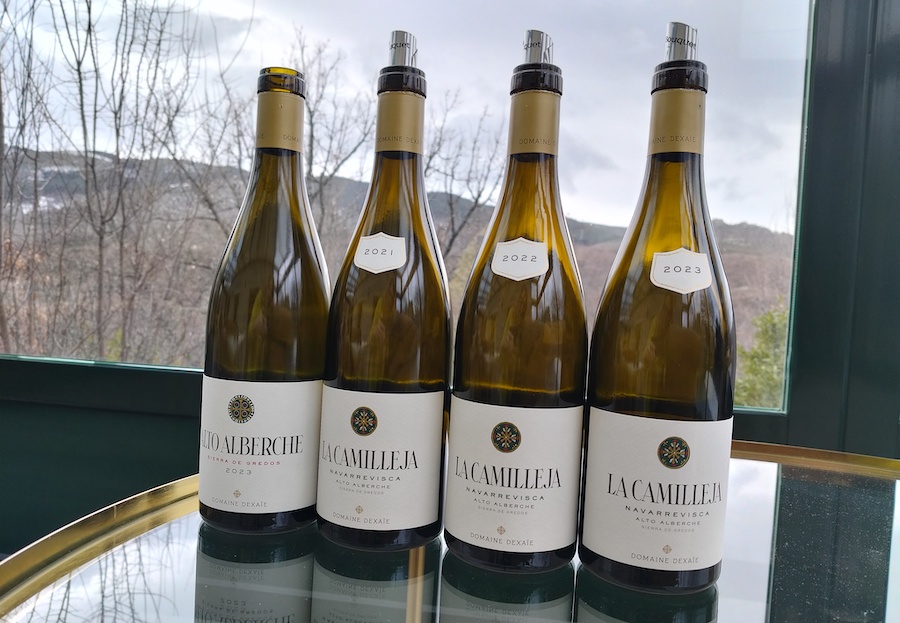
For the 2024 vintage, they expect to release around 1,500 additional bottles across both wines, and they are also ageing another La Camilleja cuvée from a part of the vineyard with more clay-rich soils, which lend extra depth. “We’ve made 2024 and 2025, but we want to take things slowly to ensure that when the wine is released, it truly makes sense,” they say.
They expect this new wine —still to be defined— to sit stylistically between Alto Alberche and La Camilleja, but are clear that nothing will sit below that level. Despite relatively high prices (“we have to justify them through consistency and hard work”) and the youth of the project, they have already sold 80% of production, mainly in Italy, Switzerland and the United States. Distribution in Spain is handled by Ithaca Wines.
The start has been promising, but their outlook is firmly long-term. “Our great wine will come in 20 or 30 years,” say Carmen and Emmanuel, who are also considering planting white varieties, convinced of the area’s potential. In a region where wine was historically drunk young, the challenge is to build something enduring.
“In the end, it’s about leaving something behind. I think what all the producers are doing here is incredibly important in giving the area a future,” Emmanuel concludes. “My hope is that those who come after us will see these vineyards and feel what we felt when we first saw La Camilleja."

Author
Yolanda Ortiz de Arri
A journalist with over 25 years' experience in national and international media. WSET3, wine educator and translator
Previous Post