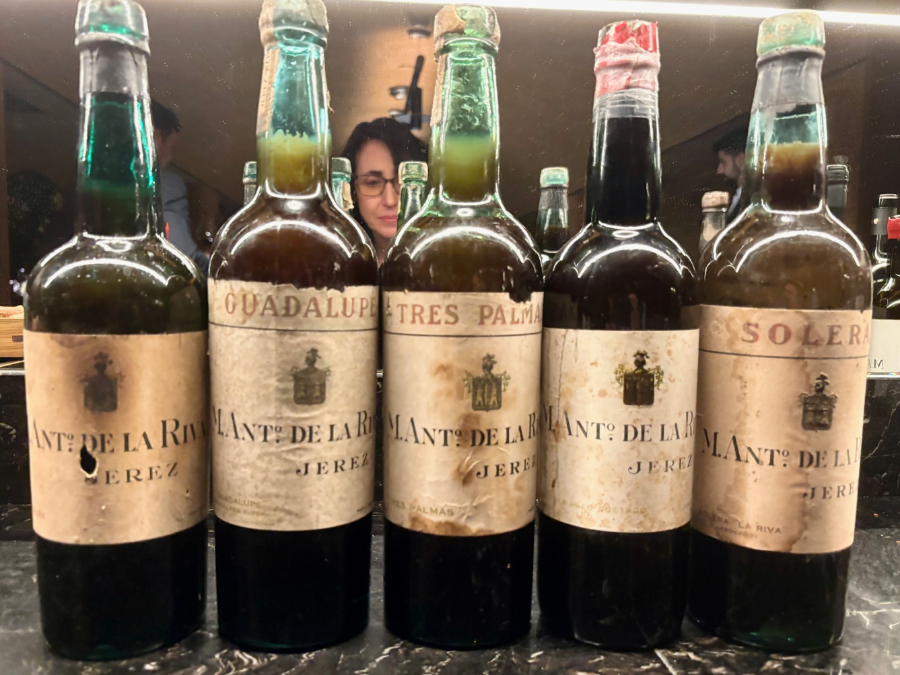
After profiling De la Riva in 2023, SWL had another chance to taste its historic wines alongside the modern range created since Willy Pérez and Ramiro Ibáñez revived the brand.
For two of Jerez’s most innovative figures, reviving the winery founded in 1858 by Manuel Antonio de la Riva y Pomar —after he purchased a business started by a relative in 1776— held a double attraction. With as many as 53 hectares in Pago Macharnudo, De La Riva was one of the few wineries in the area whose identity was firmly rooted in terroir. When Pedro Domecq bought the estate in the 1970s, however, its wines disappeared into the vast Domecq portfolio. Equally valuable was the pair’s access to the vineyard ledgers and winemaking records preserved by Willy’s father during his time as technical director at Domecq.
On this occasion, the historic wines were generously supplied by Luis Baselga, sommelier at Leña and Smoke Room restaurants in Madrid. Baselga felt that bottles of this calibre deserved more than another wine-pairing dinner, so he invited the two winemakers and a small group of wine professionals and enthusiasts for a truly memorable lunch at Leña. Some of us had also attended the tasting held three years earlier: Raúl Barroso, our host at Las Esparteras restaurant in Toledo; Borja Beneyto, co-founder of the Brandelicious communication agency; and Raúl Álvarez of Vinnac, who distributes De La Riva’s wines.
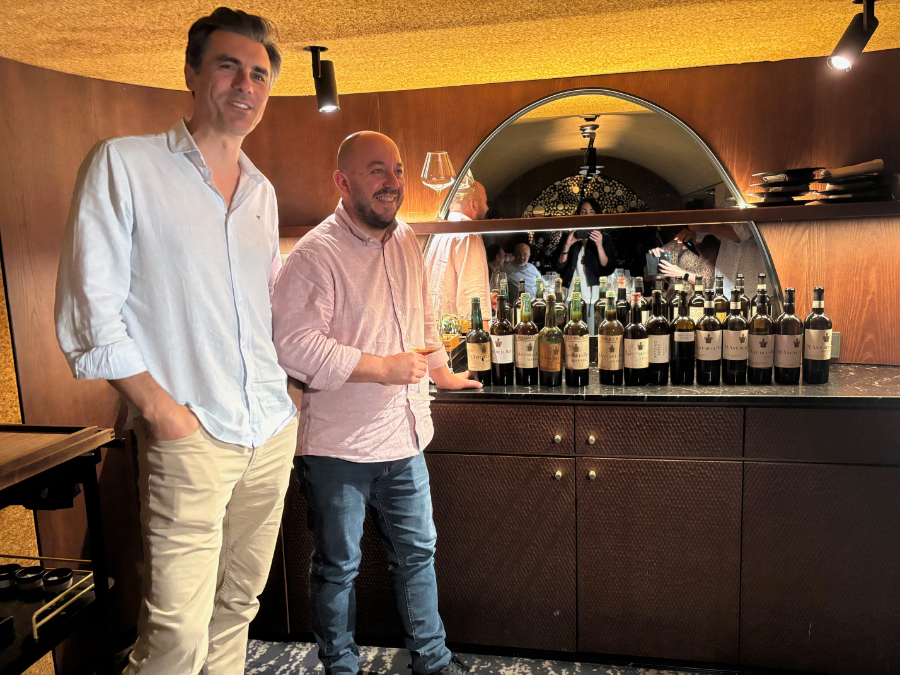
Some of the wines had already featured at the Las Esparteras tasting, but the old bottles were from a different era. The photograph at the top of this article shows the wines tasted at Leña, while the image below features the ones opened three years ago.
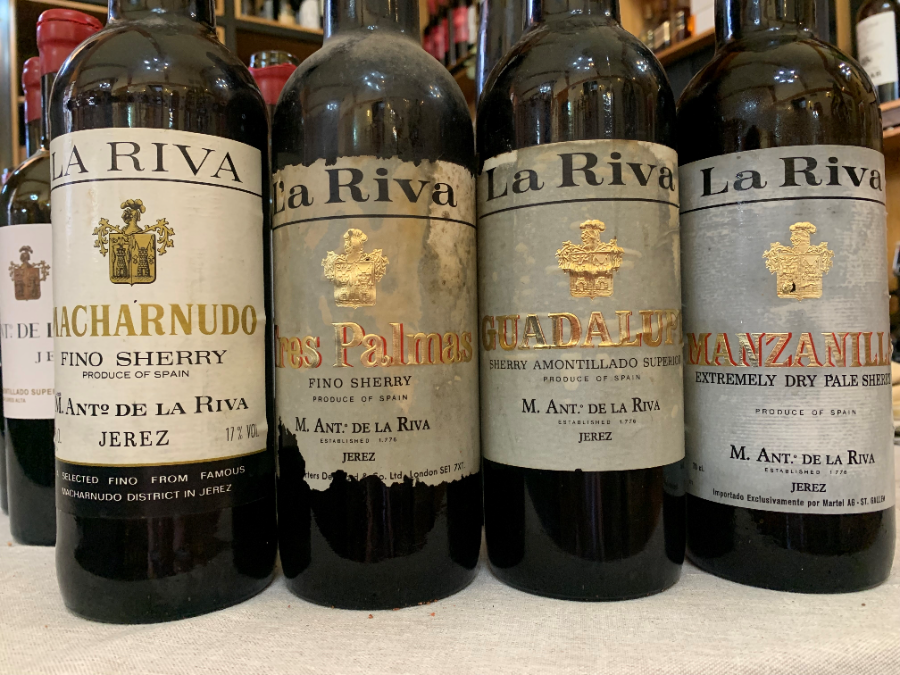
In our 2023 article, we explored the history of De La Riva and the backgrounds of Willy Pérez and Ramiro Ibáñez. This time, the focus is on the current range of unfortified whites (Vinos de Pasto), which are eligible for the forthcoming Vinos de Albariza designation; the revival of static ageing and the blending practices behid De La Riva’s historic wines.
Unfortified whites: one idea, different styles
For Willy and Ramiro, Vinos de Pasto provide the purest expression of Jerez’s diverse terroirs. As in De la Riva’s heyday, the wines also come from Pago Macharnudo. Grapes are sourced from two vineyards: San Cayetano in Macharnudo Bajo, with distinctly calcareous soil; and the celebrated El Notario vineyard, next to the Torre del Majuelo on the most elevated section of Macharnudo Alto.
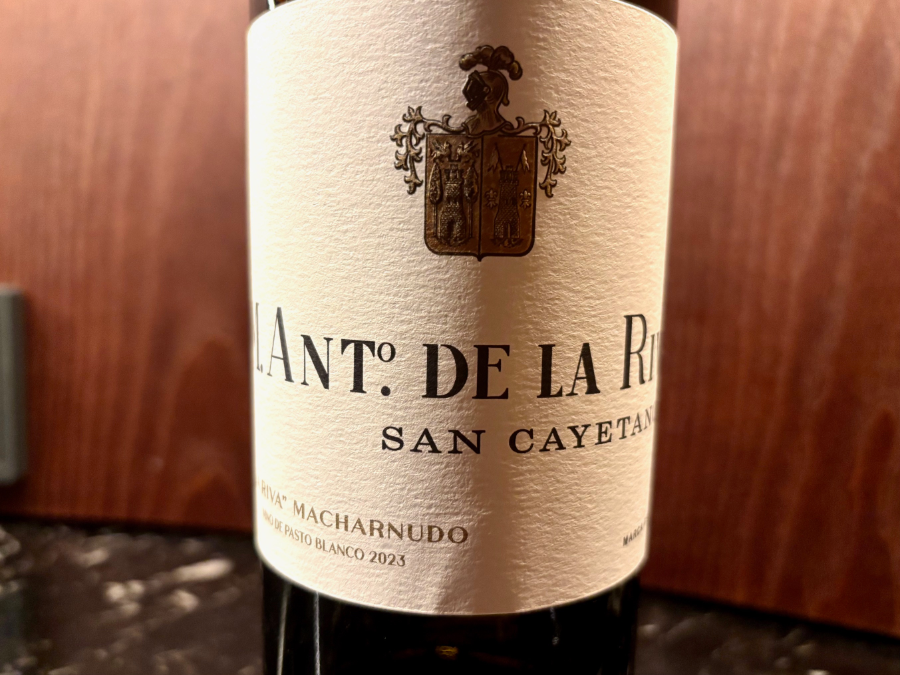
For readers less familiar with Sherry, La Riva Macharnudo San Cayetano is the best introduction to the De La Riva style. It is also the only Spanish white wine sold through La Place de Bordeaux. "The aim here is to capture the essence of albariza de barajuela," explains Willy, referring to the layered structure of this limestone soil, which resembles a pack of playing cards. Intended for an international audience, the wine is aged mainly in stainless steel, with just 15% maturing in oak barrels under flor. Although still very young, the 2023 vintage offers a serious palate with chalky notes and a very long finish. We recommend keeping an eye on this wine as it develops in the bottle.
La Riva Macharnudo El Notario takes a more traditional route, spending two years in casks under flor. Thanks to its naturally high alcohol, the layer of yeasts polishes and refines the wine significantly. Once again, we were able to taste the 2016 and 2019 vintages alongside the current 2022 release. Although all three wines come from the same vineyard, El Notario name is only mentioned on the 2022 label. Our impressions were much the same as three years ago. The 2016 vintage is more delicate with a lower alcohol level (13.5% abv), yet it is saline and vertical with a superb finish. At 14.5% abv, the 2019 is deeper, more powerful and fuller-bodied with fabulous toasted notes that once again transported us to Burgundy. The 2022 vintage (14% abv), despite its youth, sits somewhere between the two. Despite being a hot vintage, it retains a welcome freshness and spicy white pepper notes, while its elegant mouthfeel and fine texture give the wine poise.
In contrast to the two permanent wines in the range, the duo took a different approach with Antonio López 2022, the wine that accompanied issue Z of the cultural magazine Matador, the latest in the series. Although the grapes are also from San Cayetano, the winemakers sought extra ripeness by exposing the bunches to the sun for six hours, increasing richness without compromising the underlying structure provided by the limestone soil.
The sun-drying technique, which Willy Pérez has helped revive alongside other traditional practices at Bodegas Luis Pérez, also plays a role at De La Riva wines. Pérez explained that until 1969, Sherry regulations required grapes to be sun-dried for at least 24 hours. At a time when wines were fortified before shipment, this was the standard method of increasing potential alcohol. "Sun-drying requires grapes with medium to high acidity and the influence of the Levante eastern wind," he pointed out. "For dry wines expoure should not exceed 48 hours, as beyond that the Maillard reaction begins to produce toasted and caramelised notes. For Oloroso, however, the grapes can remain in the sun for up to three days. Just one single day of sun-drying can increase the must by one-degree Baumé,” he added.
Currently, this practice is used to varying degrees at De La Riva. Decisions such as whether to sun-dry the grapes, for how long, how the bunches are arranged and whether they are turned all depend on the specific features of each vintage.
Static ageing: Palmas, Cortados and more
De La Riva’s historic range began with the Macharnudo wines, encompassing virtually all the wine styles produced in the region, including fino, amontillado and oloroso. Above this came a second tier, comprising Tres Palmas, Tres Cortados, Extra and Guadalupe. The Solera San Onofre wines occupied the third level, while the Viejísimos (very old) wines sat at the very top of the pyramid.
The Tres Palmas and Tres Cortados labels originated from vintage wines produced in the 19th century which, following the phylloxera outbreak, provided the basis to establish a solera. The 2017 Fino Dos Palmas, a serious and elegant wine from the El Notario vineyard, was inspired by vintage sherry. Released in 2024, it has yet to be followed by another bottling. Nevertheless, Palmas and Cortados from other vintages continue to mature in the De La Rivas cellar.
As part of their archaeological search for old wines, the pair also launched the incredibly powerful and highly concentrated Veracruz Cuatro Cortados a few years ago. Although it was never intended as a vintage sherry, it effectively became one after spending four decades undisturbed. The cask had been discovered in the home of a grower in Trebujena. "The ageing of a cortado is much slower than a palma," Ramiro explained. "The standards required to reach tres palmas or tres cortados are extremely high. Reaching cuatro is extremely rare."
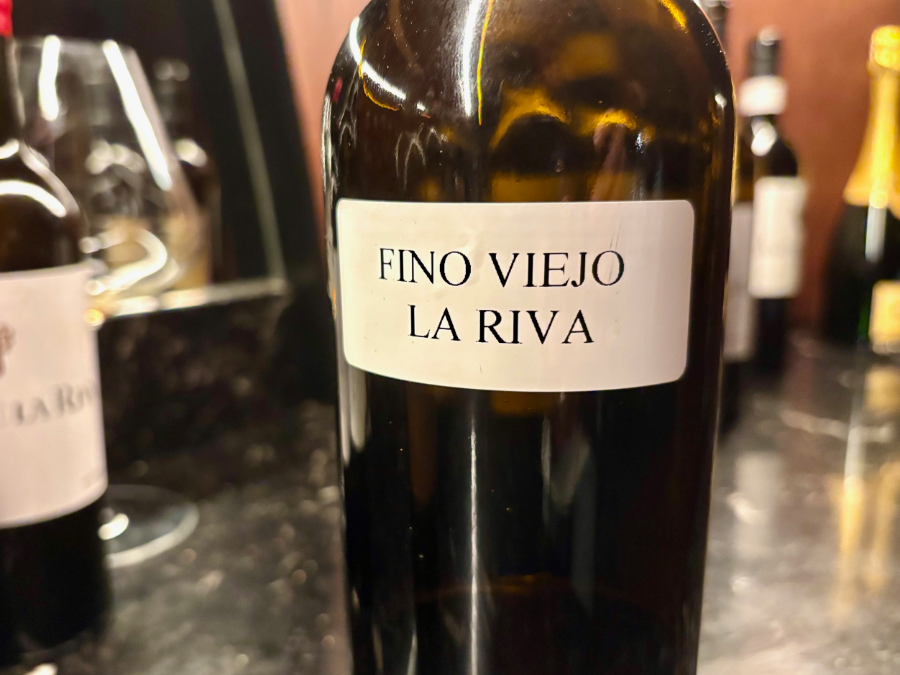
A new vintage blend from El Notario is currently in production, though no release date has yet been set. The sample of the so-called Fino Viejo that we tasted consists mainly of wine from 2016, with a significant proportion from 2017 and smaller quantities from 2019 and 2020. It is a complex sherry with pronounced salinity and pleasantly rounded texture.
According to Ibáñez, "a solera-style wine is fresher and more expressive, whereas a vintage wine is tighter, more restrained and more serious on the nose. Vintage sherry is more typical of Jerez, while the solera system is characteristic of Sanlúcar”.
Blending recipes
One of the most fascinating aspects of the tasting at Leña was the insight Willy and Ramiro shared into the composition of the old wines, drawing on records from the De La Riva archives. According to those documents, the Fino Tres Palmas, which they date to around the 1940s or 1950s based on the label and bottle style, is a blend of 52% Fino Macharnudo and 48% Fino Solera San Onofre. This represents a very different philosophy from the later emphasis on preserving the purity of individual vintages. One of the most spectacular wines of the tasting, it showed remarkable concentration. Decades in bottle had softened and rounded the palate while preserving strong flavour intensity. In my opinion, it was an even better and more refined version than the bottle we tasted three years ago.
The Amontillado Guadalupe, which also featured in the 2023 tasting, contains 1% vino de color, which provides a ripe aroma and a smooth, gentle finish without compromising the length of the aftertaste. Made either from sun-dried grapes or arrope (cooked grape must), vino de color was traditionally used to sweeten and colour the blends.
Perhaps, the most profound and impressive wine of the tasting was M. Antº de la Riva Palo Cortado, a blend of 90% Oloroso Macharnudo and 10% Oloroso San Onofre. It was extraordinarily deep and almost piercing in its intensity, yet with a full-bodied intensity that very few wines in the world can hope to rival.
We also tasted M. Antº de la Riva Matusalén, most likely produced using a blending recipe dating from 1933. It had 50% Fino Macharnudo, 25% Palo Cortado Solera San Onofre, and 25% Oloroso Solera San Onofre. The alcohol was noticeable, but it was matched by notable depth and flavours that leaned more towards riper than sweet. The finish was slightly more subdued, though that may simply have reflected the intense Palo Cortado that had preceded it.
Few regions can rival Jerez for complexity. Its extraordinary diversity of wine styles, unique ageing process, centuries of evolving winemaking practices and the distinct identities developed by individual bodegas all contribute to create one of the world’s most complex wine-producing regions. That complexity is also what makes it so fascinating.
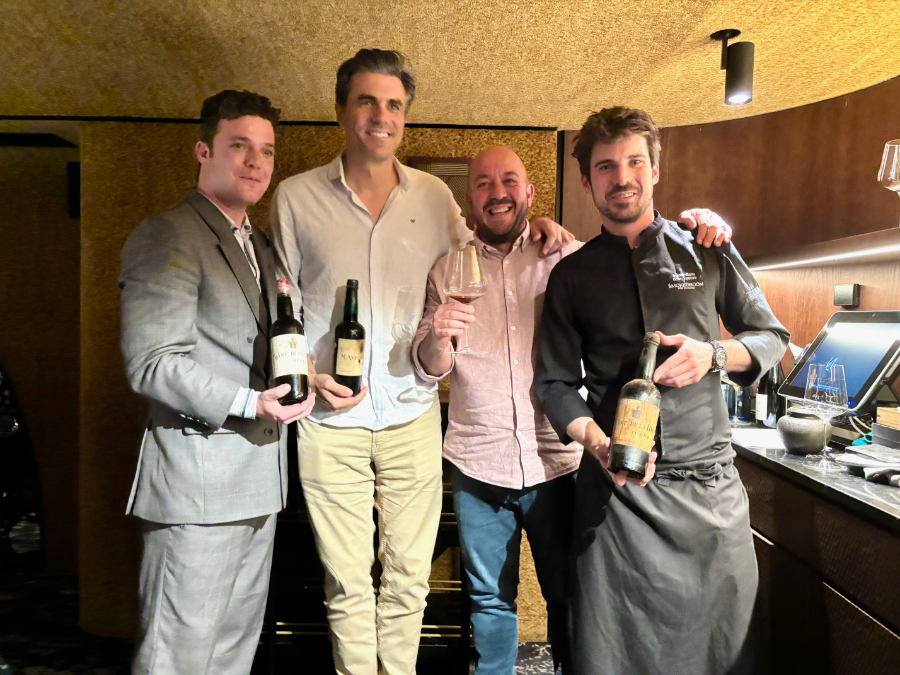
At the start of the tasting, Luis Baselga admitted that his first encounter with Sherry—during a class given by Paco del Castillo at the Basque Culinary Center— had come as something of a shock. “I didn’t understand it,” he said. Determined to change that, he spent long periods in the region between 2009 and 2010. The image below shows Baselga on the left, alongside Willy Pérez, Ramiro Ibáñez and Leña's head chef, Massimiliano Delle Vedove.
No one can hope to understand Jerez in the course of a single morning. That’s why projects like De La Riva are so compelling: by reviving historic practices, re-establishing the connection between wine, terroir and vineyards, and at the same time developing styles capable of appealing to an international audience of fine white wine lovers, Willy and Ramiro are helping to reconnect the region with both its past and its future. One project that wine enthusiasts have been eagerly awaiting for years is their book, which will bring together all these issues in a single place. Hopefully, our next feature on Jerez will be its publication.

Author
Amaya Cervera
A wine journalist with almost 30 years' experience, she is the founder of the award-winning Spanish Wine Lover website. In 2023, she won the National Gastronomy Award for Gastronomic Communication
Previous Post
Next Post
Vera Vides 2024 Red