For Spanish Wine Lover readers spending their holidays in the Canary Islands, we recommend exploring the local wines and soaking up the archipelago’s stunning vineyard landscapes. You might even be tempted to visit a winery or two!
One of the islands' greatest assets is its diverse range of grape varieties.These are mainly made up of vines originally brought from the mainland and Portugal, along with a few local crossbreeds resulting in new varieties. The archipelago's isolation has not only helped preserve varieties that have lost ground or are almost extinct on the mainland, but it has also kept the Canary Island vineyards free from phylloxera.
Borja Pérez is one of the producers who has championed grape diversity in the north-west corner of Tenerife. As well as growing the two most widely planted varieties in DO Ycoden-Daute-Isora — Listán Blanco and Listán Negro — he produces single-varietal wines under the Ignios Orígenes brand. His red wines are often very limited and include Vijariego, which shares its DNA with Catalonia's Sumoll, and Baboso Negro (the Portuguese Alfrocheiro Preto and Bruñal from Arribes in northwest Spain). Among the whites, he works with Marmajuelo, a variety that requires a lot of water and has been badly affected by drought in recent years, preventing Pérez from vinifying it separately since 2019. From the 2022 vintage onwards, he has also been producing Albillo Criollo, a variety commonly found in high-elevation vineyards in the north of La Palma, using a plot he regrafted in 2016.
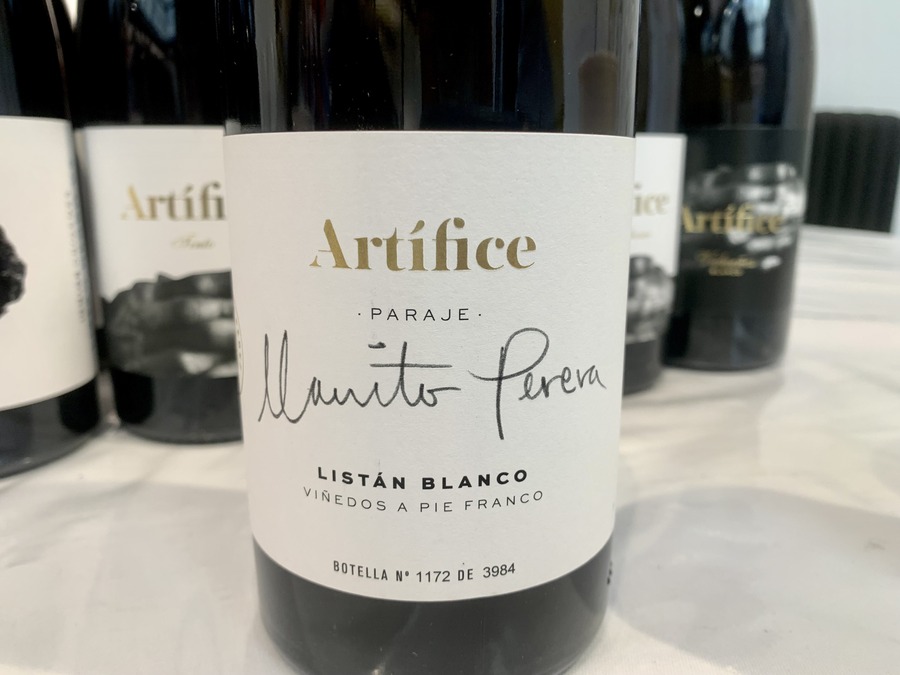
Another area of interest for Pérez is the expression of Listán Blanco and Listán Negro across different terroirs. The 2023 vintage will see the release of Ventura, a single-vineyard wine made from an original field blend of 60% Listán Blanco and 40% Listán Negro. Since 2016, he has also been producing Listán Blanco from the Llanito Perera site, which is our wine of the week. Both wines are released under the Artífice range, which focuses on grapes sourced from old vineyards tended by small local growers. They are the only two wines in the range outside the Ycoden-Daute-Isora appellation.
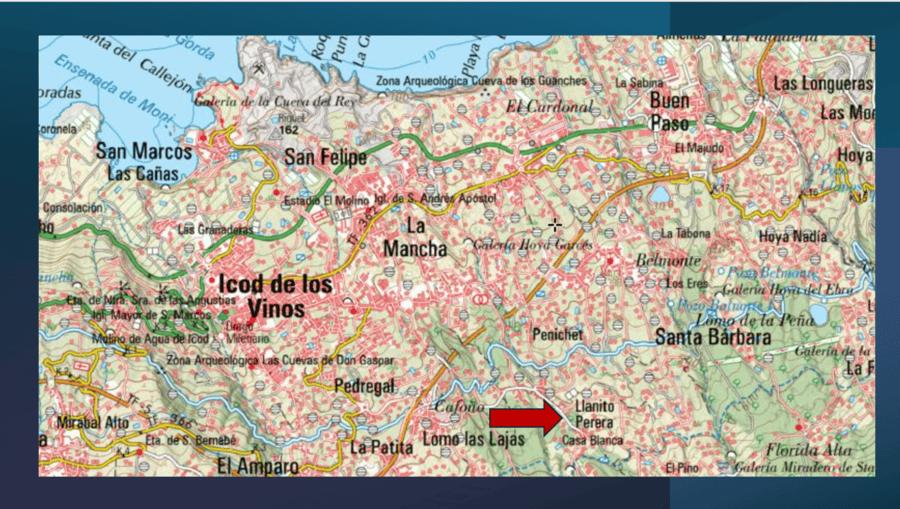
Llanito Perera is a neighbourhood in the village of Icod de los Vinos. You can see its location on the map below, taken from Sigpac — Spain's Geographic Information System of Agricultural Plots.
This area is characterised by stony, basalt-rich soils. Local winegrowers have long believed that this terrain is particularly well suited to Listán Blanco. Last week, we had the opportunity to sample Pérez’s current range with him and were struck by the distinctive texture of Llanito Perera compared to his other whites. While most of his whites are vertical, Llanito Perera is more fluid and gentler, with an almost slippery texture and plenty of dry-stone notes on the finish. It showed greater finesse and less reduction than some of his other whites, which often exhibit matchstick or phosphorus notes. Un Llanito Perera we found hints of gunflint, sunflower seeds, white fruit and spices.
The grapes are sourced from two plots on the Llanito Perera site. The picking is done when the skins are tight and firm, and the wine is aged in a 2,500-litre foudre and 500-litre barrels. Unlike the hot and dry 2023 and 2024 vintages, 2021 and 2022 were significantly fresher.
12.5% abv.
3,900 bottles
€32
Score: 93

Author
Amaya Cervera
A wine journalist with almost 30 years' experience, she is the founder of the award-winning Spanish Wine Lover website. In 2023, she won the National Gastronomy Award for Gastronomic Communication

Previous Post

Next Post
Tips to get the most out of your Coravin