With scarcely a pause after three packed days at Barcelona Wine Week (2-4 February), many Spanish producers headed to Paris to get their stands ready for 9 February and dive into another intense round of business meetings in the French capital.
As the third-largest exhibitor at Wine Paris, Spain has more than doubled its floor space compared to 2025. Even so, it was not granted a standalone hall. That privilege remained with the host nation and with Italy, each occupying its own three-storey building.
Overall, Wine Paris 2026 posted impresive growth figures: visitor numbers rose by 20% to over 63,500, while exhibitor numbers climbed to 6,537. International participation reached 51% in both cases. President Emmanuel Macron's presence at the opening ceremony was a clear signal of the event's growing prestige.
New features included a dedicated spirits area, Be Spirits Stage, and Be No Stage, for no- and low-alcohol beverages. The latter attracted more than 64 exhibitors from 13 countries, Spain among them. Tucked away in a basement, it was hardly the most inviting space at the fair, yet it proved one of the liveliest. We spotted a prominent British buyer in the free tasting area, as well as several Spanish producers eager to sample and gain a better insight into the category.
Exploring Hall 6
Most Spanish wineries were grouped in Hall 6. Hall 4, the other international space, hosted the tasting and conference rooms, as well as the press area, thereby attracting additional visitors.
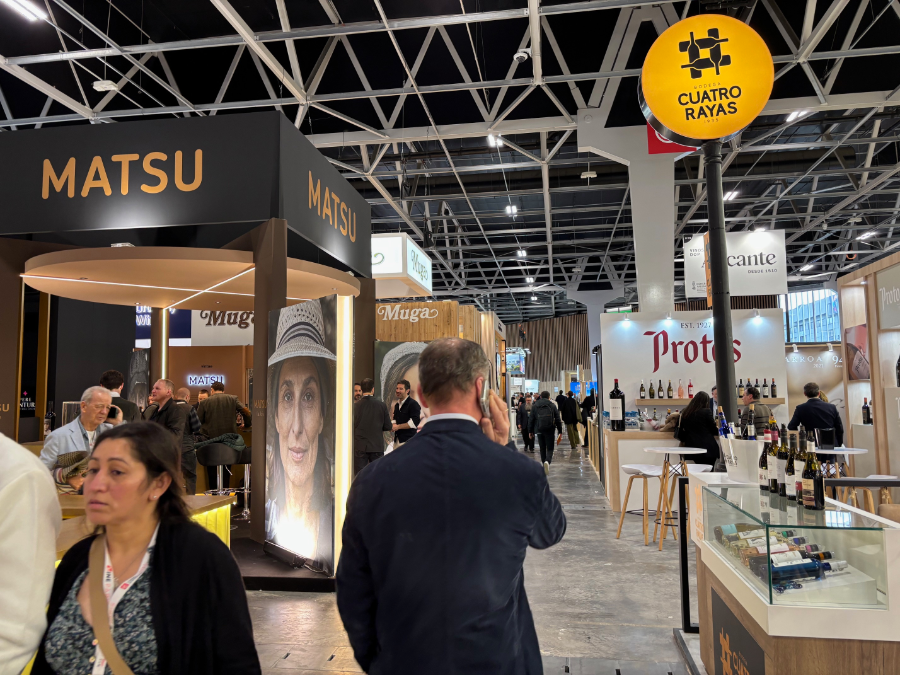
Some of the most eye-catching stands in Hall 6 included the free tasting areas run by Guía Peñín and DO Ribera del Duero, as well as an area featuring large black-and-white photographs set up by La Rioja regional government. Big brands such as Familia Torres, Vintae, Muga, Marqués de Riscal and Juvé & Camps were also present.

Appellations represented this year in Wine Paris included Rueda, Valencia, Alicante or Montilla-Moriles. Regional bodies were out in force too: Prodeca (Promotora de Alimentos de Catalunya), Aragón Exterior, the Region of Murcia, ICECYL on behalf of Castilla y León, and the Balearic Islands all invested in promotion. Rioja 'n' Roll producers made their Wine Paris debut with a joint stand.
Given that Real de Asúa Carromaza has been sold via La Place de Bordeaux since 2022, it was no surprise to find Cvne pouring wines at its courtier's stand in the French hall. The group presented Chorus, a red wine from Viñedos del Contino made in collaboration with Guillaume Thienpont from Vieux Château Certan in Pomerol. It will go on sale through La Place de Bordeaux in April — we will write more about it soon.
Wine Paris vs ProwWein
The mood among Spanish exhibitors was broadly upbeat, particularly among those who had attended previous editions of Wine Paris. Many cited tangible improvements in organisation and venue, with the 2025 location representing a significant step forward.
Paris offers excellent international flight connections and a wide range of accommodation and dining options. “Paris works because it's Paris, and that carries weight,” observed Ricardo Arambarri of Vintae. “Spain can’t draw this volume of international buyers, so we have to come here. BWW went very well this year. I think it will keep growing because it attracts many Spanish specialists. We've made high-quality contacts and met excellent international buyers. Investing in two trade fairs a year is more than enough for us,” he concluded.
Others see scope for refinement. Familia Torres opted for Wine Paris this year instead of ProWein, the Düsseldorf wine fair, which has seen declining figures ahead of its 15-17 March edition. "The international area should be much larger, and countries less intermingled," said Mireia Torres, fifth generation. Even so, she described the fair as "productive and professional, with more than 100 meetings logged".
Marqués de Riscal is another to have shifted its focus from Germany to France. With an eye-catching stand, the century-old Rioja house has put all its eggs at Wine Paris, showcasing a raft of forthcoming releases, including the new Rioja white Barón de Chirel. The highlight was the ceremonial opening of three bottles from the 1930s and 1950s, drawn from its historic wine cellar. “We've gone from 30 meetings at ProWein to 100 here, not to mention several dinners with key players,” explained managing director Ricardo Diéguez, who plans to strengthen the company's presence at the 2027 edition.

In terms of sparkling wines, Juvé & Camps expanded its footprint after testing the waters with a modest stand last year. “We have seen strong growth in recent years, so it makes sense for us to concentrate a significant part of our commercial agenda and meetings in Paris,” explained CEO Meritxell Juvé, also pointing to the logistical ease of the French capital. That said, the producer will still atend ProWein via its importer.
On the media front, Guía Peñín switched from ProWein to Wine Paris in 2024 once it became clear the industry's centre of gravity was shifting, according to managing director, Adolfo Gatell. Spanish participation in Düsseldorf has fallen sharply —from almost 700 exhibitors in 2022 to 570 in 2025— with not many more than 400 expected this year.
Europe's wine fair circuit
Timing is also important. For a white wine specialist such as Cuatro Rayas (Rueda) early year visibility is essential. In this regard, Paris offers the opportunity to connect with buyers who may not have travelled to ProWein.
Bryan MacRobert, a member of Rioja 'n' Roll, has exhibited at ProWein a couple of times, but believes the March timing makes it difficult for smaller producers to secure business. "Paris attracts top-level names which in turn draw serious buyers. The fair will continue to grow. It is also very well positioned geographically, between the United Kingdom and continental Europe. International buyers follow a circuit that starts in Montpellier (26–28 January)moves to Barcelona and then Wine Paris. ProWein comes a month later."
Not everyone is retreating from Germany. Raíces Ibéricas, a wine group producing wines in Calatayud and Requena, as well as varietal ranges across Spain, has exhibited at both BWW and Wine Paris and will also attend ProWein, as they believe the buyer profile differs. Marketing director Andrea Draper notes that Düsseldorf attracts more Asian buyers, whereas Wine Paris has a stronger European focus. “With proper advance planning, Wine Paris works really well,” she said.
Pepe Mendoza Casa Agrícola, meanwhile, plans to attend all three in 2026. “BWW is our national showcase, covering the whole of Spain, while ProWein is the international exhibition that has helped us build a portfolio of buyers over three decades. Wine Paris, on the other hand, draws international customers such as Costco and buyers from Canada, who do not go to Prowein. It sits somewhere in the middle and is clearly going from strength to strength,” added Pepe Mendoza.

From an institutional standpoint, ProWein remains the flagship international trade fair for ICEX Spain Export and Investment. The institute, which is one of BWW's key supporters, is cautious about throwing its weight behind a fair in France, the third-largest buyer of Spanish bulk wine.
As Wine Paris closed its doors, organisers confirmed new dates for 2027: 15–17 February. Whether this might dent international attendance at BWW remains to be seen. Its director, Céline Pérez, is confident. She argues that the fair's core strength lies in its position as the leading international event dedicated exclusively to Spanish quality wine. “Being first in the annual trade fair calendar gives us a clear competitive edge. In addition, strategic backing from ICEX and MAPA (Spain’s Ministry of Agrciculture) enables us to attract the most influential buyers, who value the efficiency and specialisation of our model," she told SWL.
All photos were taken at Wine Paris.

Author
Amaya Cervera
A wine journalist with almost 30 years' experience, she is the founder of the award-winning Spanish Wine Lover website. In 2023, she won the National Gastronomy Award for Gastronomic Communication

Previous Post