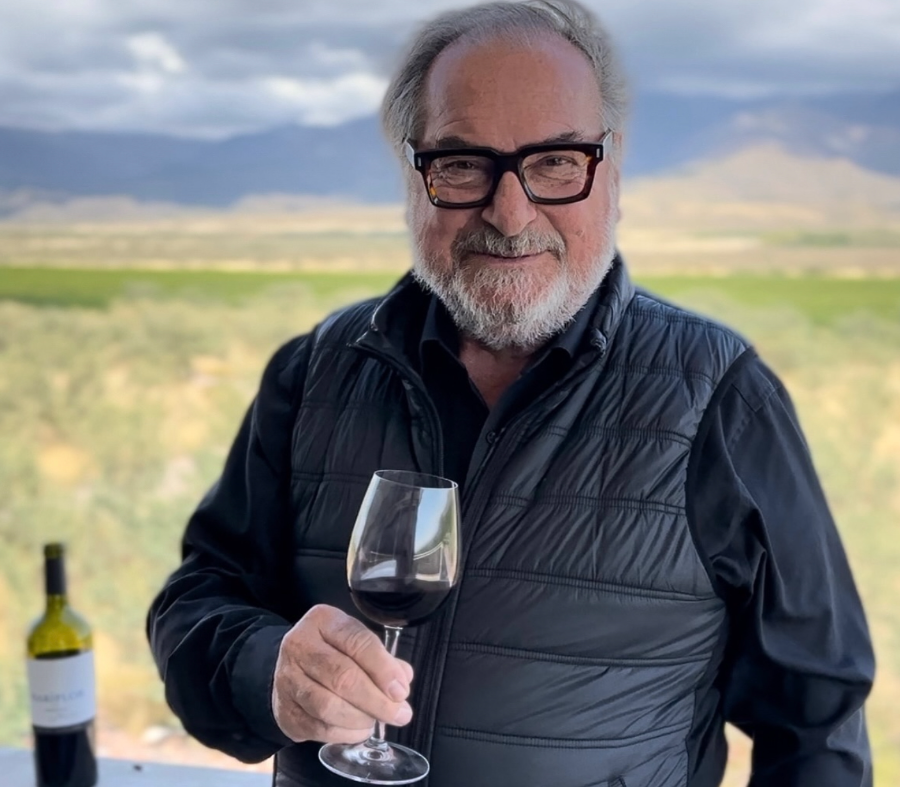
The world's most renowned wine consultant passed away in his native Bordeaux on the 20th of this month, at the age of 79. Michel Rolland (1947–2026) carried out tireless advisory work in winemaking regions across the globe from the 1980s onwards, leading to the coining of the term ‘flying winemaker’.
He worked with over 150 producers in 14 countries, including as far afield as India, and helped establish the reputations of legendary New World producers such as Harlan Estate and Screaming Eagle in Napa Valley and Clos Apalta in Chile. In Argentina, Rolland is widely credited with bringing Malbec to international prominence. He has also advised several producers in Spain, including Cosme Palacio and Marqués de Cáceres in Rioja, Cortijo de las Monjas in Ronda, Dominio de Valdepusa in Toledo, and more recently, El Grillo y la Luna in Somontano.
As a co-owner, he played a key role in establishing Campo Elíseo in Toro alongside his wife, Dany, and the Lurton brothers, François and Jacques. He also held a 50% stake in the Rolland Galarreta joint venture with Javier Galarreta, founder and chairman of Araex Grands & Spanish Fine Wines and a long-standing wine export specialist.
On styles and globalisation
Rolland’s career developed in parallel with Robert Parker’s, as both championed the 1982 Bordeaux vintage. Its riper profile became a benchmark for the round, powerful reds favoured by both men. This marked the beginning of a broader shift towards greater ripeness and fruit concentration, as well as the increased use of new oak and techniques such as barrel-aged malolactic fermentation. While the Maryland-based critic was blamed for 'Parkerisation', Rolland was seen as instrumental in popularising the Merlot-driven style associated with his native Pomerol.
Both figures were caricatured in Jonathan Nossiter’s documentary Mondovino, conceived as a critique of globalisation. Rolland was portrayed rushing frantically from one winery to another, repeatedly recommending micro-oxygenation. He later told that his voice had been altered to sound harsher and that, on the day of filming, he had only recommended micro-oxygenation twice. However, the final edit repeated this point insistently in a misleading way.
In person, Michel Rolland was approachable and affable. “He was always in a good mood, always on time and highly professional and reliable. That’s why he was so widely respected,” says Javier Galarreta.
We last met him in Spain at the 15th anniversary celebration of Basilio Izquierdo’s estate, held at the Echaurren restaurant in Ezcaray in 2022. Both Izquierdo and Rolland were born in 1947, as was Robert Parker, and they had been classmates in Bordeaux, remaining in touch over the years. According to Izquierdo, Rolland introduced straightforward quality principles, such as the need for proper ripeness at a time when the risk of rot was higher and delaying harvests was viewed with concern. “Rolland knew how to create a trend and sustain it; he had an excellent memory and could describe a wine perfectly in just three words,” Izquierdo explains. However, excesses led to overly concentrated wines. “The deeper the colour and the higher the IPTs, the higher Parker’s scores. That was crazy. Now all that has changed,” he adds.
A new lease of life for Tempranillo in Rioja
Cosme Palacio was the first wine that Rolland produced in Spain. In 1986, Jean Gervais, after leaving the presidency of Seagram Europe, bought this historic winery in Laguardia (Rioja Alavesa) and turned to the Bordeaux-based consultant to help modernise Rioja's Tempranillo. “The recommendation came from Jean-Marie Chadronnier of Dourthe Kressmann,” recalls Luis Valentín, founder of Bodegas Valenciso. He and his partner Carmen Enciso spent much of their professional careers at Cosme Palacio. “Rolland was already well known in Bordeaux. He had started his first consultancy at Simi Winery in California and Cosme Palacio was only the second winery outside France that he worked with.”
Valentín, who defended Rolland in a column published in Lo mejor del vino de Rioja following the release of Mondovino, insists that what seems obvious today was not so clear at the time. "Rolland made red wines exclusively from red grapes, sought greater ripeness without tipping into overripeness, carried out longer macerations, used French oak barrels and avoided practices that diluted the wine, such as clarifications and aggressive stabilisation." The modern, fruit-driven Cosme Palacio became the first notable Rioja wine to be sold without an ageing designation, albeit only in export markets. Rolland remained a consultant to the winery until 1998.
Émile Peynaud’s successor
Marqués de Cáceres has been Rolland's most enduring client in Spain from the early 1990s onwards. Its owner and president, Cristina Forner (pictured below with Rolland), who paid him an emotional tribute, emphasised his decisive role in launching Gaudium. "We began our first trials in 1991 to create a signature wine. My father [Enrique Forner, founder of the winery] wasn’t entirely convinced, but I was, and Michel always supported that project, just as he did with other icon wines we released later.” As well as advising on the super-premium range, Rolland also contributed to the full range of Marqués de Cáceres reds and worked with Bordeaux's Château Camensac while it remained under the ownership of the Forner family.
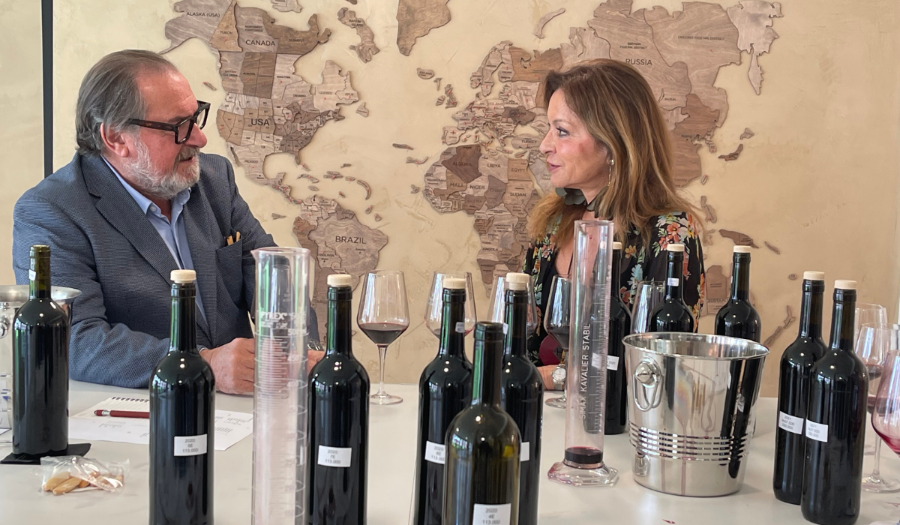
At Marqués de Cáceres, Rolland was the natural successor to Émile Peynaud, regarded as the father of modern oenology in France. After all, Rolland had been one of his students. The same transition occurred at Dominio de Valdepusa, the estate of Carlos Falcó, Marquis of Griñón, in Toledo, where Rolland replaced Peynaud as advisor during the 1991 harvest. Ignacio de Miguel, then winemaker at the estate, regards Rolland as his mentor and master. As well as learning how to taste grapes to determine optimal picking times, De Miguel occasionally worked at the laboratory in Libourne run by Rolland and his wife Dany since the early 1970s. The most valuable lesson he took from him was the art of blending, which would underpin his subsequent career as wine consultant.
Rolland Galarreta, the last venture
Rolland also invested in various projects beyond his family's estates in Bordeaux. The most prominent was Clos de los Siete in Argentina, a venture involving several leading French producers.
Although he later withdrew from the winery, he founded Campo Elíseo in Spain in 2004 with his wife and the Lurton brothers, Jacques and François, who had previous experience in Rueda. The focus was on Toro, a region well suited to producing the opulent, rounded wines that Rolland favoured.
The first harvest of Rolland Galarreta took place in Rioja Alavesa and Ribera del Duero in 2010. The project, which later expanded to Rueda and Priorat, relies on purchased grapes and the use of rented facilities where the team can implement its own winemaking approach. The two men met in Germany in 2008. Galarreta proposed Rolland to showcase Spain's finest terroirs on international markets, on the condition that his name would be exclusively associated with this project in Spain. “Rolland himself chose the vineyards in Labastida and Elvillar,” Galarreta recalls. “He also insisted on using an optical sorting table because some Tempranillo berries didn't ripen evenly.”
“He excelled at bringing out the best in each wine, depending on the location of the vineyard. Some argued that he encouraged over-ripeness, but our wines are elegant, age well, and have received high scores in blind tastings,” adds Galarreta.
The continuity of this and other projects is ensured by Rolland's daughters, Stéphanie and Marie, as well as by his partners in the consulting firm from which he withdrew in 2020. Michel Rolland's death marks the end of an era in the world of wine.

Author
Amaya Cervera
A wine journalist with almost 30 years' experience, she is the founder of the award-winning Spanish Wine Lover website. In 2023, she won the National Gastronomy Award for Gastronomic Communication
Previous Post
Next Post
Joan Rubió Sumoll 2023 Pét Nat Rosé