


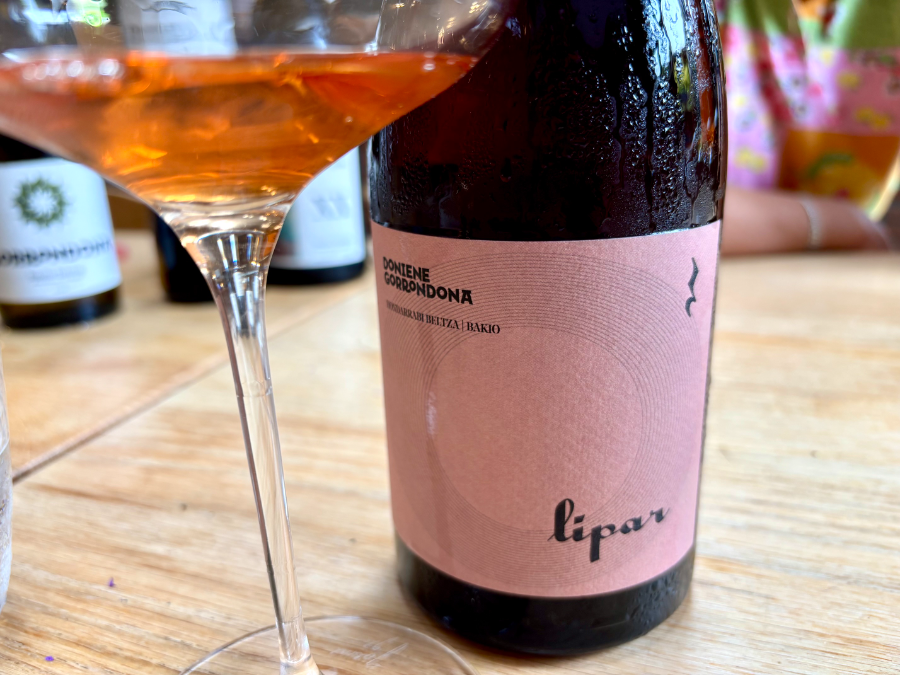
This year marks the 30th anniversary of Doniene Gorrondona, a producer that played a key role in revitalising txakoli from Bizkaia and establishing it as one of Spain's quality wines. The estate’s vineyards, located in the coastal town of Bakio near the picturesque islet of San Juan de Gaztelugatxe —the inspiration for Dragonstone in the Game of Thrones series— produce white, red and sparkling wines, as well as grape marc spirits and, more recently, a rosé.
Called Lipar, a Basque word meaning an instant or fleeting moment, the wine offers a new take on ojo de gallo, a style of rosé once common in the area and probably linked to the traditional practice of co-planting white and red grape varieties. It is also the result of the winery’s ongoing exploration of the local red grape variety, Hondarrabi Beltza.
Red grape growing –and, by extension, red txakoli production– remains very limited in DO Bizkaiko Txakolina, accounting for a mere 15 hectares out of a total of 434, of which 12 hectares are Hondarrabi Beltza.
Bakio, however, has a long-standing tradition of making red wines. Although many of its traditional pergola plots have disappeared, plant material has been recovered from old vineyards –notably those owned by Bodegas Zabala– and used for new plantings. Hondarrabi Beltza, locally known as Berdeza, has traditionally coexisted with Cabernet Franc (the parent of the entire Cabernet family, and most likely of Hondarrabi Beltza too). Cabernet Franc was referred to as Berdezaria locally, while other red varieties were called Medoka, presumably a reference to Bordeaux’s Médoc region. The French connection is clear, but Spain can take some pride in the fact that, as most experts suggest, the Cabernet family originated on the south side of the Pyrenees.
Of the 14 hectares farmed by Doniene Gorrondona, just over two are planted with red grapes. These vines are spread across different soils and sites, from Aldape, the plot next to the winery and closest to the coast, to Tellería in Basigo, on the opposite side of the valley. There are also a few vines in Irimingorrieta, the estate’s highest vineyard, which extends inland into the town of Mungia.
Lipar is made from grapes grown in Aldape and makes its debut with the 2024 vintage, one of the wettest in recent years. Winemaker Itziar Insausti opted for less than a day of bleeding, followed by fermentation and ageing in chestnut barrels. Having introduced chestnut in 2022 to complement the French oak used for the Ondarea white, she was pleased with the results: the chestnut preserved the wine's floral character and imparted less body than the French oak.
The wine was aged in oak until it was bottled in September 2025 and released onto the market in June this year. Production of this first vintage is very limited, at fewer than 600 bottles, but the estate hopes to double this figure in subsequent years.
Highly innovative and original, Lipar has been conceived with food in mind. We recommend that the wine is aerated to dissipate its initial reduction, after which herbal and citrus notes, particularly orange peel, emerge alongside spices such as black pepper. Making Hondarrabi Beltza as a rosé gives the wine a smoother texture without the variety’s tannic astringency, allowing its juicy character to take centre stage. The overall impression is evocative of woodland and cool, shady spots.
12% abv.
Hondarrabi Beltza
€25
590 bottles
Score: 92

Author
Amaya Cervera
A wine journalist with almost 30 years' experience, she is the founder of the award-winning Spanish Wine Lover website. In 2023, she won the National Gastronomy Award for Gastronomic Communication
Previous Post

