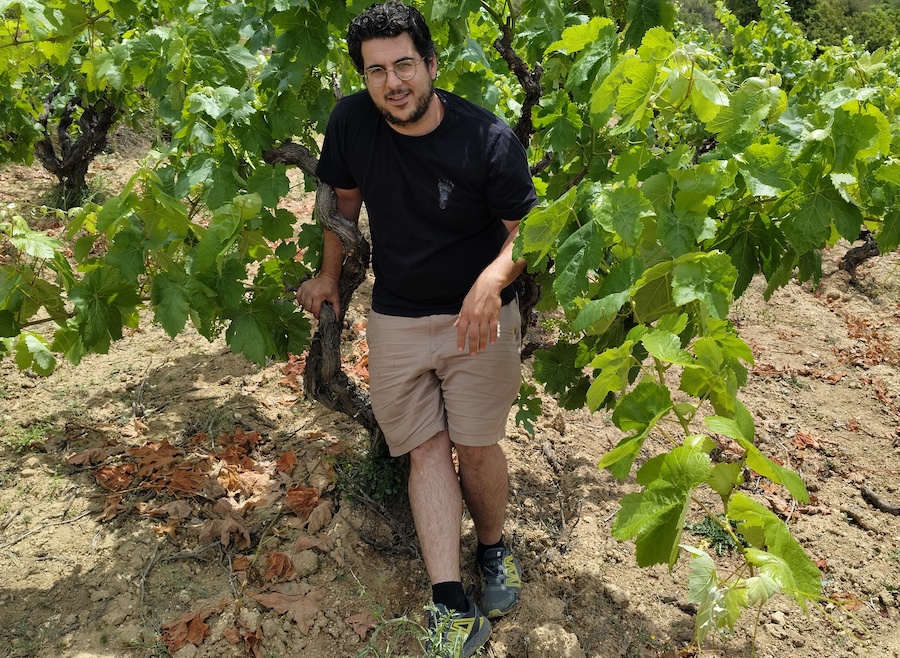
At just 35, Bernat Voraviu gives the impression of having lived several lives in wine already. He has worked as a sommelier at some of Spain's best-known Michelin-starred restaurants, founded Ithaca Wines to champion the great wines of the Mediterranean, recently launched his own wine project in Baix Penedès, and continues to advise leading restaurants such as Alkimia, Al Kostat and Bar Vertical while also teaching about wine.
Yet what strikes most when talking to him is not his CV but the speed at which he connects ideas. A question about a vineyard quickly leads him into geology, European history and even the Common Agricultural Policy. His train of thought can seem almost chaotic, but behind it lies a coherent vision of wine shaped by years of reading, travelling and, above all, a determination to understand a landscape before attempting to express it in a bottle.
This interview took place over several hours one day in June while we visited his vineyards and Mas Guineu, the winery where he rents cellar space in Penedès. It has been edited for clarity and flow, but Bernat Voraviu's words have been faithfully preserved.
Your family had nothing to do with wine. How did it all begin?
In my village, in the Catalan Pre-Pyrenees, people made wine for their own consumption. I loved tasting different neighbours' wines and seeing how they differed. Later I started comparing Garnachas from Campo de Borja. It was pure curiosity. I never imagined wine could become my profession.
When I was a child I wanted to be a writer. I never felt the need to go to university. I didn't care what job I did as long as it gave me time to read and write. While working as a gardener I met some French people from Anjou, and eventually I went to the Loire.
Is it there where you discovered wine?
That's where I began drinking more consciously. I worked in a bar, helped a grower who bottled his own wines, and a sculptor friend organised gatherings where people would turn up with seriously good bottles.
At the same time I started reading obsessively about wine. When I returned to Catalonia, a winemaker friend said to me: "You have to do a sommelier course." That's how it all started.
And did you take his advice?
I did. I spent a period working in the cellar at Poblet Monastery. Although I'm not religious, I remember getting up early simply to listen to Matins. There was a serenity there that I absolutely loved.
After that I moved to Barcelona and started working in a wine shop while studying to become a sommelier at Rovira i Virgili University in Tarragona. I didn't last long because I got bored. Meanwhile I was spending more and more time at Monvínic, and every penny I earned went on wine there.
One day I said to Isabelle [Brunet]: "Tomorrow I'm coming to work here. If you want to pay me, great. If not, that's fine too. I just want to learn." She looked at me and asked, "What shoe size are you?"
Was that the turning point?
Completely. I try to imagine somewhere else where, at the age of 22, I could have learnt more, faster and in greater depth, and I honestly can't think of one.
Antonio Giuliodori was there, and he's one of the most gifted and sensitive people I've ever met. I practically lived inside Monvínic. I'd arrive in the morning, spend time in the library, attend tastings, work the floor and, once service was over, we'd carry on opening bottles. The next day I'd do exactly the same again.
That's where I was really educated. During my sommelier course I barely understood anything. I'm almost embarrassed to admit it, but I never even went back to collect my diploma.
Do you think wine education is generally too academic?
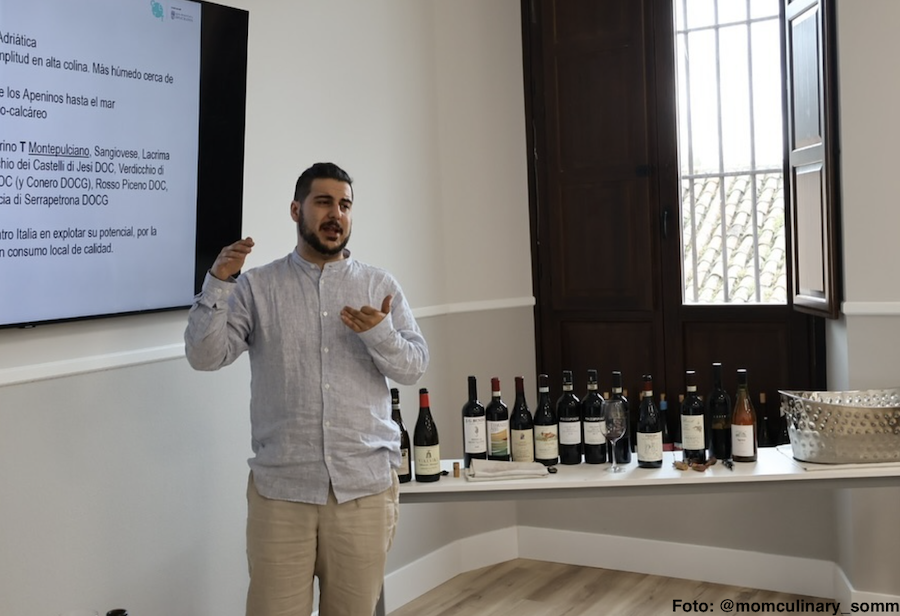
I wouldn't say it's badly taught, but I always tell my students to forget the idea that they're going to understand Italy in six lessons. It's impossible.
I teach them how to read labels, but we don't spend time on wine legislation because I think a less rule-bound education is far more interesting. What's important isn't memorising how many crus an appellation has; it's beginning to understand the style and soul of a place.
Taste a great Lambrusco. Taste a Chianti. Get a feel for Piedmont. Above all, develop a way of looking at wine. Too often we mistake knowledge for the accumulation of facts. Pretending to know everything is pointless.
What role has literature played in your wine education?
It's always been the great passion of my life. As a teenager I wrote a novel —with all the crazy stuff that goes through your head at that age. When I finished it, I thought: "This can't be it." One day I'd love to write about the Mediterranean because I feel we're still missing our own perspective on wine. Burgundy and Bordeaux have been written about endlessly, but there's remarkably little contemporary literature about the Mediterranean.
What I miss is a reflection that comes from here —not through the eyes of buyers or the market, but one that understands wine as a cultural phenomenon.
Italy has much more of that. I almost learnt Italian by osmosis, spending so much time with Antonio Giuliodori and his friends. I used to read magazines like Porthos, and I was fascinated to find articles that could move seamlessly from a vertical tasting of ArPepe to Pasolini.
When did you move from being a sommelier to founding a company importing Mediterranean wines?
The idea came to me in 2020 and we launched in 2021, almost as a form of counterculture. At the time the narrative was all about Atlantic wines, and backing the Mediterranean felt like swimming against the tide. Lots of people told me I was mad, but I had the feeling that the pendulum would eventually swing —and I think that's exactly what's happening.
I started with Ithaca, which focuses exclusively on Mediterranean producers, but gradually producers came along that I simply couldn't turn down, such as Capellano in Barolo. That's when I created Soulwines, bringing together estates from Central Europe, Atlantic regions and elsewhere. In reality it's one company; the two names simply represent two different conceptual identities.
Today the distribution business allows me to develop my own wine project and support my family. I've got an extraordinary team, which gives me the time to concentrate on the vineyards. But an equally important part of our work is rebuilding connections between the great producers of the Mediterranean. I genuinely think it's the most rewarding job I could have imagined.
Is there real demand for these wines today?
More than I ever expected —and not just in Madrid or Barcelona. I never imagined we could build such a solid business so quickly. For quite a while people saw us almost as a dissenting voice, but we're no longer reacting against anything.
Ithaca is now a very stable project, and I think it's only going to become stronger because we're at the beginning of the Mediterranean wine boom.
I keep telling producers: wake up, because the amount of extraordinary talent emerging across the Mediterranean is going to sweep through Central Europe.
What do you look for when adding a winery to your portfolio?
The whole concept of luxury repels me. What I'm interested in is agronomic value.
I first try to understand the landscape itself —where genuine quality really lies— and then I look at where the grower is in their own journey. There are extraordinary places where nobody has yet fully understood how to interpret the landscape. Sometimes you find a producer in exactly the right place, but they haven't quite got there yet. In those cases, I wait.
We haven't built our portfolio around market demand. Fortunately, we've been able to choose.
Burgundy is often held up as the benchmark. How do you see the region today?
I think we're living through a bubble. The very best vineyards rarely change hands. People arriving in Burgundy today often end up working third- or fourth-tier sites while the market continues to drive prices ever higher. If I had several million euros tied up in newly established Burgundy producers, I'd sleep badly.
The market moves incredibly fast, and when the narrative changes, valuations change with it. That's why I'd rather focus on regions where there's still a sound relationship between agronomic quality and price.
The Mediterranean lies at the heart of your philosophy. What does it mean to you?
It's a supranational concept, and that's the starting point if you want to understand it. If you're making wine in Abruzzo, it makes no sense for Piedmont to be your point of reference. It should be Dalmatia. If you're producing wine in Jumilla, constantly looking towards Rioja, Burgundy or Bordeaux means you're fighting against nature. Your references should be regions that are culturally and geologically similar.
That doesn't mean erasing each place's identity. Quite the opposite. It means developing a shared perspective among landscapes that exist within the same broader context.
There's still an enormous amount of work to be done. I see it every time I talk to producers. Many of them want to make a great white wine in Empordà, Montsant or another Mediterranean region, but when you ask who inspires them, they're still looking towards Burgundy or the Loire. The Mediterranean remains the great unknown.
How did you arrive at that conclusion?
Partly through travelling and partly through reading. I've been taking notes for years for this book about the Mediterranean, and whenever I teach, I devote an entire session to the subject. I begin with a simple question: Where are the world's great terroirs? Most people answer: Mosel, the Côte d'Or, Piedmont... Then I ask another question: if we isolated soil alone as a factor, where should we expect to find the greatest diversity?
All you have to do is look at a seismic map to see that Europe's greatest geological diversity lies around the Mediterranean. The same applies to the vine itself. More than 95% of the genetic diversity of Vitis vinifera is found here.
That doesn't mean every great wine comes from the Mediterranean. It means that wine, as a cultural phenomenon, was born here. Everything else is an exception —sometimes an extraordinary one, like Anjou, where I learnt an immense amount— but an exception nonetheless.
You challenge the way wine hierarchies have been constructed.
Because we tend to think those hierarchies are somehow natural, when they aren't. People often say the modern classification of great wines began in the medieval monasteries, but anyone who's read even a little history knows that aristocracies have always distinguished between wines.
Roman patricians drank Tarraconensian Falernian wines. In Classical Athens, people prized wines from Samos and Chios. A Wall Street executive in the 1990s drank Pétrus or La Fleur. Today, a trader in Hong Kong probably wants to drink DRC or Roumier. The aesthetic pendulum moves with power.
We like to believe we freely choose what we admire, but in reality we inherit cultural narratives far more than we realise.
Do we still interpret wine through the prism of nation states?
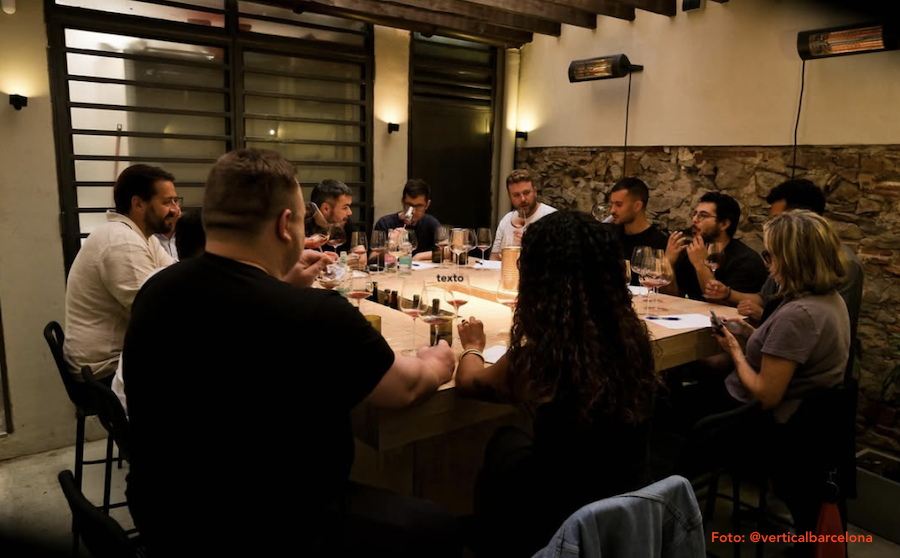
Wine is much older than nations. At Bar Vertical we do a lot of blind tastings, and when someone says, "This is an Italian wine," or "This is Spain," those answers mean nothing to me, because neither Italian wine nor Spanish wine really exists. France is probably the only country that has managed to build a certain stylistic unity, but even then Alsace doesn't make "French wine" in quite the same sense as Burgundy.
The problem begins when Mediterranean regions try to pursue an idea of beauty that doesn't belong to them. That's where a kind of stylistic schizophrenia begins.
In an increasingly homogeneous world, is that identity under threat?
The more homogeneous the world becomes, the more valuable genuine identity will be. That's why such strong communities have emerged around natural wine in Italy. Whenever the pendulum swings too far in one direction, a reaction inevitably follows. The important thing is that the search is honest.
Some people spend 20 years trying to understand their landscape. Joan d'Anguera is a perfect example. They began making one kind of wine, then swung to the opposite extreme, and eventually found a point of balance. I find that extraordinary. What's honest is trying to discover the voice of your own landscape, even when the market is looking elsewhere.
The Mediterranean is still often associated with rich, ripe, alcoholic wines. Is that stereotype justified?
For 40 years, many Mediterranean regions have tried to resemble Central European models, but that was never our tradition. I don't know of a single historic Mediterranean style that aimed for over-ripeness.
Cuisine is a collective response to the realities of a particular environment. Nobody expects to eat potato gratin in Palermo. Wine works in exactly the same way. Historically, warm regions developed other ways of maintaining balance: late-ripening grape varieties, biological ageing, fortified wines, rancios, and particular types of soil.
Take the Rhône, for example. Historically, its greatest wines came from sandy soils, not from galets. Those famous rounded stones only became practical once mechanisation arrived with petrol-powered machinery. Sand gives wines a finer silhouette. I've never come across a historic Mediterranean style that was coarse, broad or heavy.
So where does that perception come from?
From oversimplifying reality. Heat equals ripeness. Ripeness equals alcohol. Alcohol equals heavy wines. It's an incredibly simplistic explanation —a false equivalence.
I harvest some of my Xarel.lo three weeks later than they do at Chevalier-Montrachet. Chianti Classico can produce wines with lower alcohol than those from Piedmont. In Italy, the latest harvest is Aglianico in Taurasi.
Reality is far more complex and climate change is making it even more so.
You're also critical of today's obsession with acidity.
When you have a vineyard in a truly great site, in a historic region, acidity shouldn't be the goal because it neither explains what a wine is nor what makes it great.
Anselme Selosse says acidity has become completely overrated. What's really important is savoury concentration through dry extract. And that's exactly what we have here: freshness that comes from concentration.
What do you think people are overlooking?
For me, it's ripeness. In nature, what attracts us is ripe fruit, so I struggle to understand this obsession with harvesting earlier and earlier. Unripe grapes simply don't express their place.
In this drive towards fresher, lighter wines, people often assume they should extract less. But if you've got a truly great wine in your hands, extract it. Bring everything it has into the glass. I don't understand making a €70 wine by pressing halfway through fermentation. Nor do I understand blocking malolactic fermentation in a fine wine. I don't know a single great wine anywhere in the world that has built its identity that way.
How do you define a great terroir?
Terroir isn't democratic. Some places simply possess greater agronomic value than others. For me, terroir is first and foremost about the value of origin. But then comes human interpretation —without it, there is no terroir.
Take Penedès. Enric Soler makes extraordinary wines, not because Vinya dels Taus is the greatest terroir imaginable. Far from it. He makes extraordinary wines because he interprets that place in an extraordinary way. In the end, the individual matters enormously.
And what about minerality? Does that concept exist?
Conceptually, I prefer the Latin expression genius loci —the spirit of the place. It's a broader and more Mediterranean idea because it embraces the landscape, agriculture, history, culture and the people.
Wherever I find lower yields and higher dry extract relative to the amount of liquid, that's where I most strongly perceive a texture that reflects the soil.
What does "natural wine" mean to you?
I honestly don't know —and bear in mind I learnt about wine in Anjou. Is a natural wine simply one made without sulphur? If I buy grapes and make wine without adding sulphur, does that qualify? Very often I think the discussion is meaningless.
As a concept, the term doesn't interest me because, in practice, many people use "natural wine" to describe a style, and I'm not interested in styles. People with common sense generally share the same red lines that the natural wine movement helped bring into focus. That's a different matter from turning sulphur into the centre of the entire debate. Used badly, sulphur robs a wine of its plasticity, but reducing the whole conversation to that one issue seems a mistake to me.
Richard Leroy, for example, if he detects even the slightest deviation, would rather pour the wine down the drain than intervene. I think that's extraordinary. You have to be exceptionally good to make a decision like that.
Your first project was in La Noguera, but you eventually ended up in Baix Penedès. What happened?
I started making wine in Castelló de Farfanya, where I grew up. The vineyard had been planted in 1870 and, in truth, I only began making wine there because I wanted to save it.
I produced four vintages, from 2020 to 2023, but I was unable to buy the property, and that affected everything. I couldn't plant new vines, invest in the vineyard or even fence it. The pressure from wildlife was enormous because it was completely isolated. By 2022 I realised that trying to build a viticultural project entirely on my own was going to be incredibly difficult.
There's another issue here that deserves political debate. Most of the money from the Common Agricultural Policy ends up in the hands of large companies. If that money were instead used to give people the means to start their own projects, I think we could genuinely begin to save this country's viticulture. Unfortunately, I find it hard to imagine that happening.
Is that why you moved to Penedès?
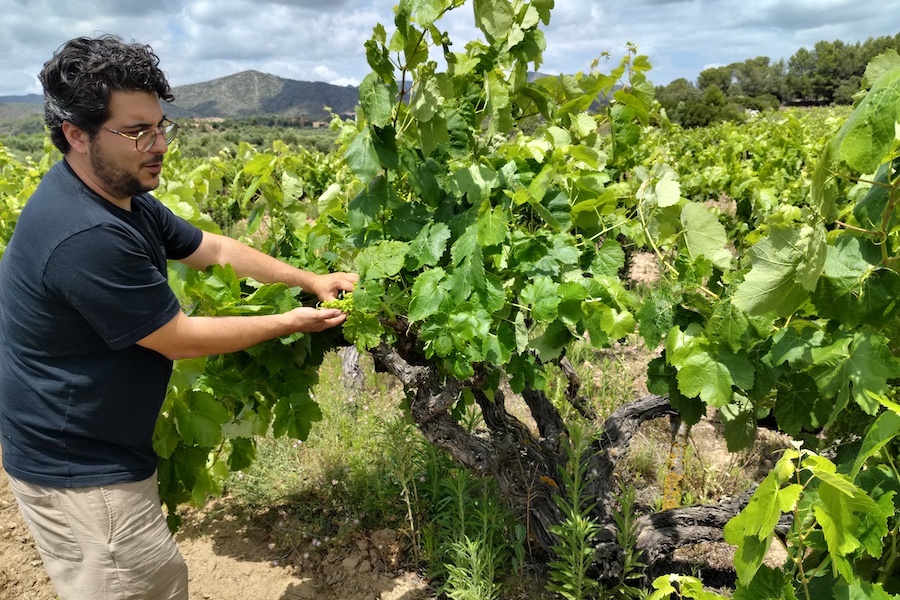
Yes. I didn't end up here by chance. I came because I wanted to make wine in a particular way, and I needed an environment that would allow me to do that.
I've had one important advantage: I arrived as an outsider and was able to choose. That changes everything. People who inherit vineyards have different constraints. Even so, if you have enough vineyards, you can still find an honest style.
I'm fascinated by wines that are good, honest and uncomplicated. I don't understand why we insist that every wine has to be extraordinary.
And within Penedès you've settled in La Bisbal del Penedès, in Baix Penedès. What did you find here?
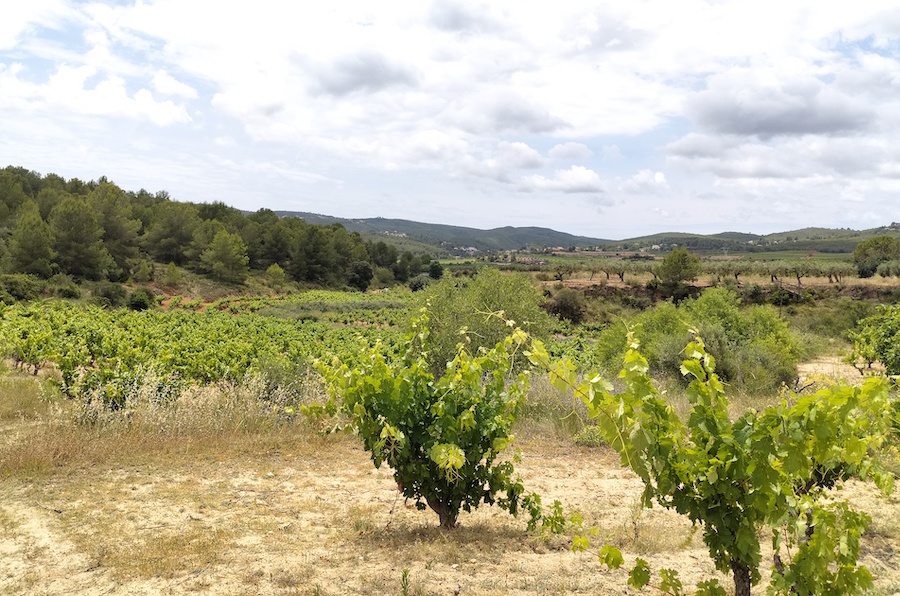
I was looking for a very specific landscape. We're standing on what was once an ancient seabed. Look at this sand —it's virtually beach sand. Even the vegetation often feels closer to the coast than to an agricultural landscape. When I first saw these vineyards, I thought: this is exactly where I can make the kind of wine I've been imagining for years.
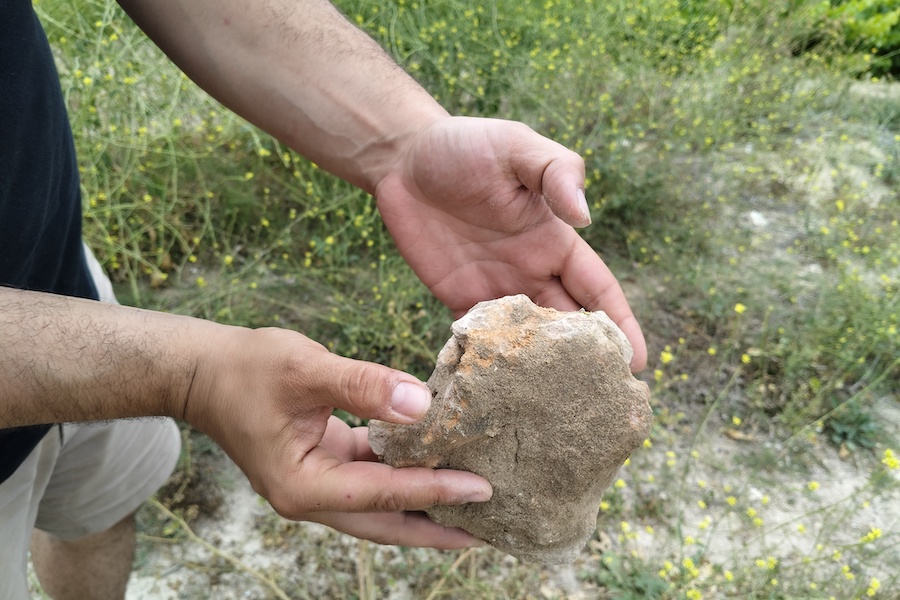
This Tortonian outcrop —named after Tortona, near Barolo— consists of Miocene deposits and appears in very few places. Raventós i Blanc has small pockets of it around Vinya dels Fòssils, but here it comes to the surface with remarkable clarity. Because we're on higher ground, erosion has been minimal, so there's hardly any material covering it. That means sand is the dominant fraction.
That's exactly what I was looking for: fine Tortonian limestone over sand. A landscape capable of producing wines with less rigid, less austere lines, but far greater vibrancy.
I believe Penedès has enormous potential, and we've barely begun to explore it properly.
Has your project, Ex Occidente, evolved as you've come to know the region better?
When I first arrived, my white wine, Stella Occidentis, came from a single vineyard because that was the only one I had access to. The idea was very straightforward: Xarel·lo from old genetic material grown on very pure, sandy Tortonian soils.
But as I got to know the region more deeply, I began discovering other vineyards which, to be completely honest, I think are even better.
Stella Occidentis will still express exactly the same idea —old Xarel·lo genetics on Tortonian soils— but it will no longer come from just one plot.
How did you discover these other vineyards?
I used to drive past here and think exactly the same thing every time: Who on earth is mad enough to practise regenerative farming only to sell the grapes to the local co-op?
One day I met Laura, who owns the La Gaona vineyard. We started talking and immediately hit it off. She'd been doing extraordinary work for years without receiving any financial recognition. She's actually a music teacher, and that's probably what allowed her to keep looking after those vineyards. In fact, when we first met, she was on the verge of giving up because she'd just been told what the grapes were worth.
I said something very simple to her: "Carry on working exactly as you are. The only thing I want to change is that instead of paying you 40 cents, I'll pay you €2.50."
Finding someone who works like that out of conviction is incredibly rare.
Do you own any vineyards yourself?
Yes —El Clot de Les Hores. From the moment I first visited it, and later when I was able to buy it, a lot of things suddenly made sense to me.
I was getting what I would normally associate with the response of a cool-climate vineyard, even though this is a very warm place with extremely free-draining soils. But once I arrived here, everything clicked into place.
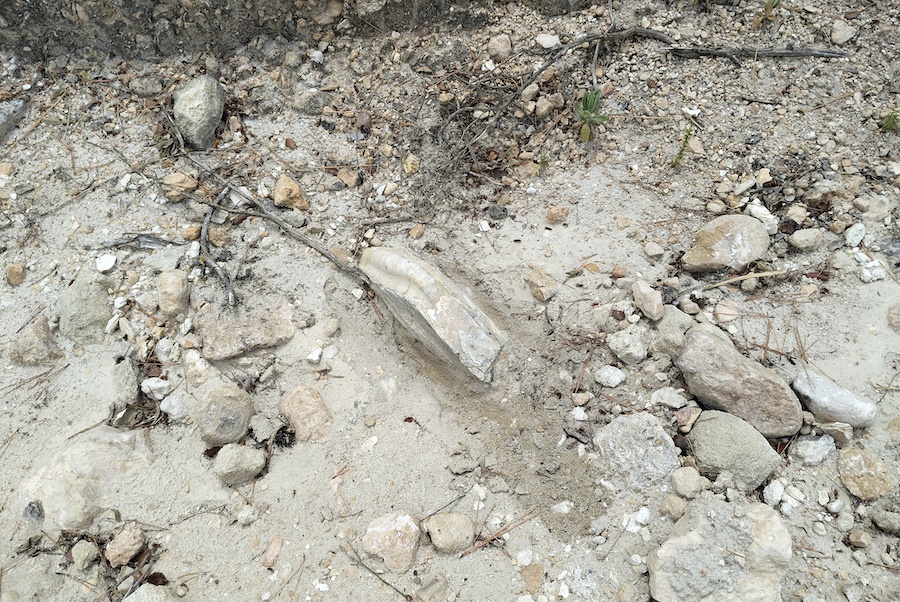
It's an ancient seabed where you can literally see the fossilised material. You don't have to imagine the terroir because it's right there in front of you. You can see fossilised molluscs, calcareous sand and the tunnels left behind by marine bioturbation. Suddenly you understand why the roots penetrate the soil the way they do.
People often describe a grand cru as a vineyard where the bedrock lies close to the surface and is fractured, allowing the roots to grow deep. Something similar happens here —not because the rock has fractured, but because all that marine life left behind a network of galleries that vine roots are still exploiting centuries later.
And it's a Macabeo vineyard. Do you like the variety?
In Ordal —the original area that first interested me— Macabeo is a disaster. It suffers from dehydration and from a much harsher climate, problems that simply don't exist in this part of Baix Penedès. Here, Macabeo has to be harvested fully ripe, and you have to understand that the wine's texture comes from the soil.
Next year I plan to graft the youngest section over to old-genetic Xarel.lo and, since there's also some Parellada planted here, I'll end up with a vineyard containing all three varieties so they can be co-fermented together.
You also have a vineyard in Ordal, in Alt Penedès.
There, Cretaceous dolomite is the dominant geological formation. Depending on where you are, there may be more or less Miocene material sitting above it, but underneath it's still Cretaceous. They're two completely different landscapes, and I think each tells a different story about Penedès.
That's why I also make a négociant wine by blending grapes from Ordal and Baix Penedès —to explain the region through the wine. It also allows me to vinify each vineyard separately, understand them better and then build the final blend. It'll leave the winery at around eight or nine euros, yet it will still embody tremendous agronomic value.
So what does Ex Occidente look like today?
Stella Occidentis, my first wine, will remain the expression of these very pure Tortonian soils through old-genetic Xarel.lo.
I'm also launching Stella Maris, which comes from the Macabeo vineyard, and I've vinified a Sumoll from some very old terraces on Laura's vineyard that I've completely fallen in love with.
I'm equally excited about another project based on Trepat in Conca de Barberà together with Ricard Foraster, from Josep Foraster. It's called Ardit and is built around a very simple idea: beginning with village wines. The first vintage is 2025 and it will be released in November. Trepat is a variety that fascinates me, and I think we've only just begun to discover what it can do.
Have you ever considered making sparkling wine?
Even though I'm only 35, I already feel too old to start making sparkling wine because I wouldn't really begin to make a name for myself until I was 50. I feel I've missed the right moment if I wanted to do it really well.
What's your approach in the cellar?
My way of making wine is very simple. Everything starts with low yields and vineyards where the influence of the soil is very pronounced. I use a vertical press, the juice goes straight into fermentation without temperature control, the wines are aged in relatively large vessels, topping-up depends on what I'm trying to achieve, and I intervene as little as possible. I hate cooling. After commercial yeasts, it's probably the tool that alters a wine more than anything else.
I don't stir the lees and, if it's a good vintage, I may even ferment without sulphur. If not, I add one gram and that's it. I don't filter my wines, but if I were in Priorat making high-extract Cariñena, I'd have no problem doing so.
Why does the concept of cru seem to carry more weight in northern Europe than around the Mediterranean?
Because the historical conditions are completely different. If you're in the Mosel, almost every vineyard has a name because the area where grapes can reliably ripen is very limited. In the south, by contrast, you can grow vines almost anywhere.
Does that mean the entire Mediterranean is a great terroir? Of course not. What it does mean is that we've planted vineyards in countless places that never really had any reason to exist.
Do you think Penedès is still seen through a model that doesn't really suit it?
Yes, and that's very much a question of style. In Ordal, you can produce great whites and sparkling wines capable of standing alongside any of the world's finest wines, Champagne included.
The problem isn't the terroir. It's the mental hierarchy we've created. Our problem lies in style and in the industrial model —not in the landscape itself.
How do you change such a deeply entrenched hierarchy?
I think Penedès is about to enter a fascinating period. On the one hand, we'll continue to see vineyard land decline. On the other, a number of wines will begin to emerge that will genuinely surprise people across Europe. That's already happening.
How can that change become established?
First, we need to stop talking about our own individual projects and start talking about Penedès as a region. I also think the region needs its own trade fair for importers. We'll organise one in two or three years' time, once we have more producers with stylistic maturity and 15 or 20 truly unarguable wines that we can put on the table.
To what end?
To explain the region. And right now we also need to be generous. It genuinely makes me happy to see projects such as Roc Gramona or Cisteller. They're far more important for the future of Penedès than my own project because they'll help build a model.
When someone tastes a great sparkling wine with 24 months of autolysis and realises it can compete with any wine in the world, they'll understand that quality isn't simply a question of extended ageing.
It might also encourage a young grower to start out here with an investment that's actually affordable, rather than having to keep bottles ageing on their lees for years and bear the financial burden that entails. That's impossible in Mâcon or Burgundy, but it can still be done here —or in Gredos.
Could Gredos serve as a model in that respect?
What Gredos has achieved deserves nothing but admiration. Historically it was a region with no wineries and no great wines, and today it's become a benchmark for revival. What Dani Landi and Fernando García have accomplished is extraordinary.
In your view, what's the fundamental problem with Cava, and what future do you see for it?
Cava's existential problem is that it's poorly structured. Cava needs a reliable core of genuinely good wines because, in this country, it's the territory that pays the price for long ageing. We've tried to convince ourselves that people enjoy those diluted, pale, insubstantial sparkling wines, but they don't.
With projects such as Cisteller we're refining the language of sparkling wine so that the fine wine world genuinely falls in love with it. If nobody is knocking at your door, it isn't because they don't know you exist. It's because your wines aren't good enough. If the wine is truly exceptional, it's already sold.
Isn't poor communication part of the problem too?
I don’t think so. Take Michael Candelario, for example —a 24-year-old on La Palma who doesn't even speak English. Do you know how many people fly there just to visit him and try to secure one of the 120 bottles he makes each year?
In Cava, we often hide behind the idea that people simply don't know us. I don't believe that's the real problem.
Which wine regions in Spain do you find most exciting today?
I always look first at the potential of the landscape itself. For me, Axarquía is an extraordinary place for making great white wines. In Galicia, I think almost everything still remains to be done. A particular style became dominant there in a somewhat forced way, but I believe the truly great white wines are still to come. What's missing is the willingness to let wines develop naturally instead of holding them back. And in Penedès, if we do things properly and methodically, we can create something remarkable. It's actually easier here than in Burgundy to produce concentrated white wines with finesse and exceptionally marked textures.
At the moment, the advantage is ours.
Has your way of thinking about wine —or tasting it— changed since becoming a producer?
Over the years I've gradually developed my own ideas about quality, concentration, elegance, finesse and what makes a Grand Cru. Everything I try to achieve as a winemaker is closely connected to those ideas I've built up over time.
Becoming a producer certainly makes you see things from another perspective. But for many years now, whenever I taste a wine, what I'm looking for is the agronomic value of its origin.
What do you see as a sommelier's most important role?
To provide context. A chef takes a tomato, clarifies it, turns it into tomato water and transforms it. A sommelier places a bottle of wine on the table and suddenly its value increases enormously, even though the wine itself hasn't changed. What the sommelier has done is give it context.
What I miss today is the ability simply to look at a wine and say, "This is extraordinary," or "I don't like this." People are increasingly afraid to make that judgement.
At the moment I import four producers from Mamoiada, a tiny village in Sardinia. The people in Ithaca think I'm mad, but that's perfectly fine because the wines are extraordinary. If you've discovered something you genuinely believe in, if your intuition tells you it's right, then you have to embrace it and show it to others. It's about recognising what someone else has seen and then making your own reading of it.
I find that harder with sommeliers. Too often they're looking for the same labels they've already seen elsewhere, trying to reproduce a familiar line-up of fashionable bottles. People like David [Villalón] at Angelita or Guillermo [Leal] at Solera are rare. They're the kind of people who have the conviction to say: "This wine has everything it should have —but it also has something extra. It has a spark. I want to show it to people, even if not everyone connects with it."
That's precisely what I miss today: the confidence to trust your own judgement. We've lost a good deal of our critical spirit.

Author
Yolanda Ortiz de Arri
A journalist with over 25 years' experience in national and international media. WSET3, wine educator and translator
Previous Post
Next Post
Predicador 2024 White